
A bank runs a 30-year-old COBOL core banking system on a mainframe with VSAM files and nightly batch jobs. Leadership requires AWS migration with minimal rewrite risk, phased modernization, automated refactoring where possible, and preserved business logic. Which migration strategy best modernizes this legacy mainframe workload?
Select an answer to reveal the explanation.
Short Explanation
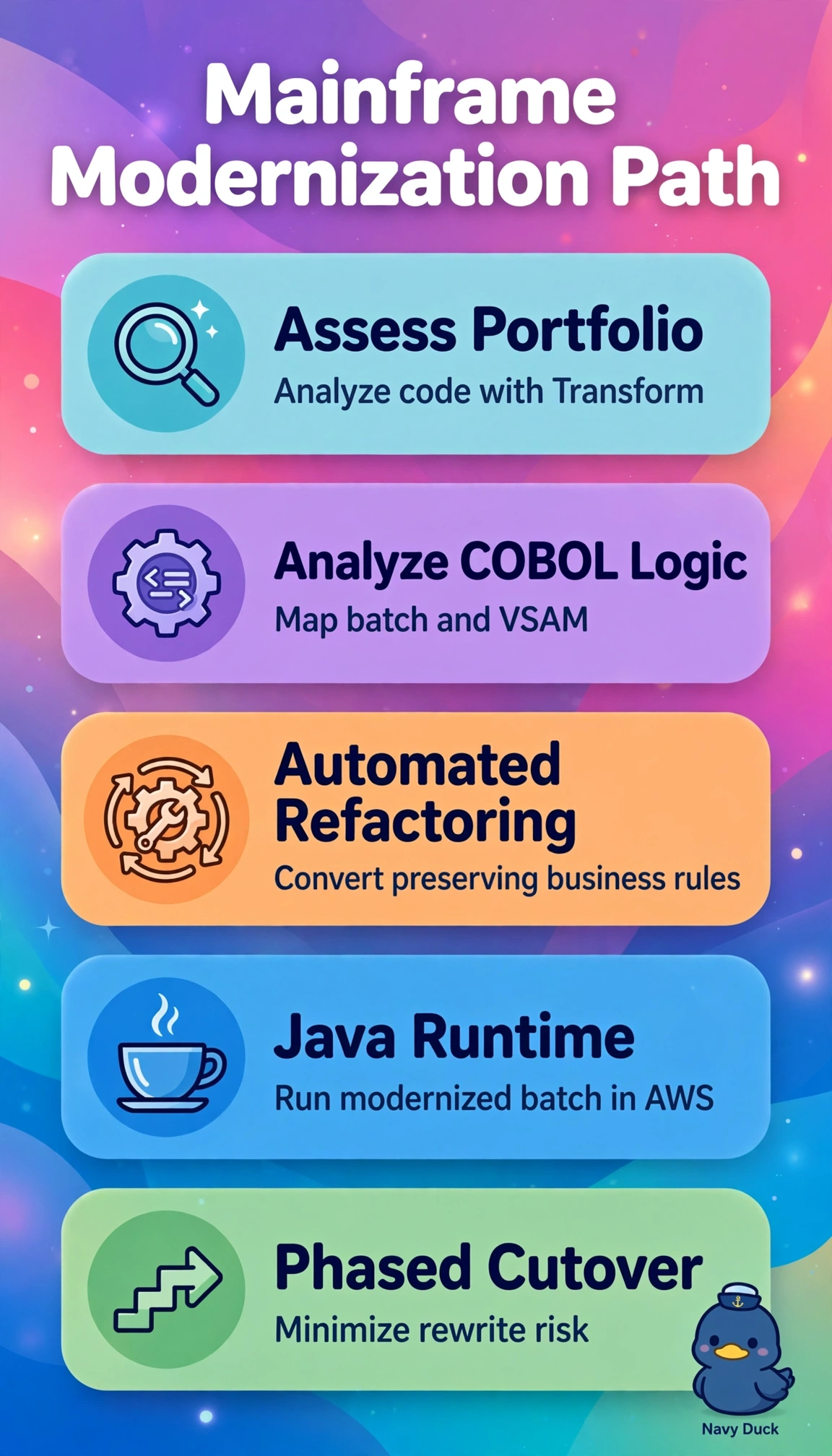
You can reduce rewrite risk by letting AWS Transform for mainframe analyze your system and modernize it in manageable phases, rather than replacing everything at once. Its automated refactoring can carry your COBOL business logic into modern Java while you validate each wave.
Full Explanation
AWS Transform for mainframe fits the requirements because it can analyze COBOL, JCL and VSAM assets, generate documentation, identify business logic, organize work into waves, and automatically refactor COBOL into Java. Phased delivery helps preserve business rules while limiting rewrite risk and allowing you to validate progress. Lifting the mainframe onto EC2 bare-metal hosts and moving VSAM files to EBS would retain key mainframe dependencies without the refactoring needed to modernize them; rescheduling batch jobs with cron does not resolve those dependencies. Rewriting all COBOL as cloud-native microservices in one release creates the broadest change and highest rewrite risk, while Snowball moves data rather than transforming code. Moving VSAM data to RDS with DMS but leaving batch on premises creates a split architecture, with latency, consistency, and VPN-operational concerns, and does not modernize the batch workload. Exam caveat: automated refactoring reduces manual effort but does not remove the need to test business logic and validate each migration wave. Practical check: assess the portfolio and run a proof-of-concept refactor on a noncritical batch job before expanding to additional waves.