
A financial analytics firm runs nightly risk jobs on EC2 with gp2 volumes showing bursty latency. They need 12,000 IOPS and 800 MiB/s throughput for large sequential scans at minimal cost without paying for unused provisioned IOPS. Which block storage optimization meets the performance target at lowest cost?
Select an answer to reveal the explanation.
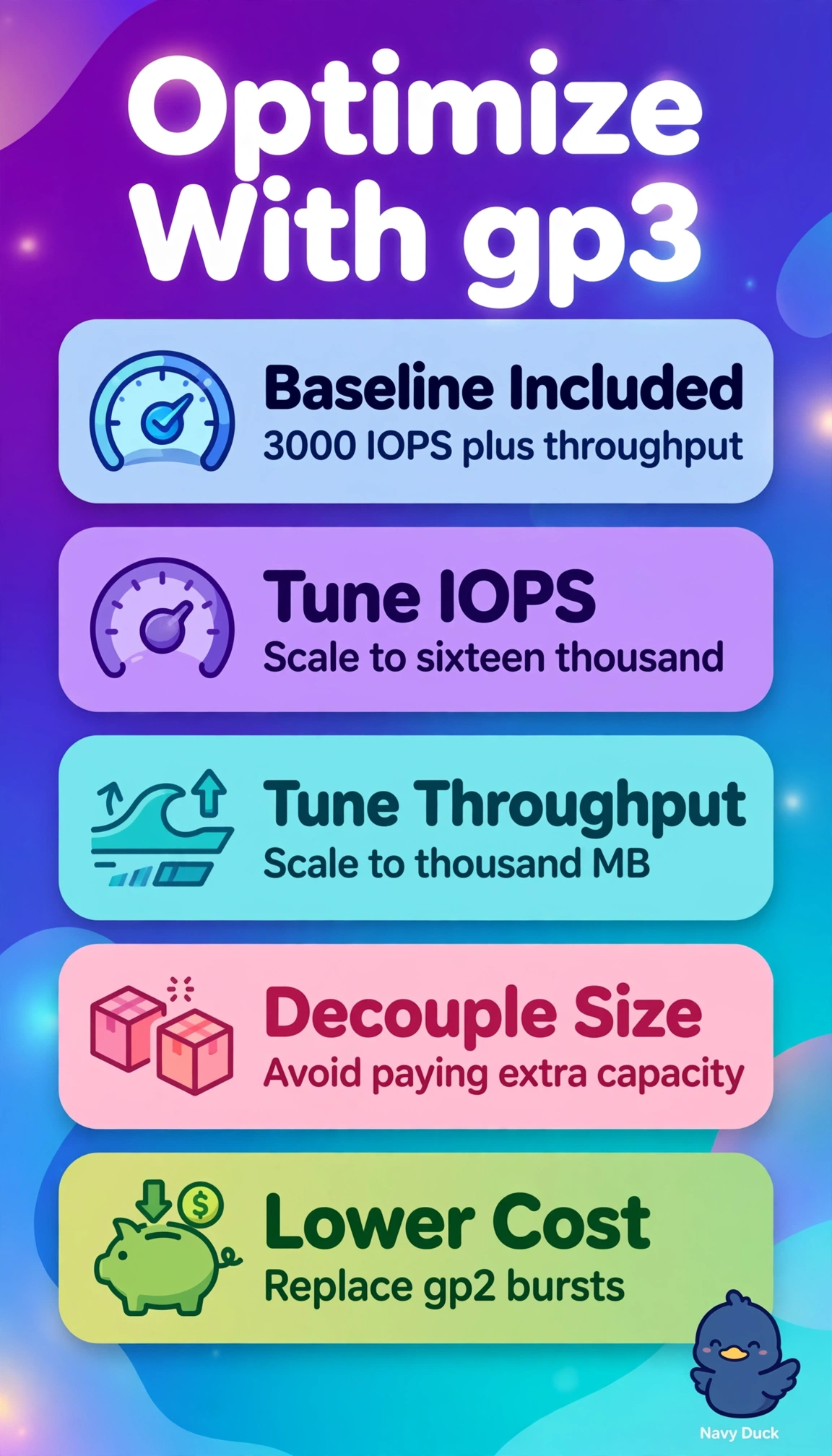
Short Explanation
You're paying for a sports car when you need adjustable gears. gp3 volumes decouple IOPS and throughput from size so you dial exactly what those nightly scans need.
Full Explanation
EBS gp3 provides baseline 3,000 IOPS and 125 MiB/s included in price with independent provisioning up to 80,000 IOPS and 2,000 MiB/s (comfortably covering 12,000 IOPS and 800 MiB/s), making it ideal for bursty analytics that need high throughput without overprovisioning capacity, unlike gp2 where performance scales with size and burst credits. Retaining gp2 forces larger, costlier volumes to sustain IOPS and throughput and retains burst variability that causes latency. io2 Block Express delivers sub-millisecond consistency and very high provisioned IOPS for transactional databases but charges a premium for provisioned IOPS unsuitable for cost-sensitive sequential scans. st1 is a throughput HDD for streaming without provisioned IOPS control and cannot meet low-latency IOPS needs or boot use. Exam caveat is that gp3 is the default cost-optimized successor to gp2 with tunable IOPS and throughput, and practical check is to monitor VolumeIdleTime and provision only the IOPS and throughput shown by CloudWatch during peak jobs.