
A financial advisory firm wants a Bedrock assistant that answers from 50,000 internal PDFs with citations, daily document updates, and low-latency semantic search without fine-tuning a model. Retrieved context must stay fresh and traceable to source chunks. Which RAG ingestion and retrieval design meets the grounded generation requirement?
Select an answer to reveal the explanation.
Short Explanation
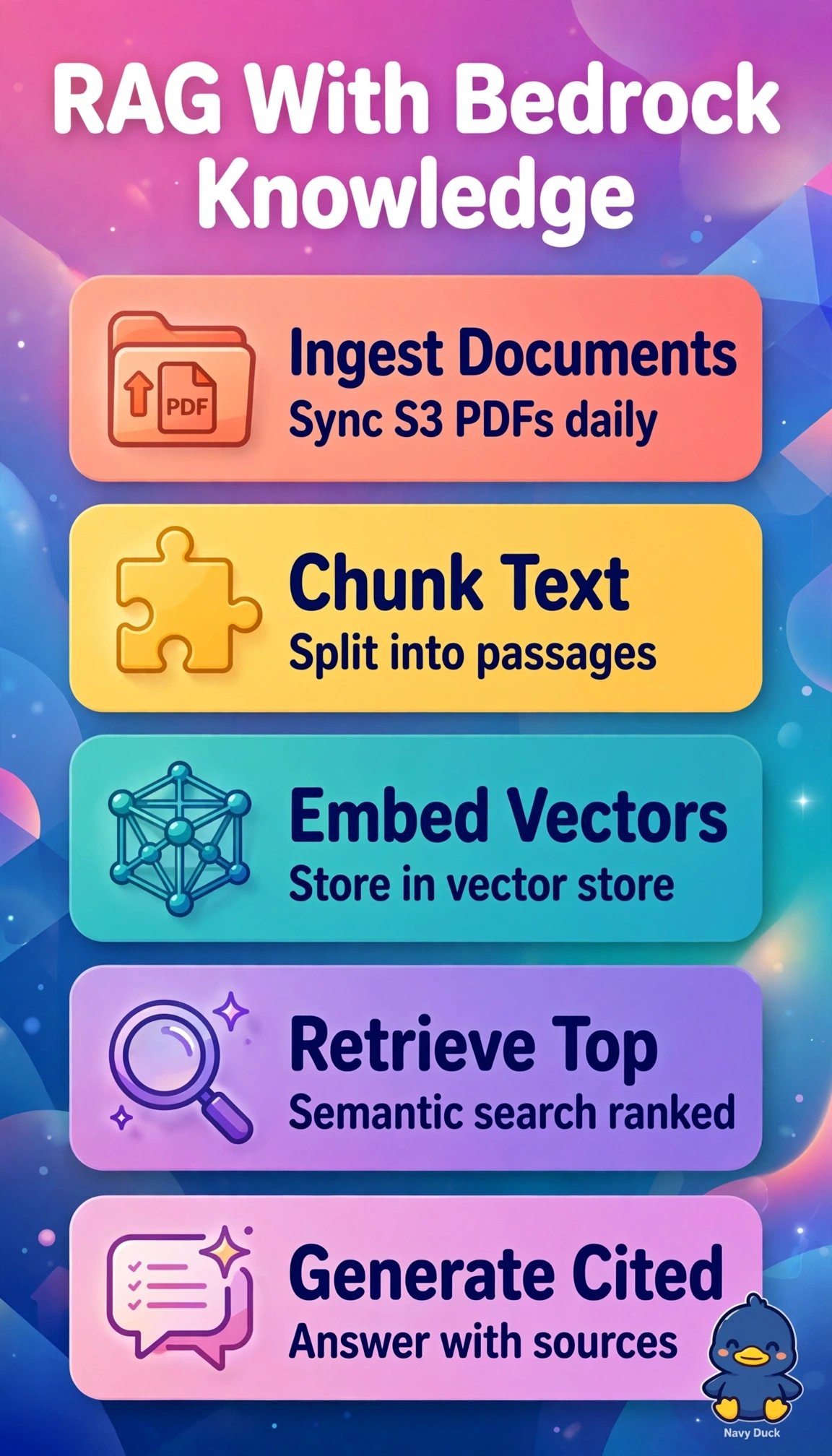
You can keep answers fresh and traceable with a knowledge base that chunks S3 PDFs, creates embeddings, and retrieves cited passages. That gives you semantic search without relying on memorized model weights.
Full Explanation
A Bedrock knowledge base with chunked S3 ingestion, vector embeddings, and retrieval with citations meets the requirement: embeddings support semantic similarity and low-latency search, while retrieved passages and citations ground answers in traceable source chunks. Syncing the documents daily keeps context current across the 50,000 PDFs without fine-tuning a model. Semantic retrieval without citations can find relevant passages, but answers returned without source citations are not traceable to chunks for verification or audit. Weekly Glue re-embedding can produce cited semantic answers, but a weekly schedule cannot keep pace with daily document updates, leaving retrieved context stale between runs. BM25 lexical search can return cited results and sync daily, but keyword matching does not provide the requested semantic search across paraphrases and conceptually related wording. Exam caveat: separate the combination of chunking, embeddings, semantic retrieval, citations, and daily freshness from designs that satisfy only some of those conditions. Practical check: verify daily S3 synchronization, then test that queries retrieve relevant chunks with source references and that generated answers include working citations within the firm’s latency target.