
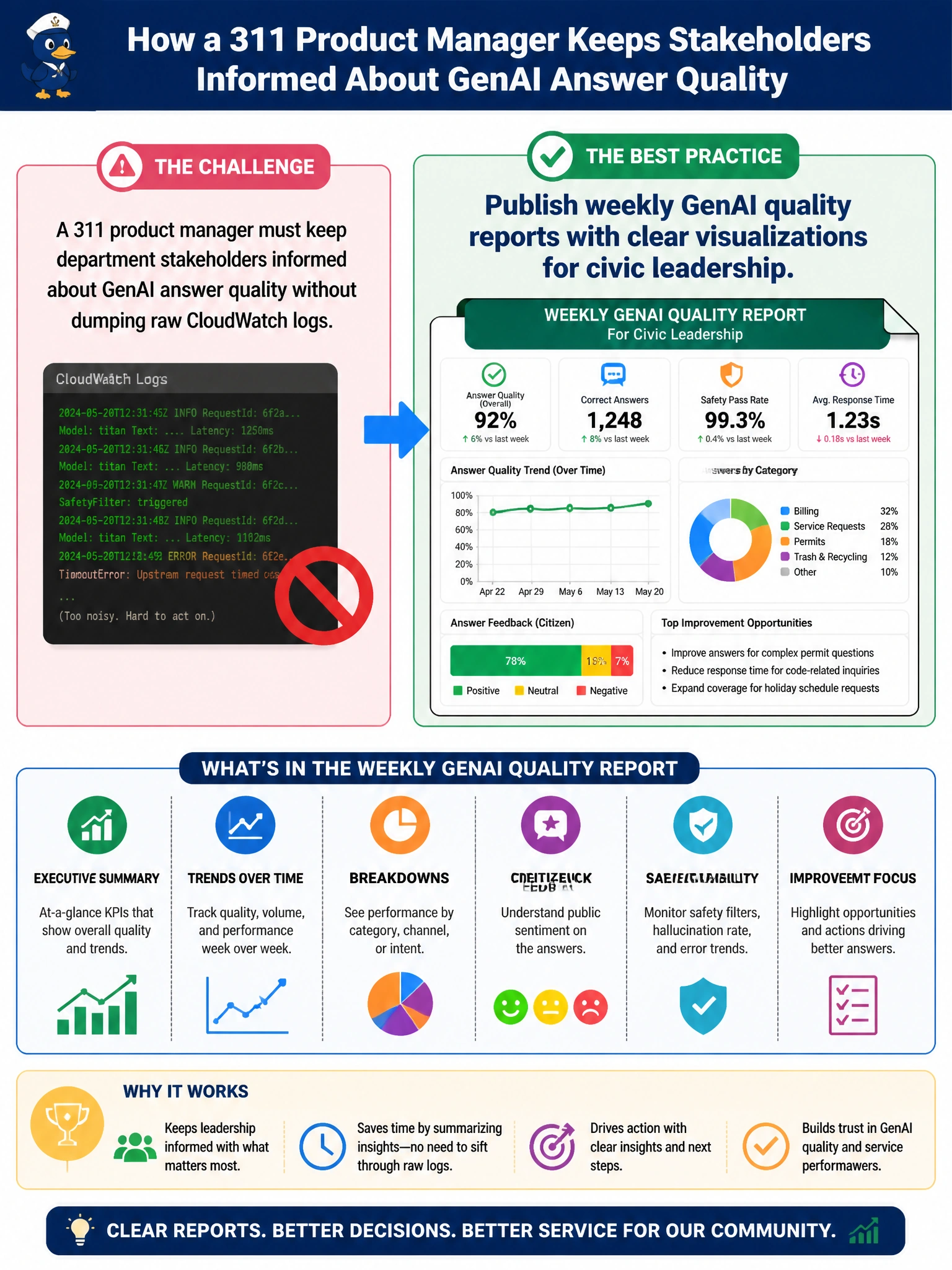
A 311 product manager must keep department stakeholders informed about GenAI answer quality without dumping raw CloudWatch logs. What practice best meets that need?
Select an answer to reveal the explanation.
Short Explanation
Department heads do not want a firehose of logs—they want a clear weekly scoreboard. Visual GenAI quality reports turn token chaos into something a 311 steering group can actually discuss.
Full Explanation
Publishing weekly GenAI quality reports with clear visualizations for civic leadership is the practice that best keeps 311 department stakeholders informed about answer quality without dumping raw CloudWatch logs. Leaders need trends on relevance, escalation, citation health, and complaint themes presented in readable charts and brief narratives so steering decisions happen on signal, not log archaeology. Weekly cadence matches municipal governance rhythms and creates accountability for quality owners. Emailing stakeholders a binary executable of the Bedrock SDK weekly fails by concept: shipping SDKs is not stakeholder communication about answer quality. Hiding all metrics because GenAI quality cannot be summarized fails by concept—quality can and must be summarized with rubrics, samples, and trends even if imperfect. Replacing quality reporting with only idle EC2 instance counts fails by concept: idle capacity is an infra efficiency metric, not GenAI answer quality. Exam caveat: stakeholder communication questions favor accessible quality reporting over raw telemetry dumps, metric nihilism, or unrelated capacity charts. Operational check: automate a weekly GenAI quality pack (score trends, top failure themes, sample answers, actions), distribute to 311 leads, discuss in the steering meeting, track action closure, and keep raw logs available to engineers without making them the leadership interface.