
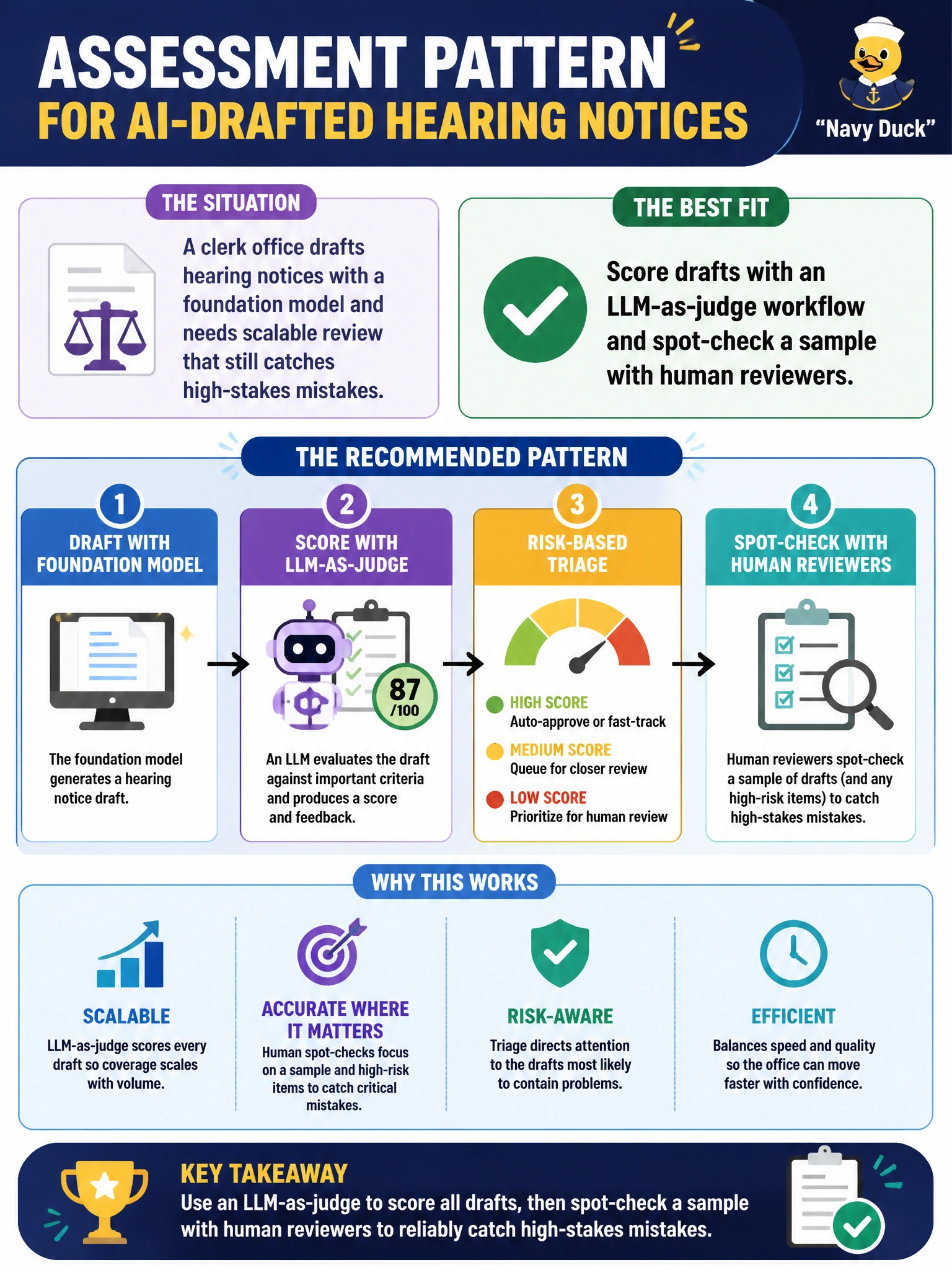
A clerk office drafts hearing notices with a foundation model and needs scalable review that still catches high-stakes mistakes. Which assessment pattern best fits?
Select an answer to reveal the explanation.
Short Explanation
Hearing notices are serious paper—you want a smart first pass and a human second look. LLM-as-judge grades at scale; clerks spot-check the risky ones so nothing weird slips onto the docket.
Full Explanation
Scoring drafts with an LLM-as-judge workflow and spot-checking a sample with human reviewers is the assessment pattern that best fits scalable review of clerk-office hearing notices while still catching high-stakes mistakes. LLM-as-judge provides consistent, high-throughput scoring against rubrics for structure, required elements, and obvious errors; human spot-checks catch nuance, legal sensitivity, and judge-model blind spots before notices reach the public docket. The combination balances scale with accountability for civic legal text. Publishing every draft to the public docket with zero review fails by concept and governance: unreviewed generative drafts can publish incorrect hearing details with real due-process impact. Using only random string matching against emoji lists as the quality score fails by concept—emoji heuristics do not assess legal notice adequacy. Replacing human review forever with an unmonitored autocomplete model fails by concept: permanent removal of human oversight abandons control of high-stakes clerk outputs. Exam caveat: scalable GenAI review patterns combine automated judging with sampled human oversight rather than zero review or gimmick scores. Operational check: define a hearing-notice rubric, run LLM-as-judge on every draft, route low scores and a random sample to clerk reviewers, log accept/edit/reject decisions, and raise sampling rates after prompt or model changes affecting notice generation.