
A public-health team refuses to promote GenAI builds that regress hallucination rates. How should that policy be enforced in the delivery pipeline?
Select an answer to reveal the explanation.
Short Explanation
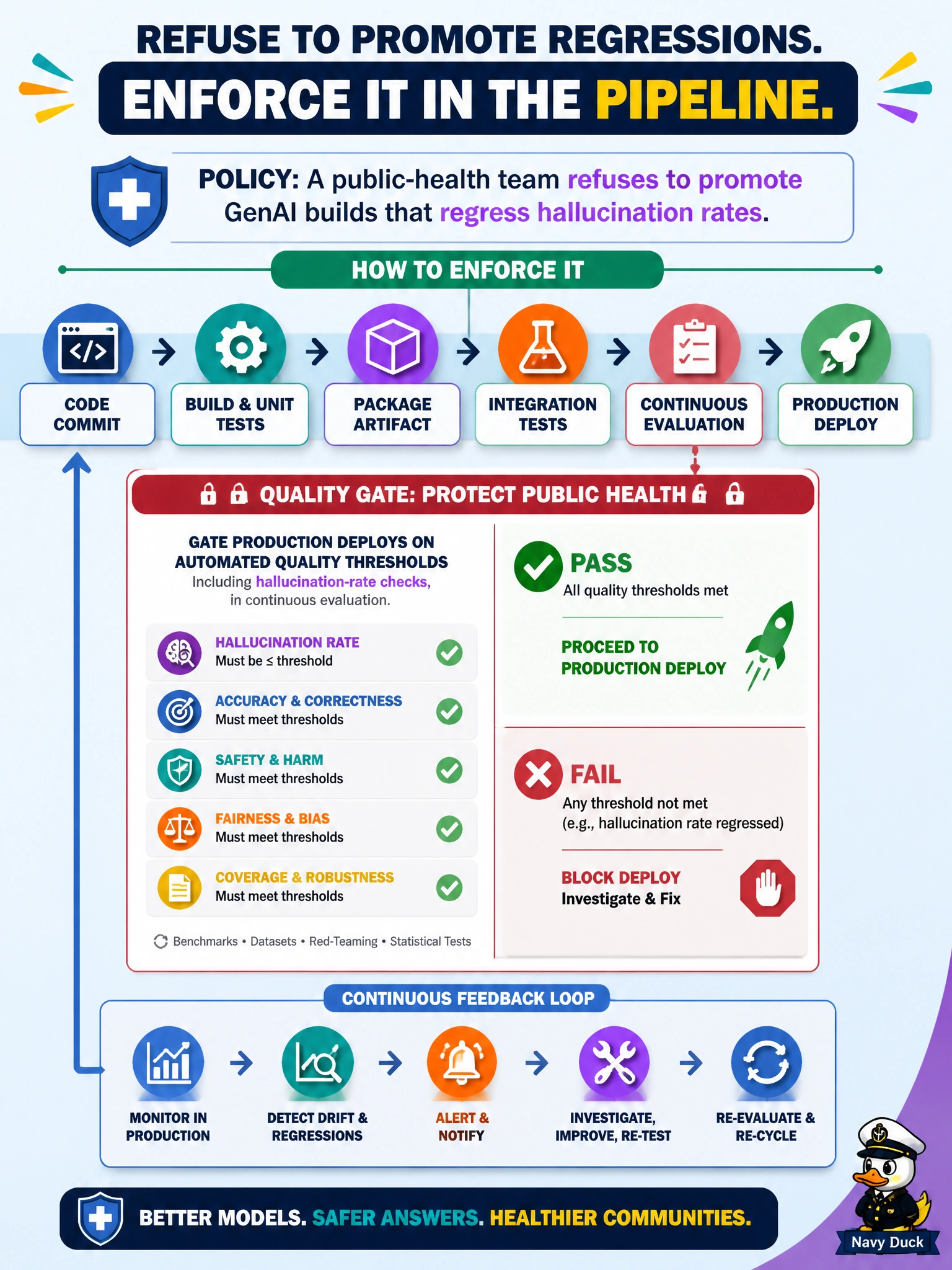
Think of the deploy gate like a health inspection before opening the clinic doors. If hallucination rates fail the automated check, the build stays in quarantine—no matter how pretty the CSS looks.
Full Explanation
Gating production deploys on automated quality thresholds, including hallucination-rate checks, in continuous evaluation is how a public-health team should enforce refusal to promote GenAI builds that regress hallucination rates. Pipeline gates turn policy into mechanism: if hallucination metrics on a fixed evaluation set fail thresholds, the build cannot reach production regardless of schedule pressure. That protects residents from regressions in outbreak or guidance content that fluent but false text can cause. Promoting every commit to production as soon as unit tests for CSS pass fails by concept: front-end unit tests do not measure generative factuality for public-health answers. Disabling evaluation jobs during release week to save time fails by concept and risk—the period of highest change is when hallucination gates matter most. Relying only on a manual hallway conversation with no recorded thresholds fails by concept: undocumented opinion does not create enforceable, repeatable promotion criteria. Exam caveat: quality policy without automated gates is aspirational; the exam answer couples continuous evaluation thresholds to deploy control. Operational check: define hallucination-rate (and related) thresholds on a public-health golden set, run them on every candidate build, block promotion on failure with visible CI status, require documented waiver only for emergencies with time-boxed rollback, and report gate outcomes in the release review.