
An emergency-management dashboard must prove GenAI answer time meets published board SLAs after each release. Which practice best supports that performance goal?
Select an answer to reveal the explanation.
Short Explanation
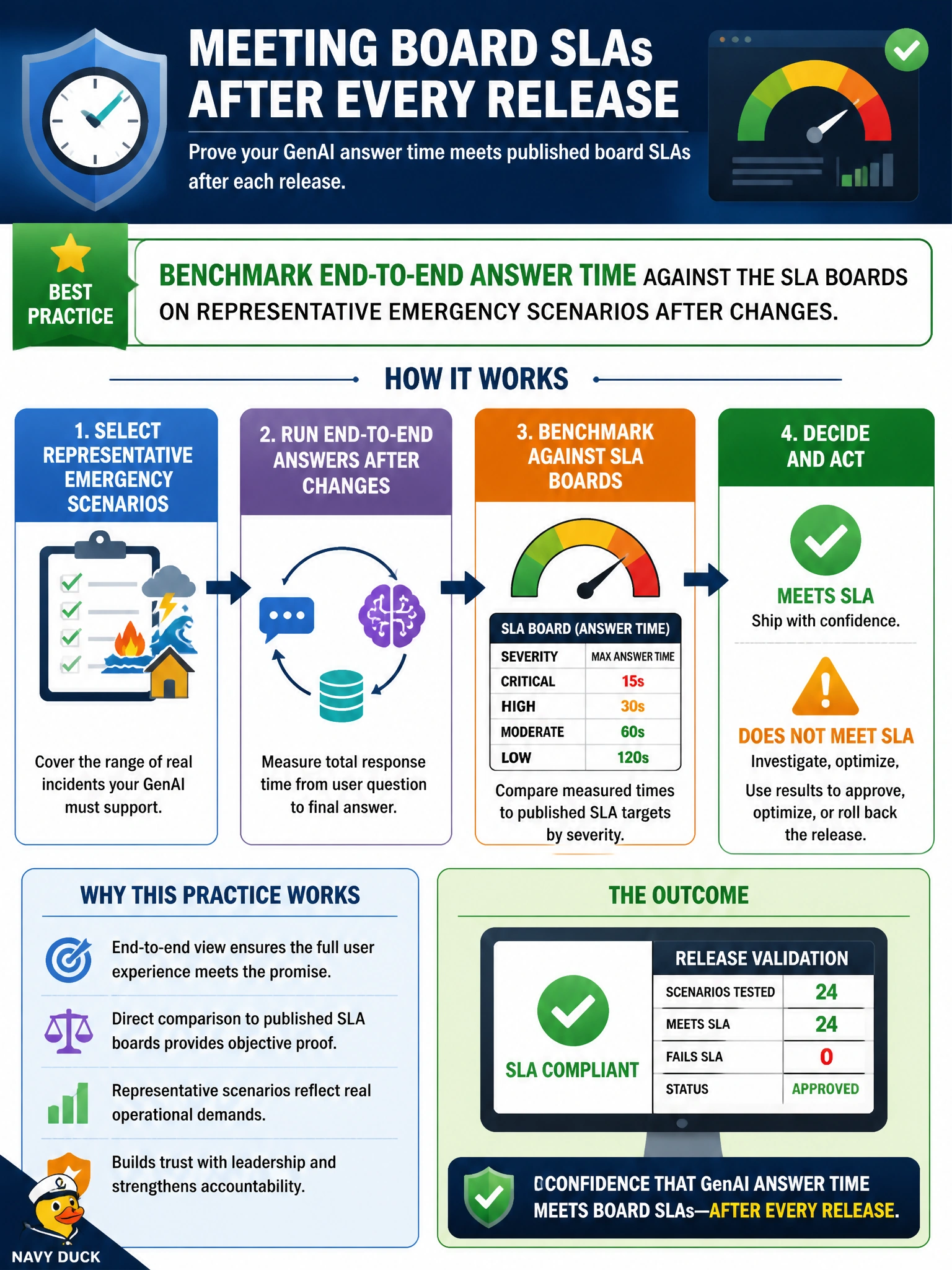
If the board posted a stopwatch target, you need a stopwatch—not vibes. Benchmark end-to-end GenAI answer time on real emergency scenarios against the SLA.
Full Explanation
Emergency-management dashboards that commit to published board SLAs on GenAI answer time need evidence after each release. Benchmarking end-to-end answer time against those SLAs on representative emergency scenarios—alert drafting, shelter FAQs, resource routing prompts—verifies that changes did not regress operational performance. Measured benchmarks support release readiness and detect latency regressions before residents and responders feel them in a real incident.
Skipping timing tests and relying on developers’ feelings that the release “seems fast” is not an SLA control and cannot satisfy board oversight. Measuring only model training accuracy metrics unrelated to civic answer latency answers the wrong question for inference UX. Publishing SLA dashboards with synthetic green status and never running real timings fabricates compliance and hides regressions.
Exam caveat: Performance commitments require measured end-to-end benchmarks on representative civic scenarios—not vibes, training metrics, or fake green lights. Operational check: maintain a scenario suite with SLA thresholds, run it in CI/CD or pre-prod gates, block release on p95 breach, and archive results for board reporting.