
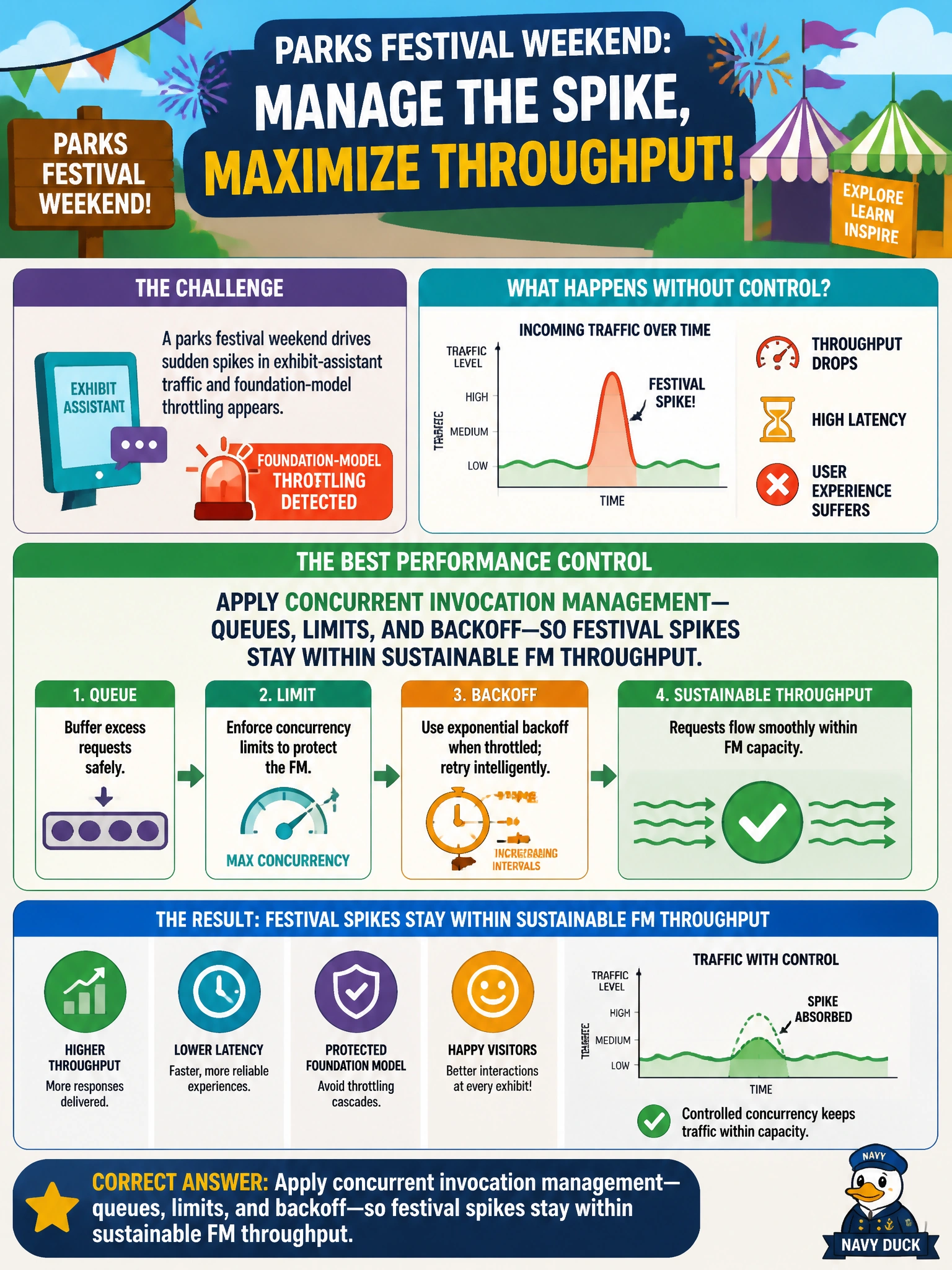
A parks festival weekend drives sudden spikes in exhibit-assistant traffic and foundation-model throttling appears. Which performance control best manages throughput during those spikes?
Select an answer to reveal the explanation.
Short Explanation
Festival crowds need ropes and ticket lines, not an open stampede. Manage concurrent FM invocations with queues, limits, and backoff so the parks assistant survives the spike.
Full Explanation
Parks festival weekends create sudden spikes in exhibit-assistant traffic that can exhaust foundation-model throughput and trigger throttling. Concurrent invocation management—bounded parallelism, queues, and client/gateway backoff—keeps spikes within sustainable FM limits, sheds or delays excess load gracefully, and preserves partial service instead of cascading failures. Predictable event-driven civic demand is exactly when these throughput controls matter.
Allowing unbounded concurrent FM invocations with no limits invites thundering herds and widespread throttle errors. Canceling the festival digitally so demand never spikes avoids the engineering problem by canceling the public service. Serializing every visitor question worldwide through a single-threaded worker destroys usable throughput and creates extreme queue latency.
Exam caveat: Throughput under spike load maps to concurrency limits, queues, and backoff—not unbounded fan-out or extreme global serialization. Operational check: set max concurrent Bedrock calls per service, queue overflow with retry/backoff and user-friendly wait messaging, load-test festival peak profiles, and alert when queue depth or throttle rates exceed thresholds.