
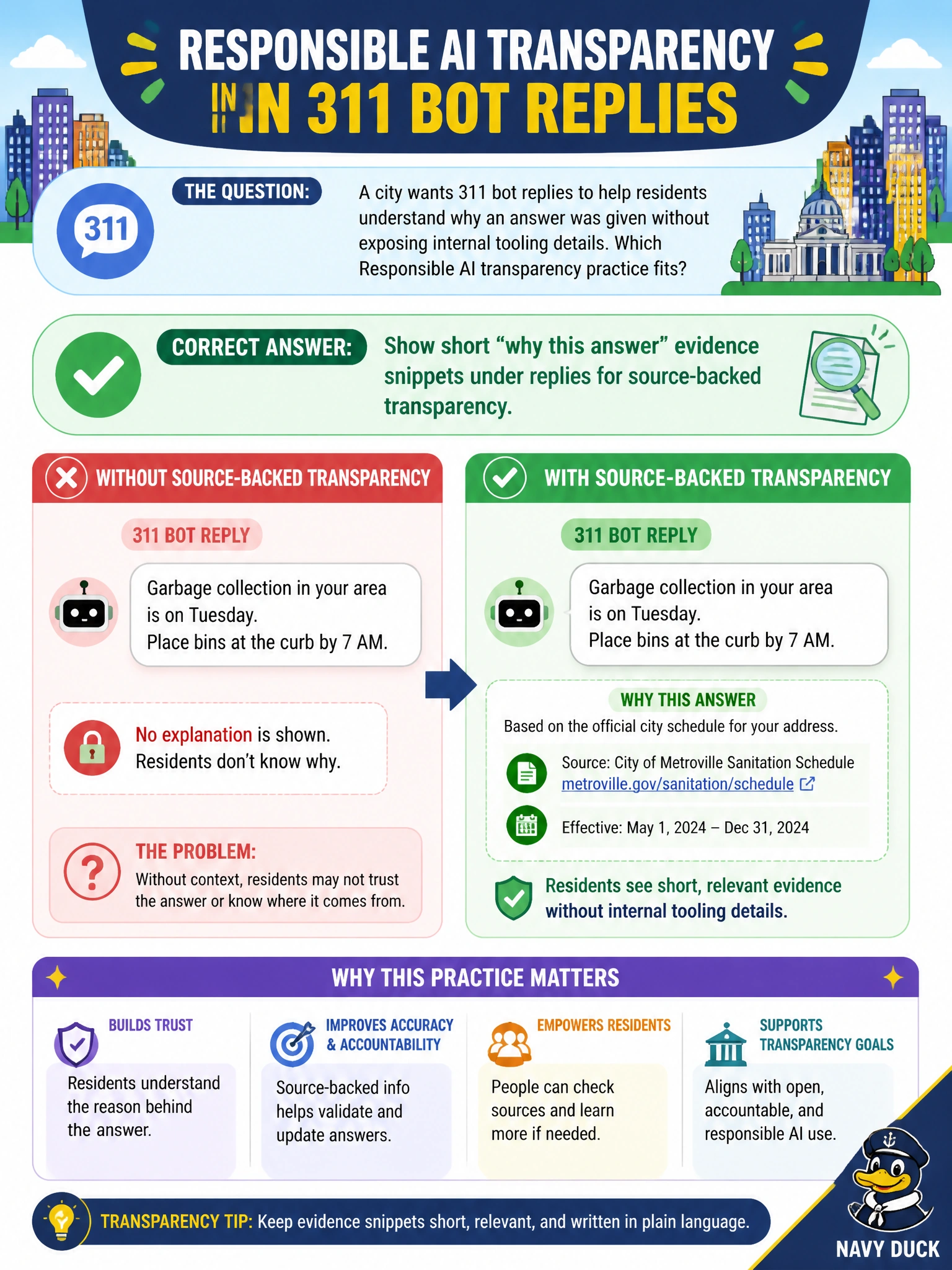
A city wants 311 bot replies to help residents understand why an answer was given without exposing internal tooling details. Which Responsible AI transparency practice fits?
Select an answer to reveal the explanation.
Short Explanation
Residents do not need the whole kitchen tour—just a clear “here’s the flyer this came from.” Short evidence snippets under 311 replies build trust without dumping internal chains of thought or staff credentials.
Full Explanation
Showing short “why this answer” evidence snippets under replies for source-backed transparency is the Responsible AI transparency practice that helps residents understand why a 311 answer was given without exposing internal tooling details. Concise citations or retrieved passage snippets grounded in approved knowledge sources explain the answer’s basis while omitting staff credentials, full chain-of-thought, tool schemas, and infrastructure. That UX balances explainability for residents with operational secrecy for the city’s GenAI stack.
Hiding all sources so residents must trust the bot blindly fails transparency and reduces ability to spot wrong grounding. Dumping full internal chain-of-thought and staff credentials into the public reply overshares operational detail and creates security and privacy risk. Refusing to answer whenever a citation might be required abandons service instead of providing appropriately scoped evidence snippets.
Exam caveat: civic RAI transparency favors resident-facing evidence snippets/citations—not raw reasoning dumps or total opacity. Distinguish user-appropriate grounding from internal tooling disclosure.
Operational check: render short source snippets under 311 replies in staging, confirm credentials and chain-of-thought are absent, verify snippets map to cataloged knowledge sources, and measure resident comprehension or trust metrics without increasing secret leakage.