
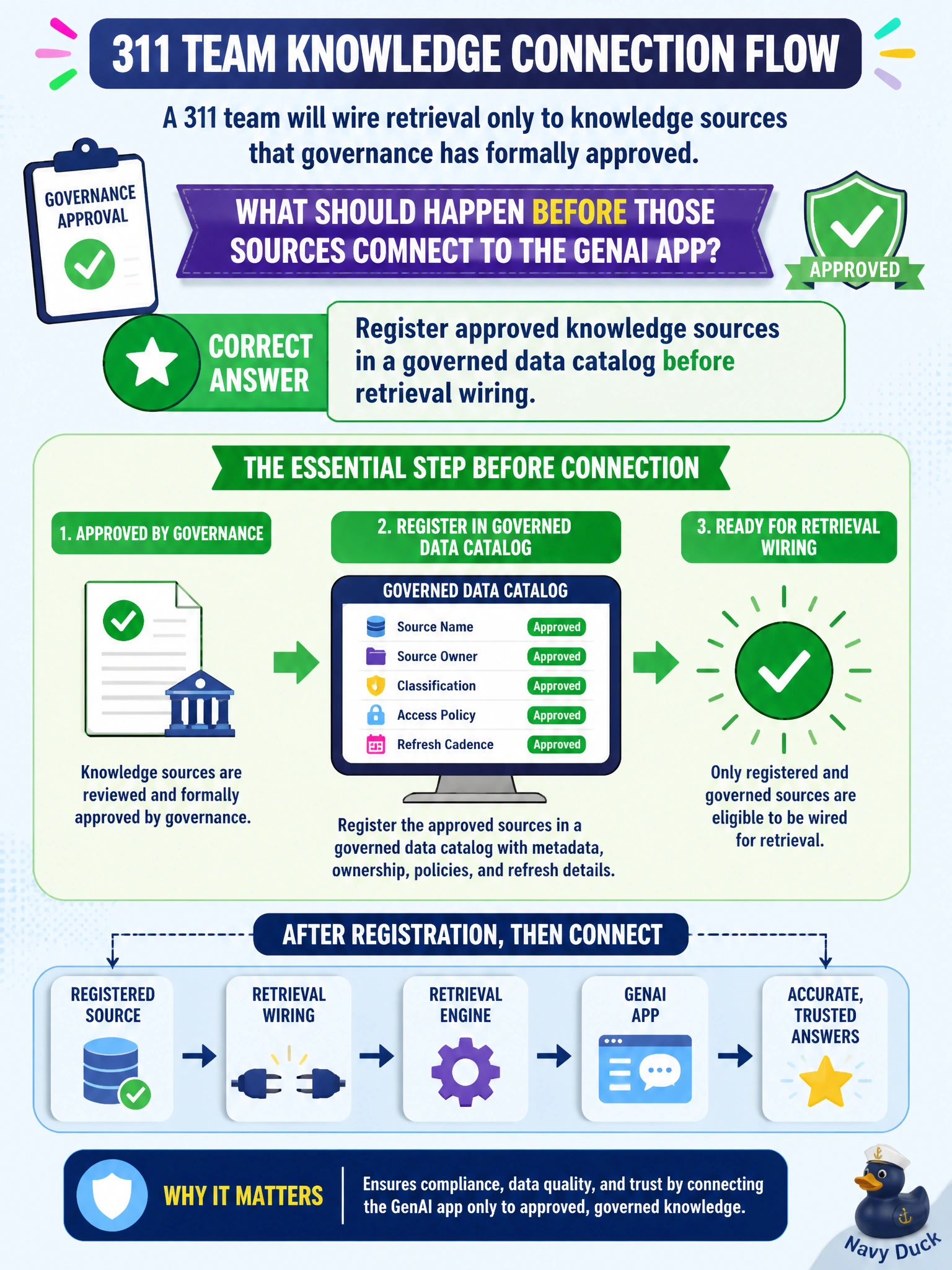
A 311 team will wire retrieval only to knowledge sources that governance has formally approved. What should happen before those sources connect to the GenAI app?
Select an answer to reveal the explanation.
Short Explanation
A governed catalog is the approved vendor list for knowledge—if it is not registered, the 311 bot should not shop there. Register sources first, then wire retrieval, so rogue folders never become quiet authorities.
Full Explanation
Registering approved knowledge sources in a governed data catalog before retrieval wiring is what should happen before a 311 team connects those sources to the GenAI app. Governance formally approves corpora; catalog registration records ownership, sensitivity, freshness, and approval status; only then does the retrieval layer resolve those cataloged sources. That sequence prevents personal Drive folders and unowned scrapes from quietly becoming answer authorities for resident 311 responses.
Letting developers point retrieval at any personal Drive folder that seems useful bypasses ownership, retention, and accuracy controls and injects shadow IT into production answers. Scraping random municipal blogs without ownership or freshness metadata creates unauthoritative, stale, or conflicting guidance with no steward to fix errors. Skipping catalog registration to accelerate the next sprint demo trades a short demo win for long-term governance failure and unvetted retrieval paths.
Exam caveat: governed RAG starts with approved, cataloged sources—wiring retrieval is a downstream step, not the approval mechanism itself. Exam distractors emphasize speed and convenience over catalog registration.
Operational check: require catalog IDs and approval flags before 311 retrieval configs can reference a source, block unauthorized source URIs in CI, periodically reconcile the live retrieval allowlist against the catalog, and assign stewards responsible for freshness of each registered corpus.