
A county counsel’s office must show how an ordinance PDF became the text behind a RAG answer during a records review. Which governance mechanism best supports that traceability?
Select an answer to reveal the explanation.
Short Explanation
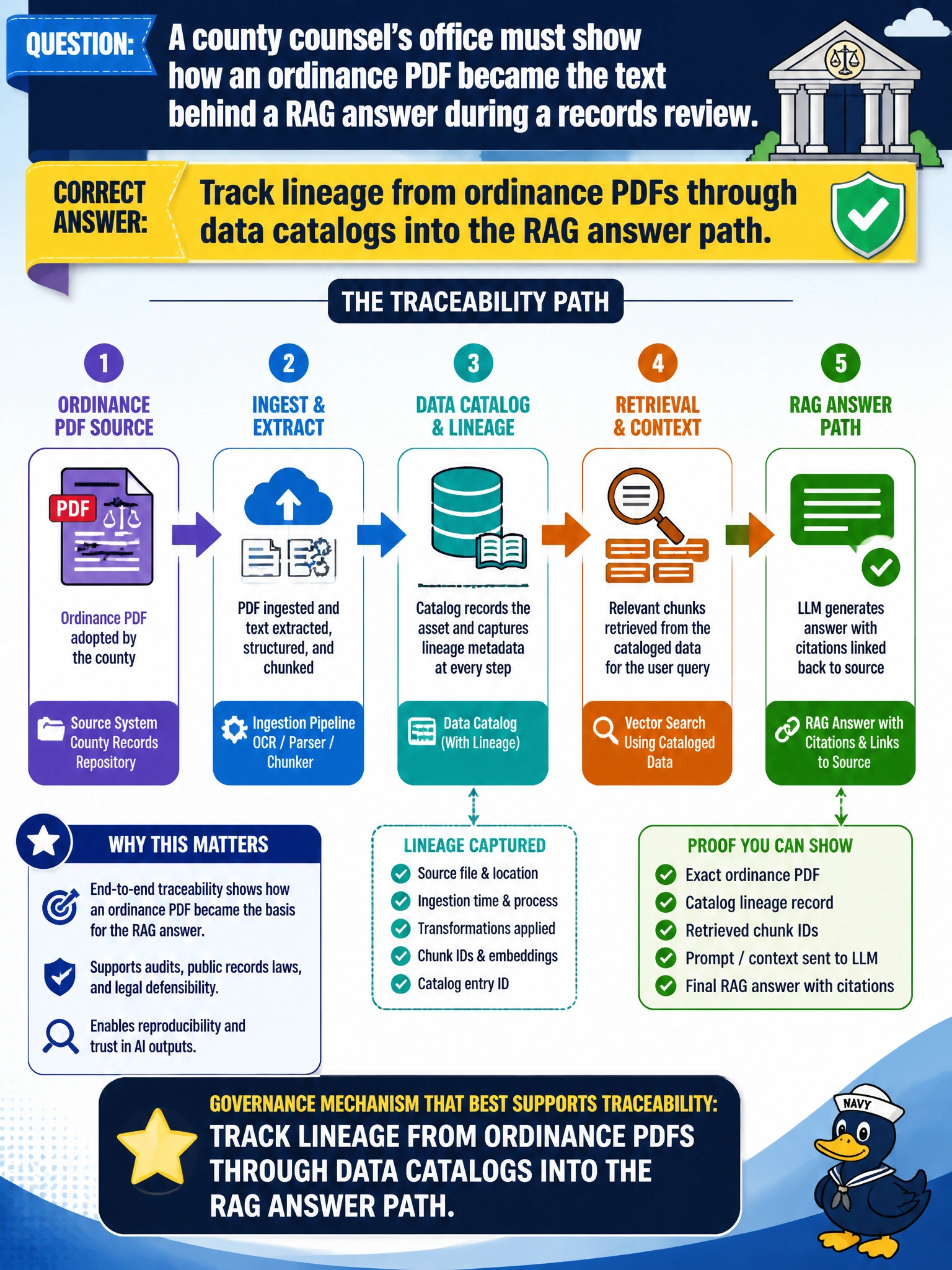
Lineage is the chain-of-custody sticker from the PDF on the shelf to the sentence the bot just said. Catalogs that track ordinance files into RAG paths let counsel follow that sticker when someone asks “where did this come from?”
Full Explanation
Tracking lineage from ordinance PDFs through data catalogs into the RAG answer path is the governance mechanism that lets county counsel show how a specific PDF became the text behind a RAG answer during a records review. Lineage records capture source object identity, ingest/transform jobs, catalog registration, embedding/index versions, and retrieval hits that grounded a given response. That chain is what counsel needs to demonstrate provenance—from the ordinance file in the clerk’s repository to the citations or passages used in the GenAI answer—without relying on folklore.
Deleting intermediate catalogs after each deploy so pipelines stay “clean” destroys the very metadata required for retrospective traceability. Relying on staff memory about which PDF was uploaded last spring is non-reproducible and fails under personnel change or contested records requests. Allowing anonymous uploads into the knowledge base with no source identifiers makes provenance impossible by design: if the system never recorded the source, counsel cannot reconstruct it later.
Exam caveat: RAG governance questions often test data lineage and cataloging as the path from source document to generated answer. Attribution is a systems property (IDs, catalogs, lineage graphs), not human recollection.
Operational check: ensure each ordinance PDF receives a stable source ID at ingest, catalog entries reference that ID, retrieval logs store retrieved chunk/source IDs per answer, and counsel can open a sample RAG reply and walk backward to the PDF object and version used.