
A city wants its permitting RAG corpora to reach Amazon Bedrock without placing those corpora on a public internet path. Which data-security pattern best meets that requirement?
Select an answer to reveal the explanation.
Short Explanation
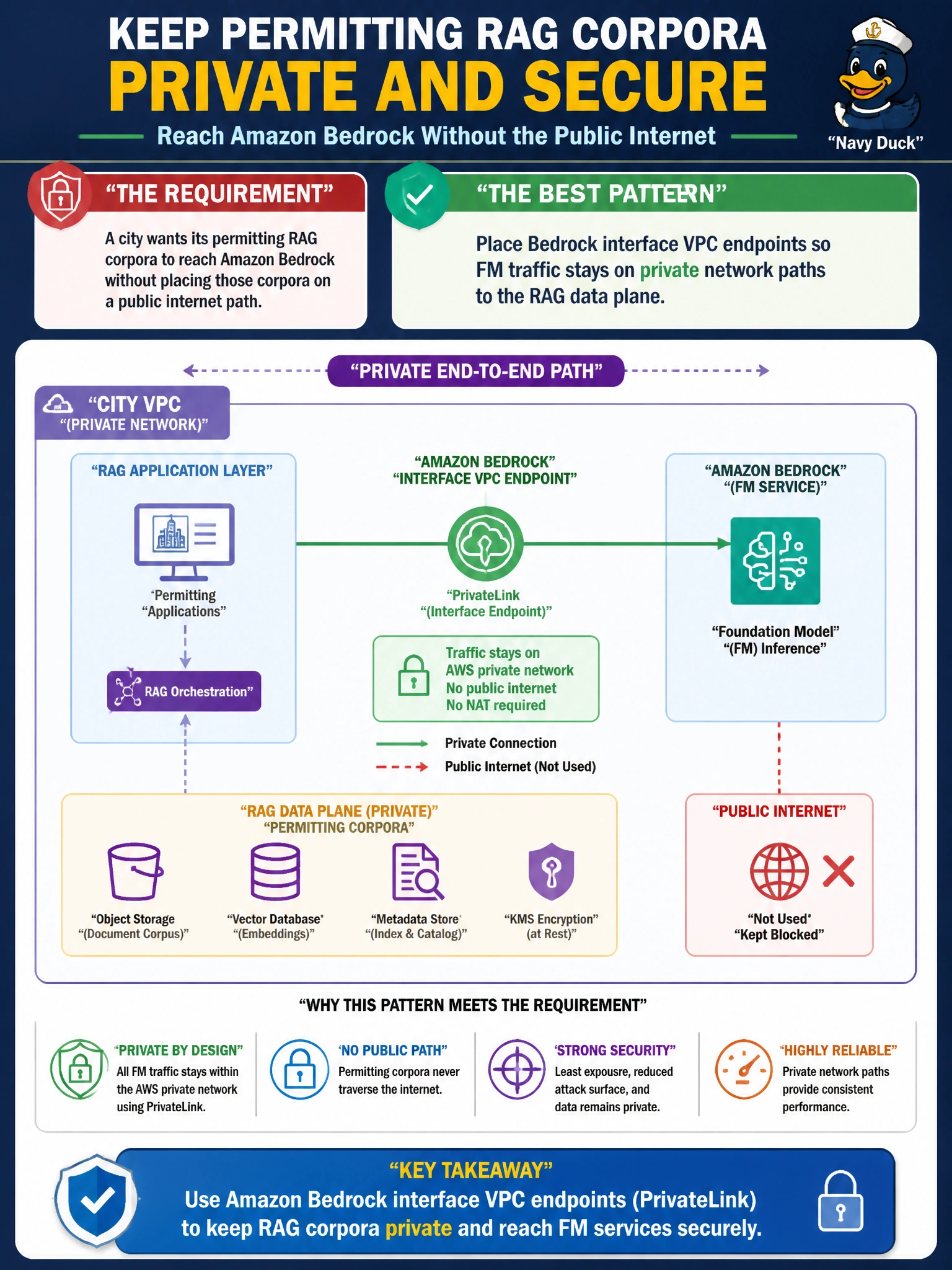
Picture city hall’s records room with a private corridor to the clerk—not a street-facing window. VPC interface endpoints give Bedrock that private corridor so RAG corpora are not hanging out on the public internet path.
Full Explanation
Placing Amazon Bedrock interface VPC endpoints keeps foundation-model traffic on private network paths to the city’s permitting RAG data plane, which is the pattern that meets the requirement to avoid a public internet path for those corpora. Interface endpoints allow application services inside the VPC to reach Bedrock without traversing the public internet, so ordinance embeddings, vector-store calls, and FM invocations stay inside controlled municipal network boundaries with security groups, private DNS, and logging aligned to the rest of the city’s private connectivity model.
Exposing the vector store through a public S3 website endpoint for “simpler FM access” places RAG corpora on a public path and widens exfiltration and scraping risk—the opposite of isolation. Moving every ordinance PDF to an unauthenticated CDN so Bedrock can scrape them likewise puts authoritative permitting content on the open internet and abandons access control. Disabling VPC networking and calling Bedrock only from developer laptops over the open internet fails production network isolation and leaves corpora and credentials dependent on unmanaged endpoints.
Exam caveat: distinguish private connectivity (VPC endpoints / PrivateLink-style patterns) from encryption alone. TLS on a public path does not satisfy “not on a public internet path.” Questions often pair Bedrock with RAG and ask which control keeps both FM calls and corpora off public routes.
Operational check: verify Bedrock interface endpoints exist in the target VPC/subnets, private DNS resolves the Bedrock service names, security groups allow only required app roles, route tables do not force RAG or FM traffic out a public NAT for this path, and CloudTrail/VPC flow logs show private endpoint use for permitting GenAI workloads.