
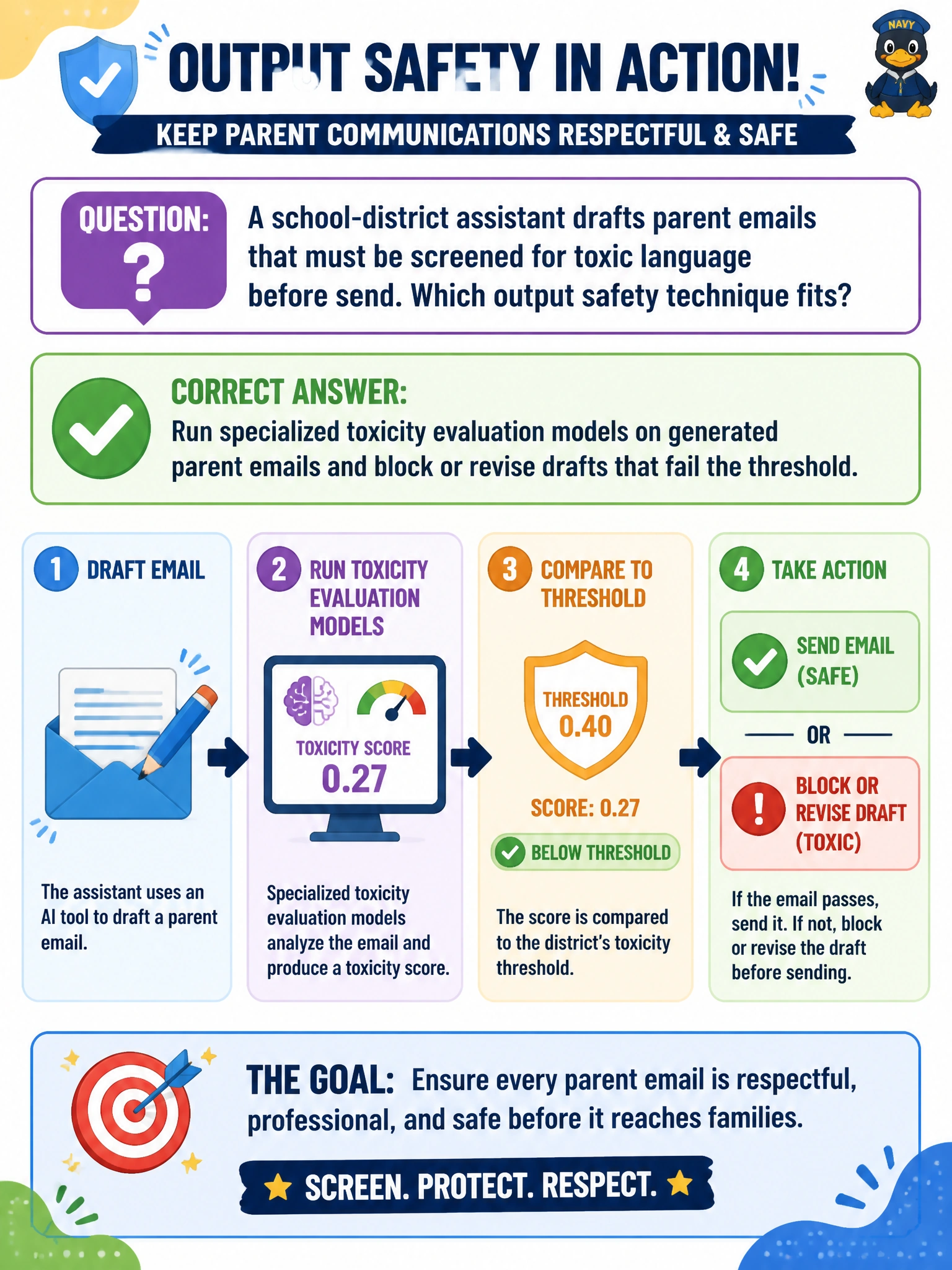
A school-district assistant drafts parent emails that must be screened for toxic language before send. Which output safety technique fits?
Select an answer to reveal the explanation.
Short Explanation
Parent emails from a district bot should pass a tone metal detector. Toxicity evaluation models score the draft and stop harsh language before it hits send.
Full Explanation
School-district assistants that draft parent emails must screen for toxic language before send. The fitting output safety technique is running specialized toxicity evaluation models on generated drafts and blocking or revising those that fail the threshold. Output-side evaluation catches harmful tone even when the prompt looked benign, which matters for communications that represent the district to families.
Sending every draft immediately with no toxicity scoring because staff are busy fails by concept: operational busyness does not justify unscreened parent outreach. Evaluating only spelling and never emotional or toxic tone fails to address the actual harm mode—technically correct spelling can still be abusive. Asking students to approve toxic phrasing before messages go to parents fails ethics and process design; students are not the moderation authority for staff-to-parent communications.
Exam caveat: toxicity models require calibrated thresholds and human appeal paths so legitimate stern disciplinary notices are not falsely blocked while truly harmful drafts are stopped. Evaluation should run after generation and before any send API; logging of scores supports continuous improvement. Toxicity checks complement, and do not replace, policy review for legal or student-privacy-sensitive content.
Operational check: generate parent-email drafts including clean and intentionally toxic samples in a sandbox, confirm the toxicity evaluator blocks or forces revision below threshold, confirm spellcheck-only paths cannot send, and verify no workflow requires student approval of toxic content.