
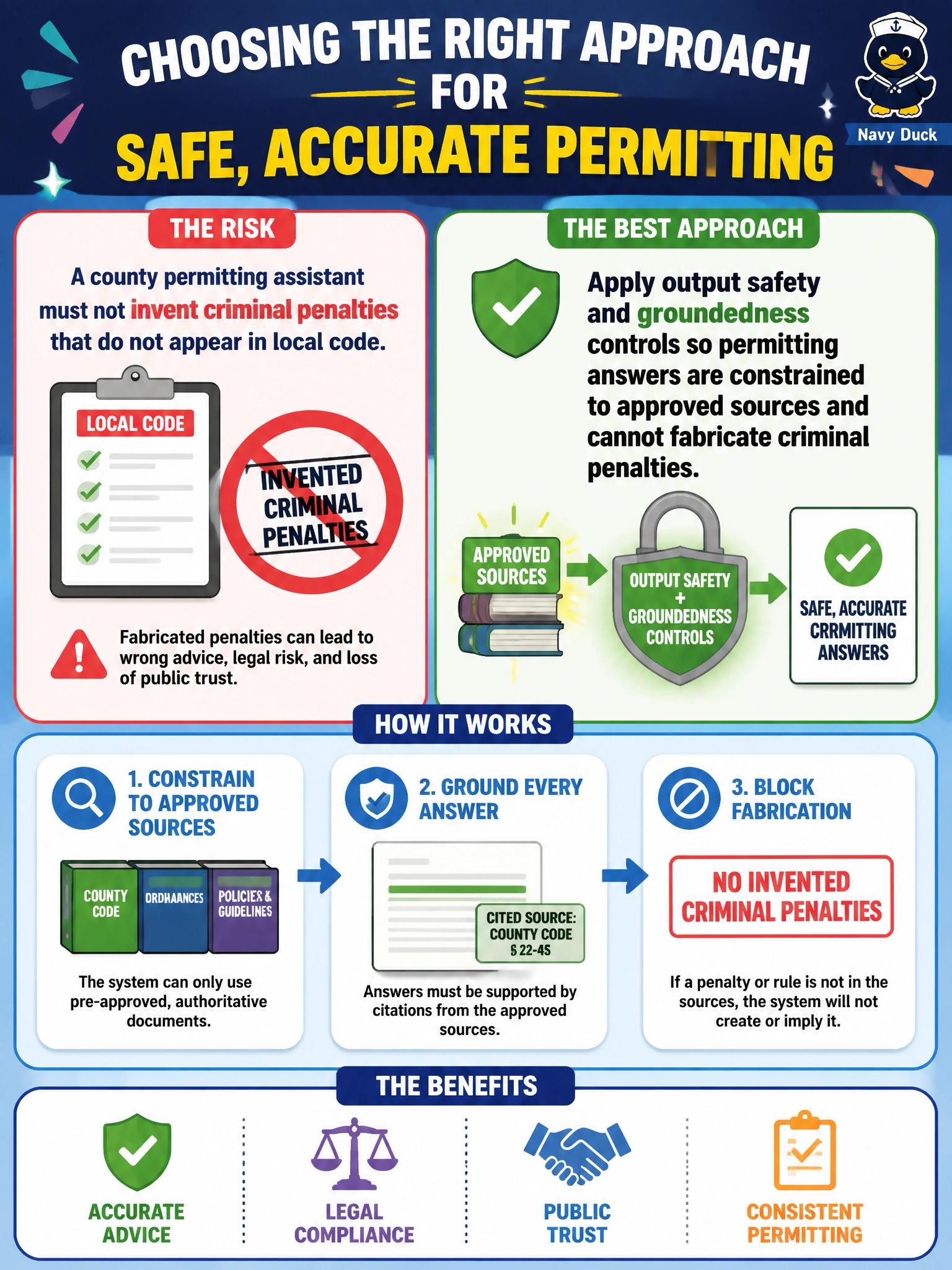
A county permitting assistant must not invent criminal penalties that do not appear in local code. Which output safety approach best addresses that risk?
Select an answer to reveal the explanation.
Short Explanation
Permitting bots should quote the code book, not invent jail time from thin air. Output groundedness controls keep answers tied to approved sources so criminal penalties are not fabricated.
Full Explanation
A county permitting assistant must not invent criminal penalties that do not appear in local code. The best output safety approach is applying groundedness and output safety controls so answers are constrained to approved sources and cannot fabricate penalties. Grounding ties claims to retrieved code sections or curated policy documents; output checks refuse or flag ungrounded legal threats that would mislead residents.
Encouraging the model to invent stricter penalties whenever residents sound frustrated fails by concept: emotional escalation is not a legal authority and creates false criminal exposure. Disabling citation requirements so the assistant can speculate freely about jail time fails transparency and accuracy duties for permitting guidance. Publishing every speculative penalty idea to the public portal without legal review fails governance and can cause unlawful or chilling communications.
Exam caveat: groundedness reduces hallucination risk but does not make the bot a lawyer; include disclaimers and escalation to human permitting staff for edge cases. If retrieval returns no penalty clause, the safe behavior is to say the code does not specify that penalty—not to improvise one. Evaluate groundedness with tests that try to elicit fabricated fines or jail terms.
Operational check: ask the permitting assistant for penalties on a topic with no criminal clause in the knowledge base and confirm it refuses to invent jail time; ask a topic with an approved cited penalty and confirm the answer references the source; attempt to publish ungrounded speculation and confirm the portal path blocks it pending legal review.