
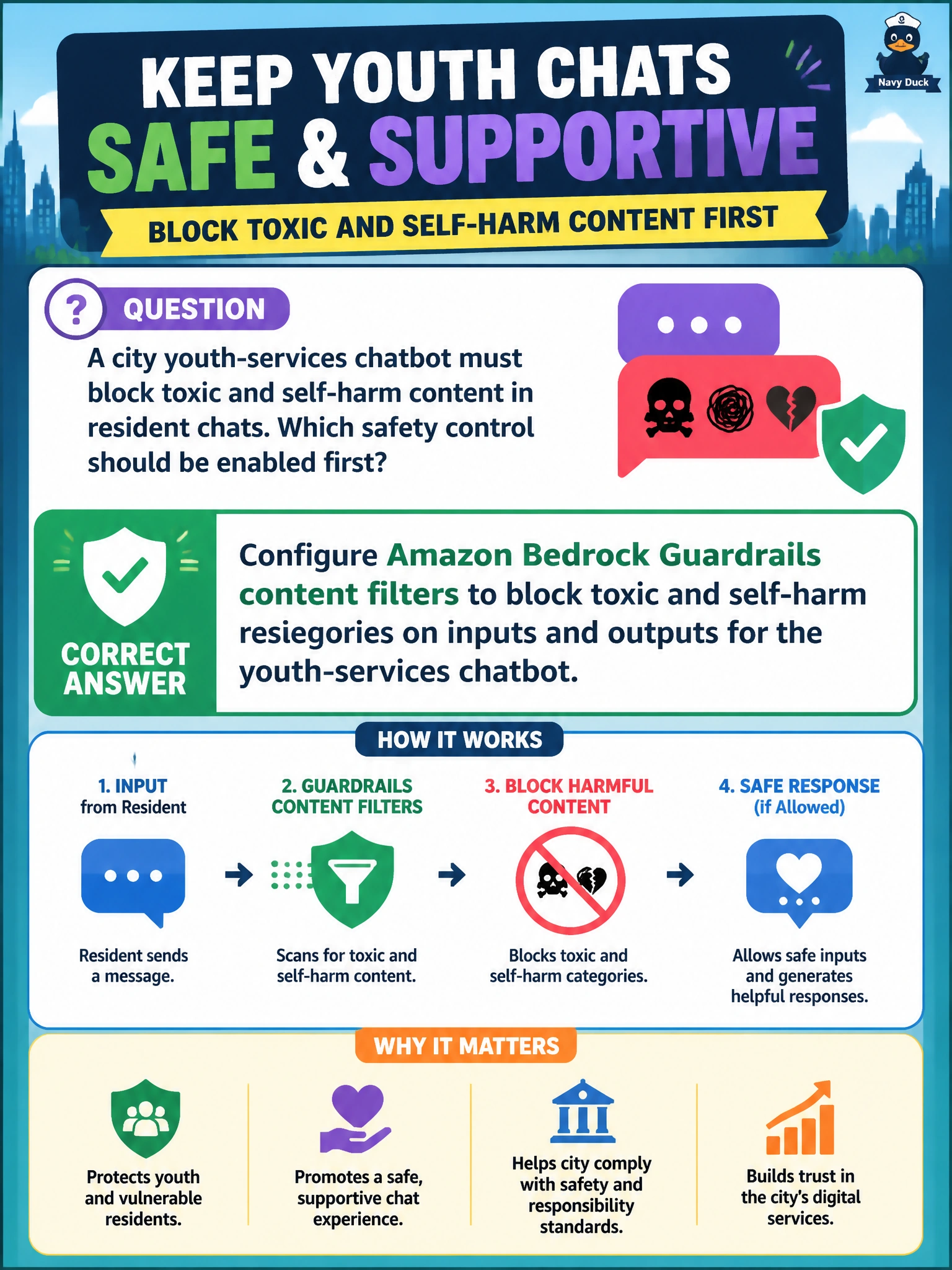
A city youth-services chatbot must block toxic and self-harm content in resident chats. Which safety control should be enabled first?
Select an answer to reveal the explanation.
Short Explanation
Youth-services chat is not the place for an anything-goes mic. Bedrock Guardrails act like the lobby security rules—toxic and self-harm content gets blocked on the way in and out before it reaches kids.
Full Explanation
A city youth-services chatbot must block toxic and self-harm content in resident chats. The first safety control to enable is Amazon Bedrock Guardrails content filters configured to block toxic and self-harm categories on both inputs and outputs. Guardrails provide managed, real-time filtering aligned to Responsible AI practice for sensitive civic populations, stopping harmful content before it spreads in a youth-facing channel.
Removing all content filters so the youth chatbot can discuss any topic without limits fails by concept: it abandons mandatory safety for a vulnerable audience. Relying only on after-the-fact weekly PDF reports with no real-time blocking fails because harm can occur in the moment; reports are detection lag, not prevention. Training a classical linear regression model on park attendance and using it as the sole safety layer fails relevance—attendance regression does not classify toxic or self-harm language.
Exam caveat: Guardrails are necessary but not always sufficient—combine with escalation paths for self-harm (human/crisis resources per policy), logging of blocked events for review, and regular policy tuning to reduce false positives that could silence legitimate help-seeking. Filters should apply to outputs as well as inputs so the model cannot emit disallowed content even if a prompt slips through.
Operational check: in a non-production youth-services bot, send prohibited toxic and self-harm test prompts from an approved safety suite, confirm Guardrails block on input or output as configured, verify weekly PDF reporting alone is not the only control, and document escalation behavior for blocked self-harm categories per city policy.