
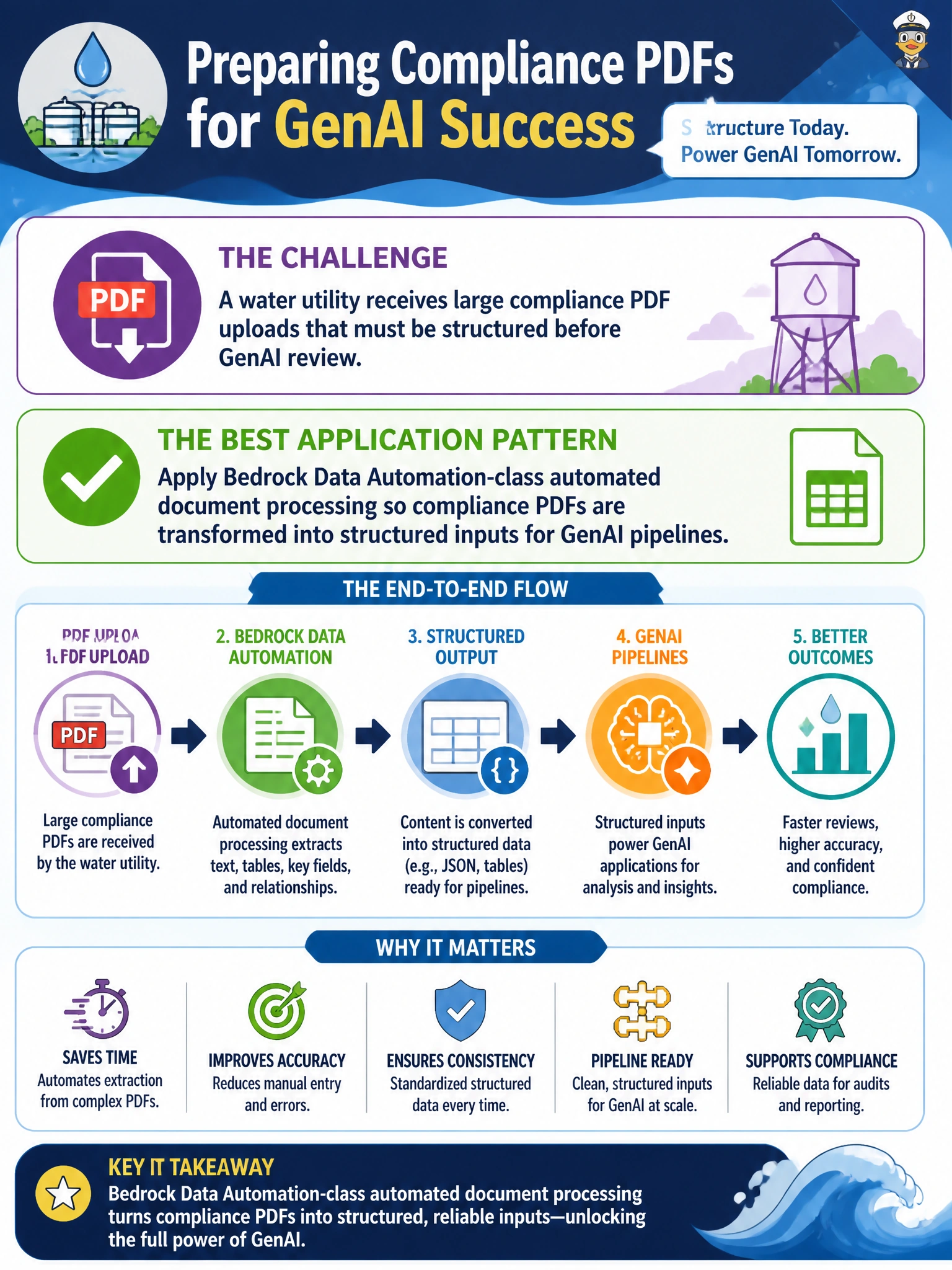
A water utility receives large compliance PDF uploads that must be structured before GenAI review. Which application pattern best prepares that content?
Select an answer to reveal the explanation.
Short Explanation
Fat compliance PDFs are like unsorted filing cabinets—you need an automated sorter before the smart assistant reads them. Bedrock Data Automation-style processing structures those uploads for the GenAI pipeline.
Full Explanation
Water utility compliance PDFs are often large and semi-structured; they must be prepared before GenAI review. Applying Bedrock Data Automation-class automated document processing transforms those PDFs into structured inputs for GenAI pipelines—extracting fields, tables, and sections so downstream prompts receive manageable, typed content rather than raw multi-hundred-page blobs. That pattern is the right application preparation step for municipal compliance review workflows.
Emailing raw unscanned PDFs to a shared inbox and hoping staff paste text into chat manually fails by concept: it is unscalable, unauditable, and bypasses malware/content controls. Ignoring document structure and sending entire multi-hundred-page binaries as single unstructured prompts fails context limits, cost control, and answer quality. Discarding PDF uploads and requiring field crews to retype every compliance page into a spreadsheet fails operationally and introduces transcription error.
Exam caveat: automated document processing improves structure; it does not replace human sign-off on regulated compliance conclusions. Structured outputs should be validated and access-controlled before they enter RAG indexes. Malware scanning and PII handling still apply at intake before or alongside automation.
Operational check: upload a representative compliance PDF to the automation pipeline, verify structured fields/sections emerge for the GenAI review step, confirm oversized raw binaries are not dumped whole into a single Bedrock prompt, and sample-check extraction accuracy against the source PDF.