
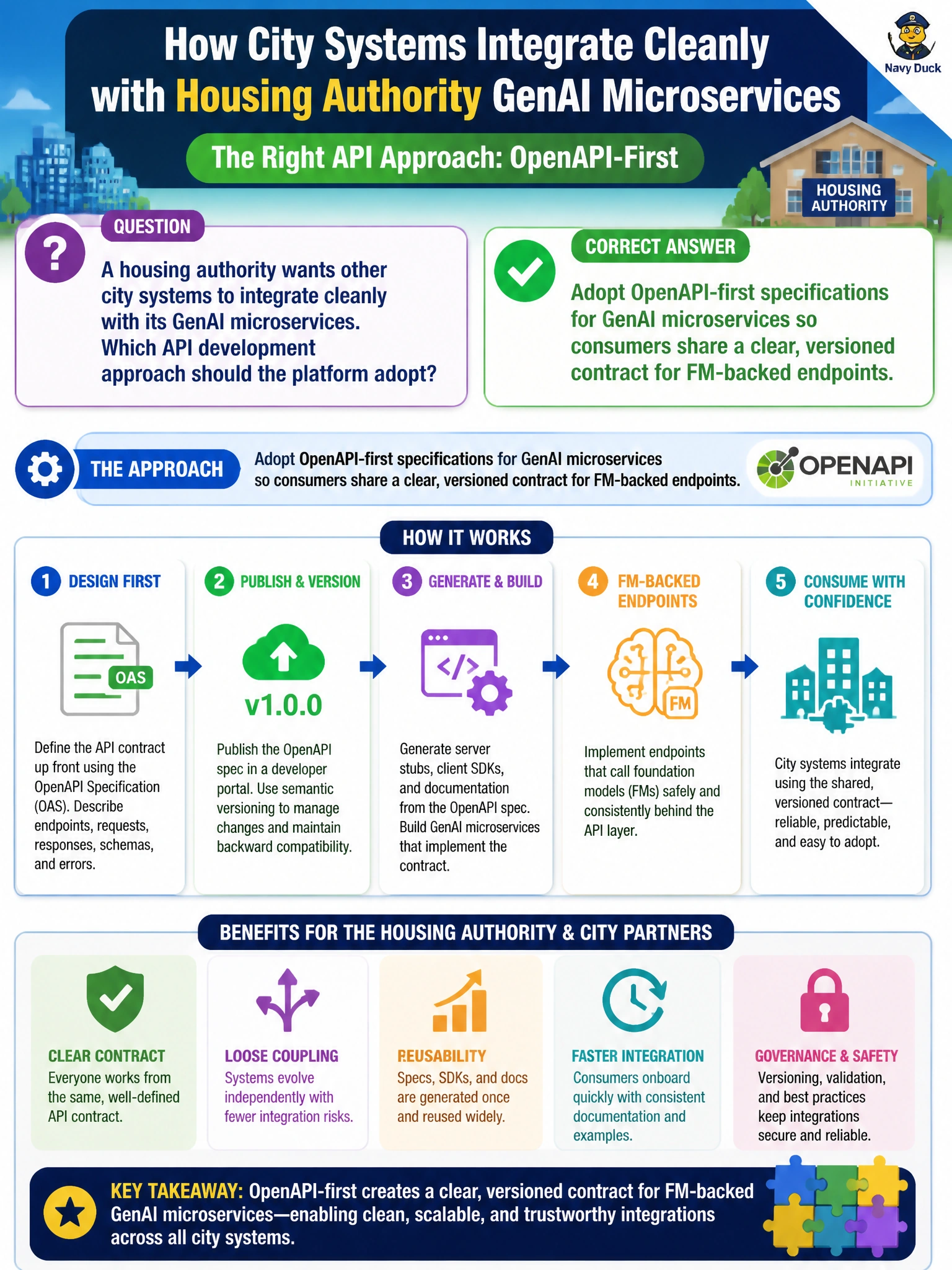
A housing authority wants other city systems to integrate cleanly with its GenAI microservices. Which API development approach should the platform adopt?
Select an answer to reveal the explanation.
Short Explanation
OpenAPI-first is the shared blueprint before anyone builds the hallway. Housing GenAI services publish the contract so parks, 311, and casework apps plug in without guessing.
Full Explanation
A housing authority that wants other city systems to integrate cleanly with its GenAI microservices should adopt OpenAPI-first specifications. Publishing a clear, versioned contract for FM-backed endpoints lets consumers share request/response shapes, auth requirements, and error models without reverse-engineering internals. OpenAPI-first improves change management across departments that depend on housing GenAI capabilities.
Exposing only undocumented ad-hoc HTTP paths that change weekly without notice fails by concept: consumers break silently and integration debt explodes. Requiring every consumer to reverse-engineer Lambda source code to learn request shapes fails platform hygiene and couples callers to implementation details. Publishing GenAI endpoints solely as unsigned SMS short codes with no HTTP API fails modern service integration and cannot express streaming, schemas, or standard auth for city systems.
Exam caveat: OpenAPI describes the contract; it does not automatically secure the service. Specs must still align with IAM/JWT auth, rate limits, and GenAI-specific errors (token limits, safety refusals). Versioning matters—breaking prompt or schema changes need explicit API versions so partner departments can migrate.
Operational check: publish an OpenAPI document for a housing GenAI microservice, generate or validate a consumer client against it, introduce a versioned additive field, and confirm undocumented path changes are rejected in review unless the spec and changelog are updated.