
A water utility’s SCADA-adjacent assistant must keep answering from approved SOP text when Bedrock calls fail. Which FM API client pattern provides that resilience?
Select an answer to reveal the explanation.
Short Explanation
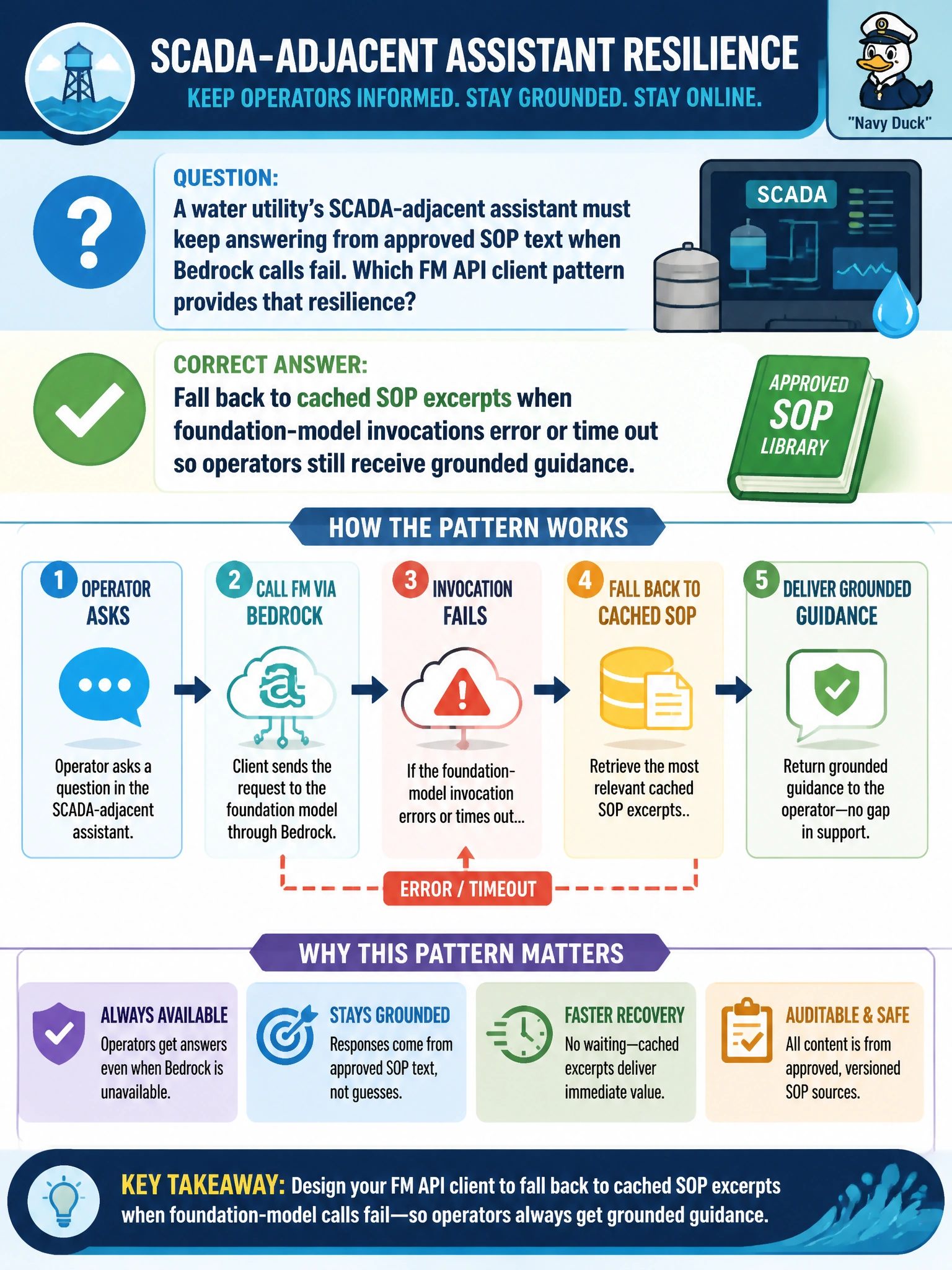
Think of it like a field crew radio: if the tower drops, you still have the laminated SOP binder in the truck. Caching approved SOP text and falling back when Bedrock fails keeps the assistant useful instead of going silent mid-incident.
Full Explanation
For a water utility SCADA-adjacent assistant, continuity during foundation-model outages is an operational requirement, not a convenience. The correct client pattern is graceful degradation: when Bedrock invocations error, time out, or are throttled, the application falls back to cached excerpts drawn only from approved SOP text so operators still receive grounded guidance. That keeps answers inside the municipality’s controlled corpus instead of inventing procedures mid-incident. Caching approved SOP content near the client or service tier is deliberate—pre-vetted material is safe to serve offline relative to live generation, whereas inventing new plant instructions without the model would be unsafe.
Disabling all SOP caches so every failure forces a live foundation-model retry fails by concept: retries without a local grounding path amplify outage impact and leave crews with silence when connectivity or quotas fail. Replacing the assistant with a classical linear regression model trained only on pump vibration fails because vibration regression does not answer SOP procedure questions and abandons the GenAI/RAG use case entirely. Deleting the SOP corpus when Bedrock returns throttling destroys the very knowledge base needed for recovery and is the opposite of resilience.
Exam caveat: fallback text must still be versioned, access-controlled, and clearly labeled as cached SOP guidance so operators do not confuse a degraded mode with a fresh model synthesis; throttling handling may include backoff, but backoff alone without content fallback does not meet the continuity requirement.
Operational check: inject a Bedrock timeout or throttling fault in a non-production SCADA-adjacent drill, confirm the client serves approved cached SOP excerpts with an explicit degraded-mode indicator, verify no unapproved free-form generation occurs, and confirm recovery restores live FM calls without wiping the SOP cache.