
A municipal enterprise architecture board requires GenAI components to meet the same continuous delivery rigor as other city services. Which pipeline expectation best reflects that mandate?
Select an answer to reveal the explanation.
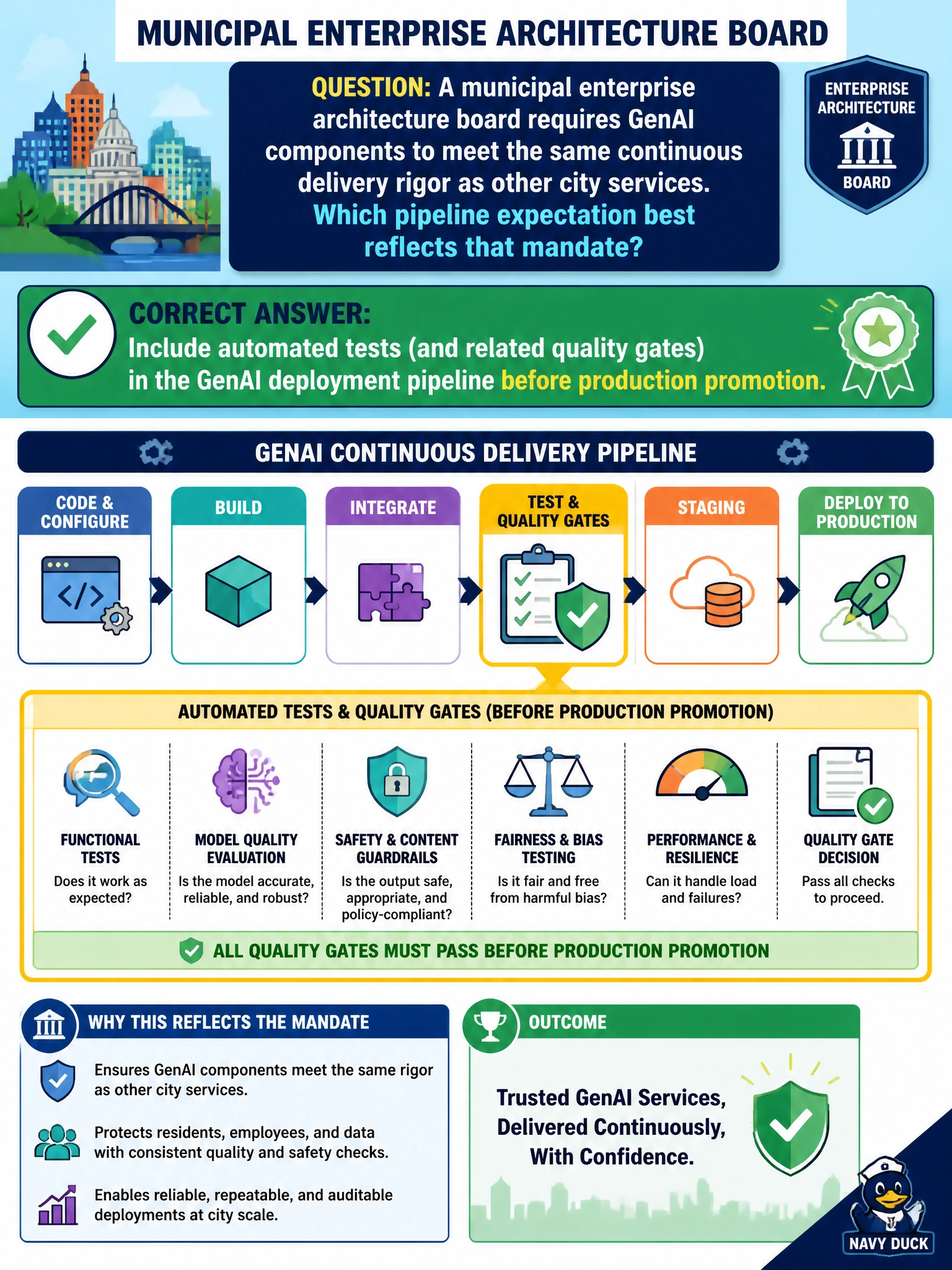
Short Explanation
City water pumps do not go live without tests, and GenAI agents should not either. Automated gates in the deploy pipeline catch prompt and integration breakages before residents feel them.
Full Explanation
Municipal enterprise architecture boards that hold GenAI to the same continuous-delivery rigor as other city services expect automated tests and related quality gates in the GenAI deployment pipeline before production promotion. Even though foundation-model outputs vary, pipelines can still validate schemas, tool contracts, evaluation suites, safety filters, and infrastructure changes. City water pumps do not go live without tests; GenAI agents that answer residents should not either. Promoting untested prompt and agent changes directly to production on Fridays fails change management and maximizes weekend incident risk. Skipping automated tests because foundation models are non-deterministic fails the premise: non-determinism motivates evaluation harnesses and contract tests, not the absence of testing. Allowing each department to email ZIP archives of agents to operations for manual install fails CI/CD, integrity, and repeatability across the enterprise. Exam caveat: “automated tests” for GenAI include more than unit tests—use golden-prompt evaluations, regression thresholds, and integration tests against stubbed tools. Gates should block on security and policy failures, not only on green compile. Keep human approval for high-risk civic agents. Operational check: Require pipeline stages for lint/schema checks, evaluation suites, security scans, and staged promotion; forbid Friday untested production edits; reject ZIP-over-email installs; and verify rollback artifacts exist for the last known-good agent release.