
A 311 platform plans stadium-event kiosk assistants that need very low latency near the venue. Which enterprise integration consideration is most relevant?
Select an answer to reveal the explanation.
Short Explanation
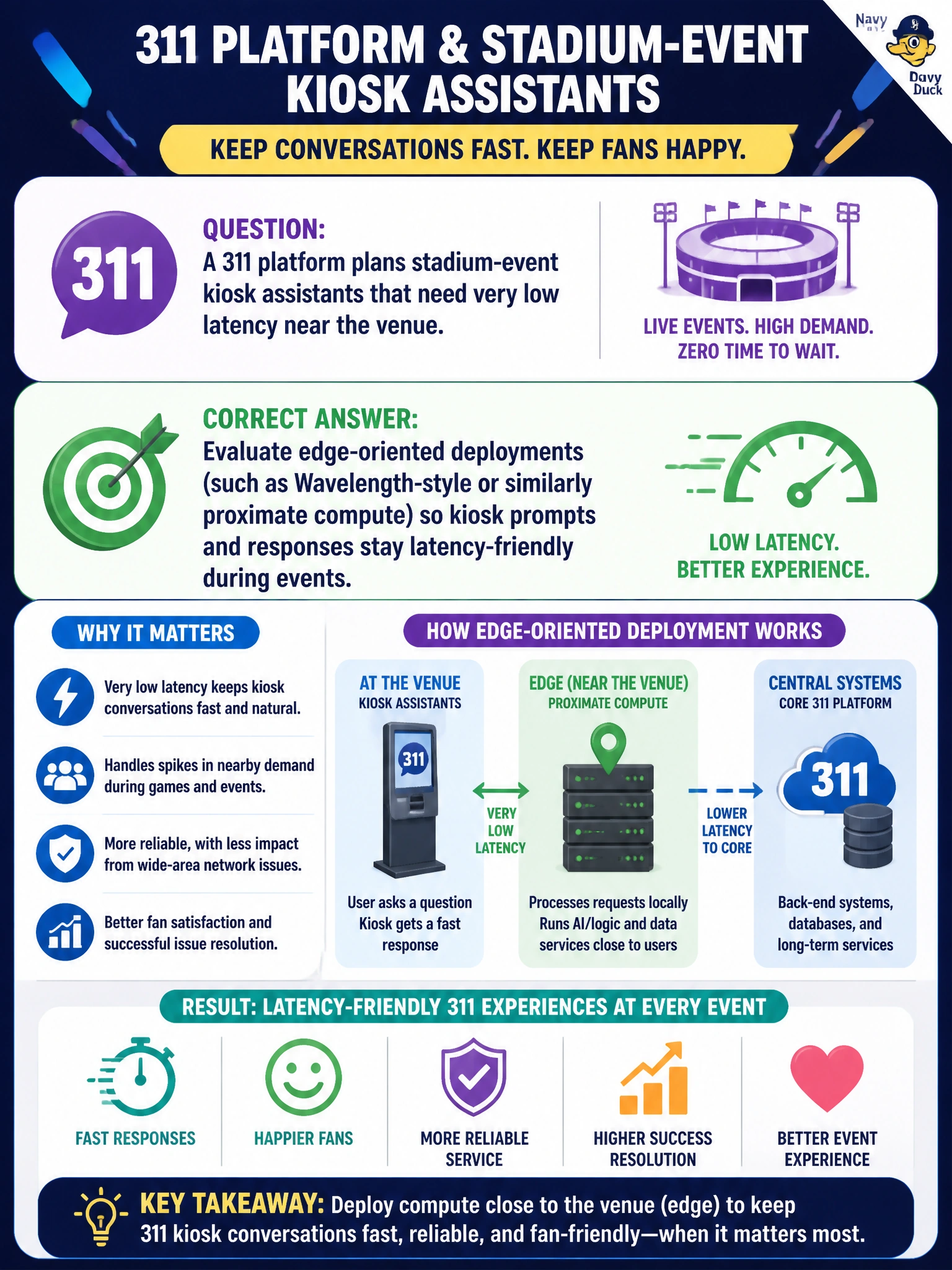
Stadium Wi-Fi is chaos and fans will not wait for a chat bubble stuck halfway across the country. Putting compute closer to the kiosks—edge or Wavelength-style—keeps answers snappy when the gates open.
Full Explanation
Latency-sensitive civic GenAI at stadium-event kiosks benefits from edge-oriented deployments such as AWS Wavelength-style or similarly proximate compute so prompts and responses stay latency-friendly when gates open. Placing inference or the application tier nearer to venue users reduces round-trip time across congested event networks and distant Regions. For 311-style assistants answering crowd questions in real time, proximity is an enterprise integration and deployment consideration—not an afterthought. Hosting the only FM endpoint in a distant Region and ignoring last-mile latency to the kiosks fails the low-latency requirement when cellular and venue Wi-Fi already add delay. Disabling networking on the kiosks and pre-printing every possible answer on paper posters fails interactive GenAI and cannot cover dynamic event questions. Routing all stadium traffic through a single on-premises desktop PC under the press box with no autoscaling fails resilience and capacity when thousands of fans arrive together. Exam caveat: edge placement helps network latency but does not remove the need for model capacity, caching of common FAQ, and offline fallbacks when the venue network degrades. Also weigh data-handling rules for any prompts that might include personal data from visitors. Operational check: Measure p95 prompt-to-first-token time from kiosks during a load test that mimics gate-open traffic; compare distant-Region versus edge or proximate tiers; configure autoscaling and circuit breakers; and prepare a static FAQ fallback if the edge path saturates.