
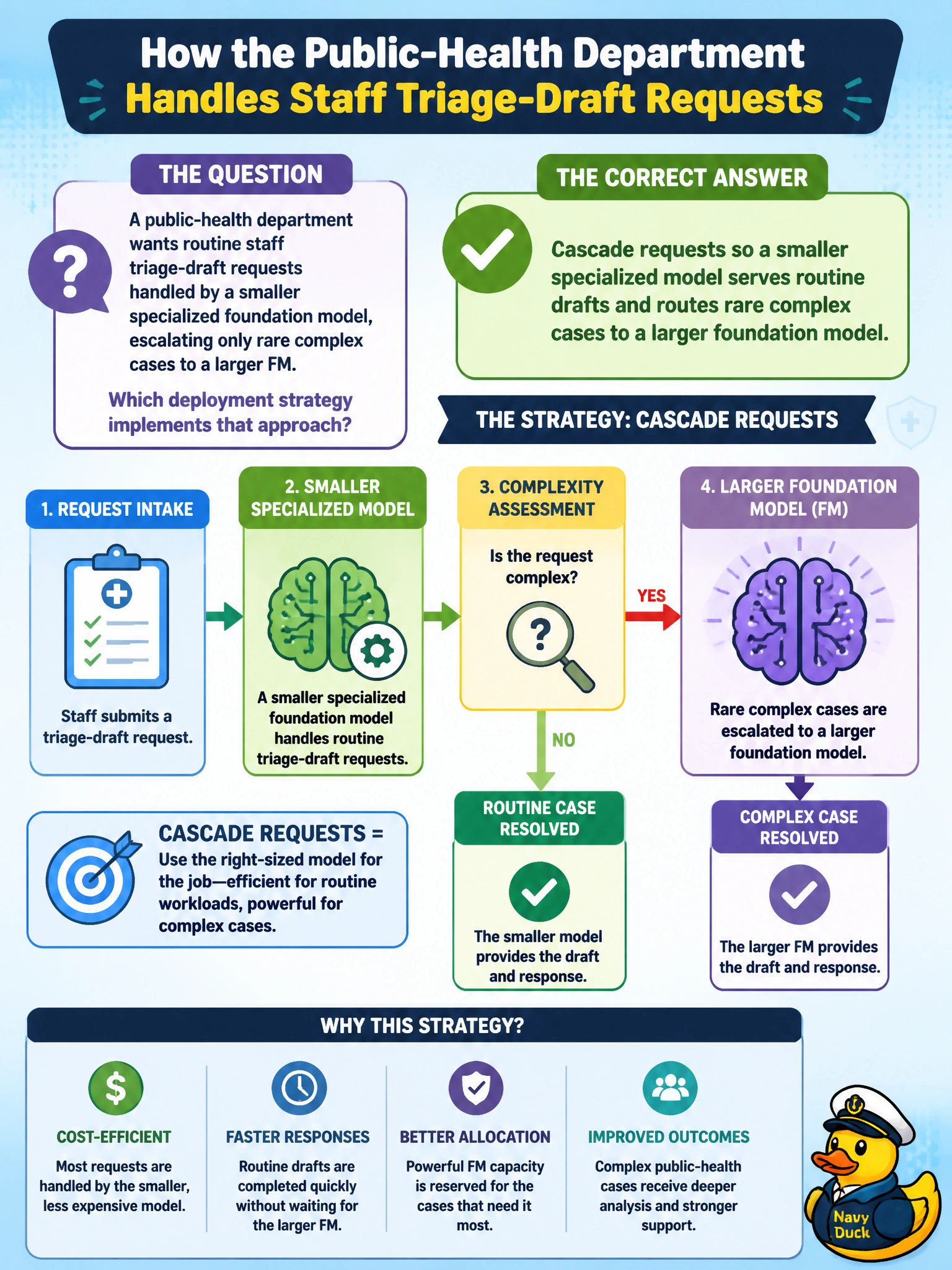
A public-health department wants routine staff triage-draft requests handled by a smaller specialized foundation model, escalating only rare complex cases to a larger FM. Which deployment strategy implements that approach?
Select an answer to reveal the explanation.
Short Explanation
Think of a clinic intake desk: a nurse practitioner clears everyday questions, and only the oddball cases go upstairs to the specialist. Model cascading works the same way—cheap specialized model first, big FM only when the case needs it.
Full Explanation
Model cascading for a public-health triage-draft workflow routes routine staff requests to a smaller specialized foundation model and escalates only rare complex cases to a larger foundation model. That deployment strategy matches civic cost and latency realities: most clinic and program staff drafts are patterned and high-volume, while unusual case narratives need stronger reasoning. Cascading preserves quality where it matters without paying large-model rates on every routine note. Always invoking the largest available Bedrock model and relying on Guardrails to shorten answers fails on cost and latency: Guardrails constrain unsafe or oversized outputs but do not make an oversized model the right first hop for routine work. Disabling all foundation models and returning only static FAQ pages fails the requirement—staff still need generative triage drafts, and static FAQs cannot draft case-specific language. Duplicating every request to both models in parallel and discarding the cheaper response fails economically and operationally: you pay twice, add contention, and invent a wasteful pattern that cascading is meant to avoid. Exam caveat: cascading needs a clear escalation rule such as confidence, intent class, length, or clinician flag. Without that rule, traffic either never escalates (quality risk) or always escalates (cost risk). Also ensure PHI handling, logging, and Guardrails apply on both model paths—not only on the large model. Operational check: Instrument what fraction of public-health drafts stay on the small model versus escalate; set latency and cost budgets per path; validate escalation examples with clinical reviewers; and confirm both endpoints share the same identity, audit, and content-safety controls before production cutover.