
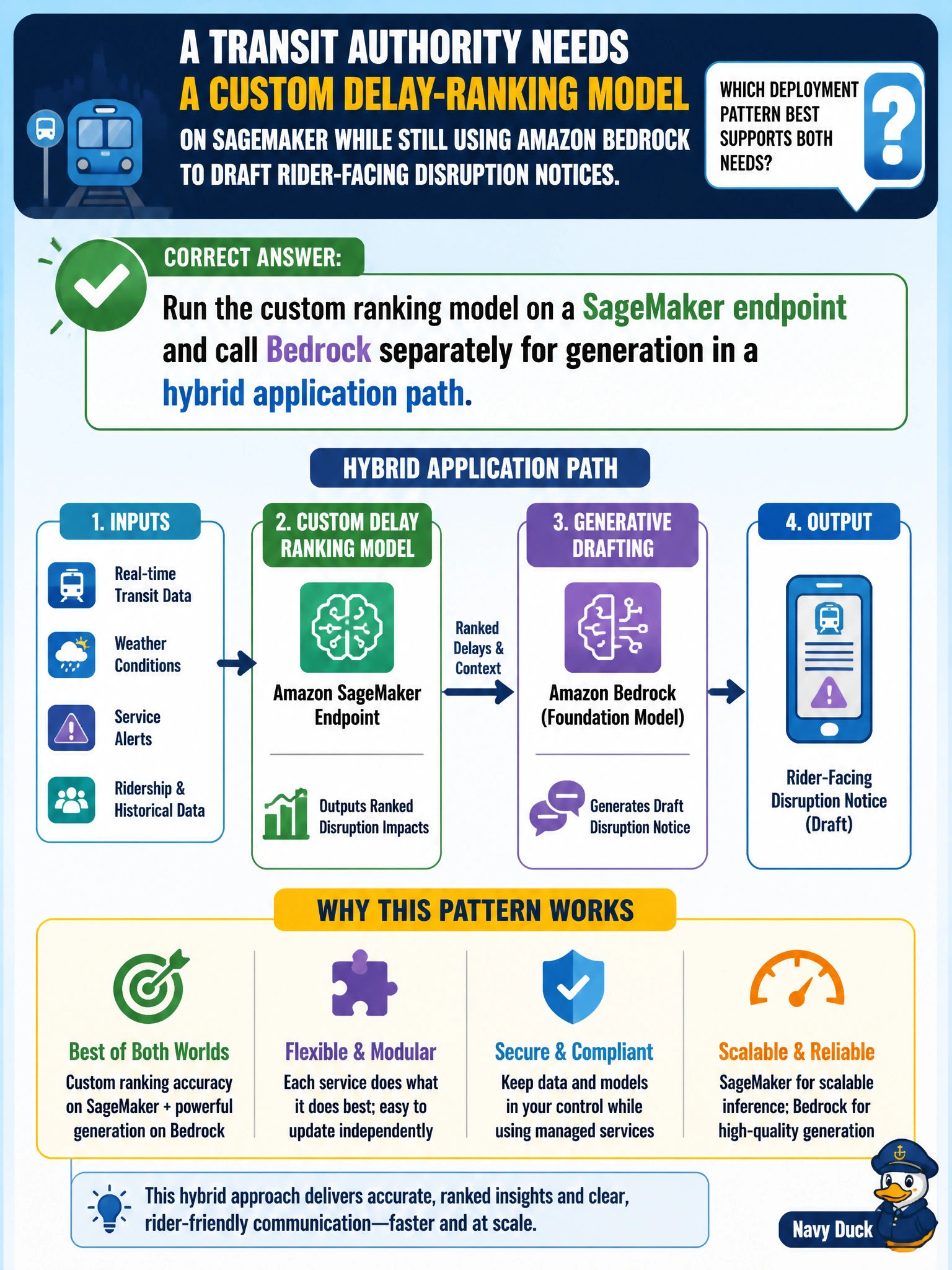
A transit authority needs a custom delay-ranking model on SageMaker while still using Amazon Bedrock to draft rider-facing disruption notices. Which deployment pattern best supports both needs?
Select an answer to reveal the explanation.
Short Explanation
Picture a dispatch board that sorts which delays matter most, then a skilled writer who turns that ranked list into clear rider notices. The ranking lives on SageMaker; the prose comes from Bedrock—two tools, one hybrid path.
Full Explanation
Hybrid GenAI deployments for municipal transit commonly split specialized ranking from managed generation: run the custom delay-ranking model on a SageMaker endpoint, then call Amazon Bedrock separately to draft rider-facing disruption prose. That pattern keeps transit-specific ranking logic under the authority’s trained model while still using a managed foundation model for clear public notices—without forcing one runtime to do both jobs poorly. The application path orchestrates both calls so ranked delays feed the generation prompt under agency editorial controls. Replacing Bedrock entirely with a single SageMaker endpoint that both ranks and generates fails when the authority already relies on Bedrock for drafting quality and managed FM operations; collapsing everything onto one custom endpoint increases ownership burden and abandons the managed generation path the scenario still needs. Training the ranking model inside Bedrock Prompt Management fails by concept: Prompt Management stores and versions prompts—it is not a training host for custom ranking models, so the specialized model still needs SageMaker or equivalent hosting. Exporting SageMaker rankings to a nightly CSV and banning live model calls fails operationally for disruption notices: delays change throughout the day, and riders need near-real-time ranked context feeding generation, not a stale overnight file. Exam caveat: hybrid does not mean uncontrolled dual spend. Cache rankings where freshness allows, bound Bedrock tokens for notice length, and keep human review for high-impact service messages. Also separate model ownership: ranking accuracy is a SageMaker ML concern; tone and safety of rider prose remain a Bedrock and Guardrails concern. Operational check: Verify the app invokes the SageMaker ranking endpoint, maps top delays into a constrained prompt, then calls Bedrock; monitor both endpoint latency and Bedrock throttling during incident peaks; and ensure fallback copy exists if either hop fails so the rider app never shows a blank disruption panel.