
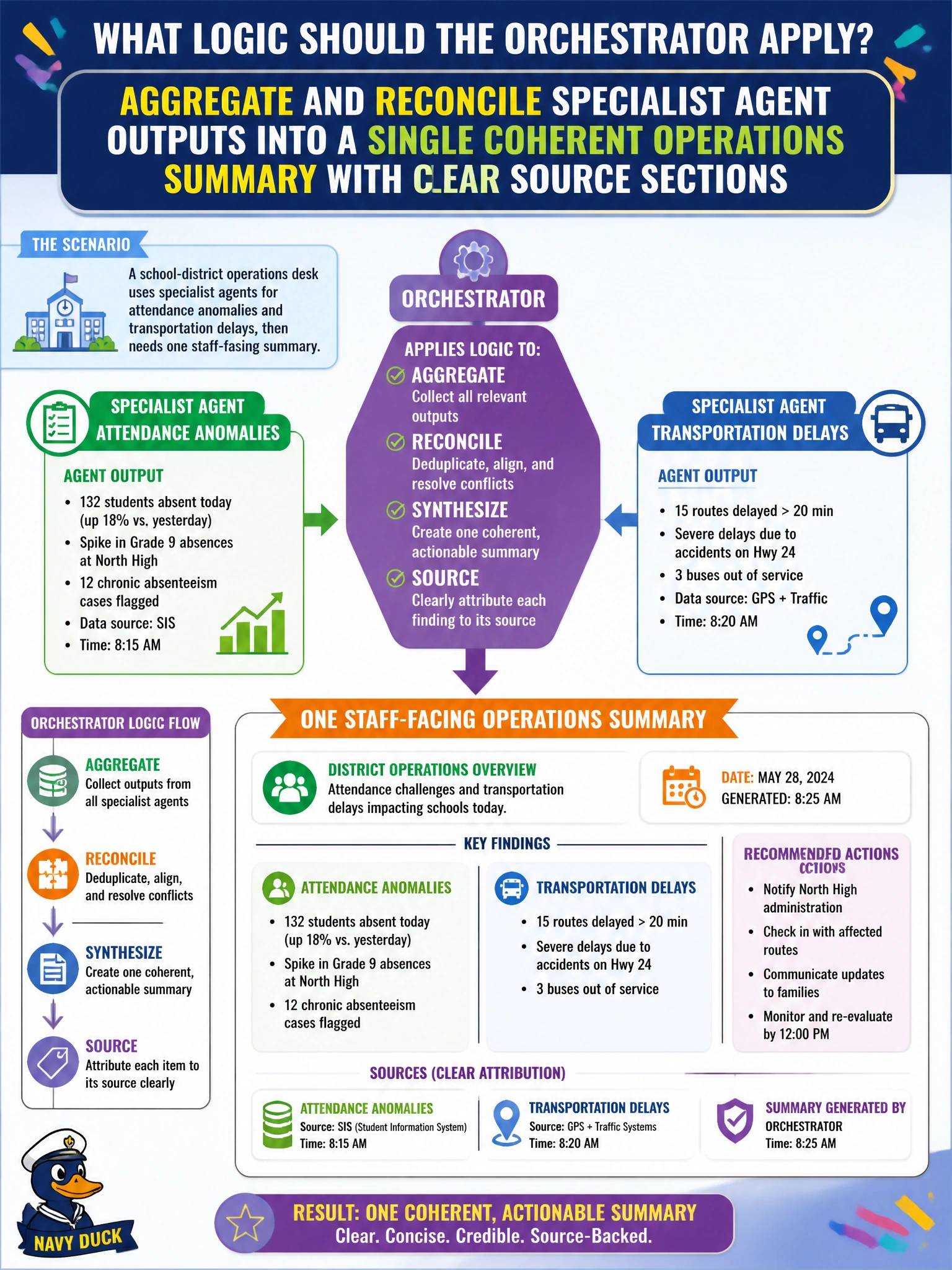
A school-district operations desk uses specialist agents for attendance anomalies and transportation delays, then needs one staff-facing summary. What logic should the orchestrator apply?
Select an answer to reveal the explanation.
Short Explanation
The ops desk wants one brief, not two competing megaphones—attendance agent and bus agent both report in, then a coordinator writes the combined picture. Aggregation with clear source sections beats “whoever finished first.” Raw JSON dumps are not a morning brief.
Full Explanation
School-district operations desks that run specialist agents for attendance anomalies and transportation delays need an orchestrator that aggregates and reconciles those outputs into one coherent staff-facing summary with clear source sections. Aggregation preserves provenance so operators see which findings came from attendance versus buses, resolves conflicts (for example, an attendance drop explained by a known route outage), and produces a usable morning brief. Discarding all specialist outputs to generate an unrelated motivational quote abandons the operational purpose of the desk. Picking whichever specialist finished first and ignoring the other domain loses half the situational picture leaders need. Concatenating raw JSON blobs without summarizing forces humans to parse machine dumps under time pressure instead of acting. Exam caveat: multi-specialist collaboration stems ask for aggregation with provenance—not first-finisher wins, discarded outputs, or raw JSON dumps. Operational check: define a summary schema with attendance and transportation sections, require both specialists before finalizing unless one timed out with an explicit gap note, highlight conflicts for human review, and store the merged brief with source agent versions.