
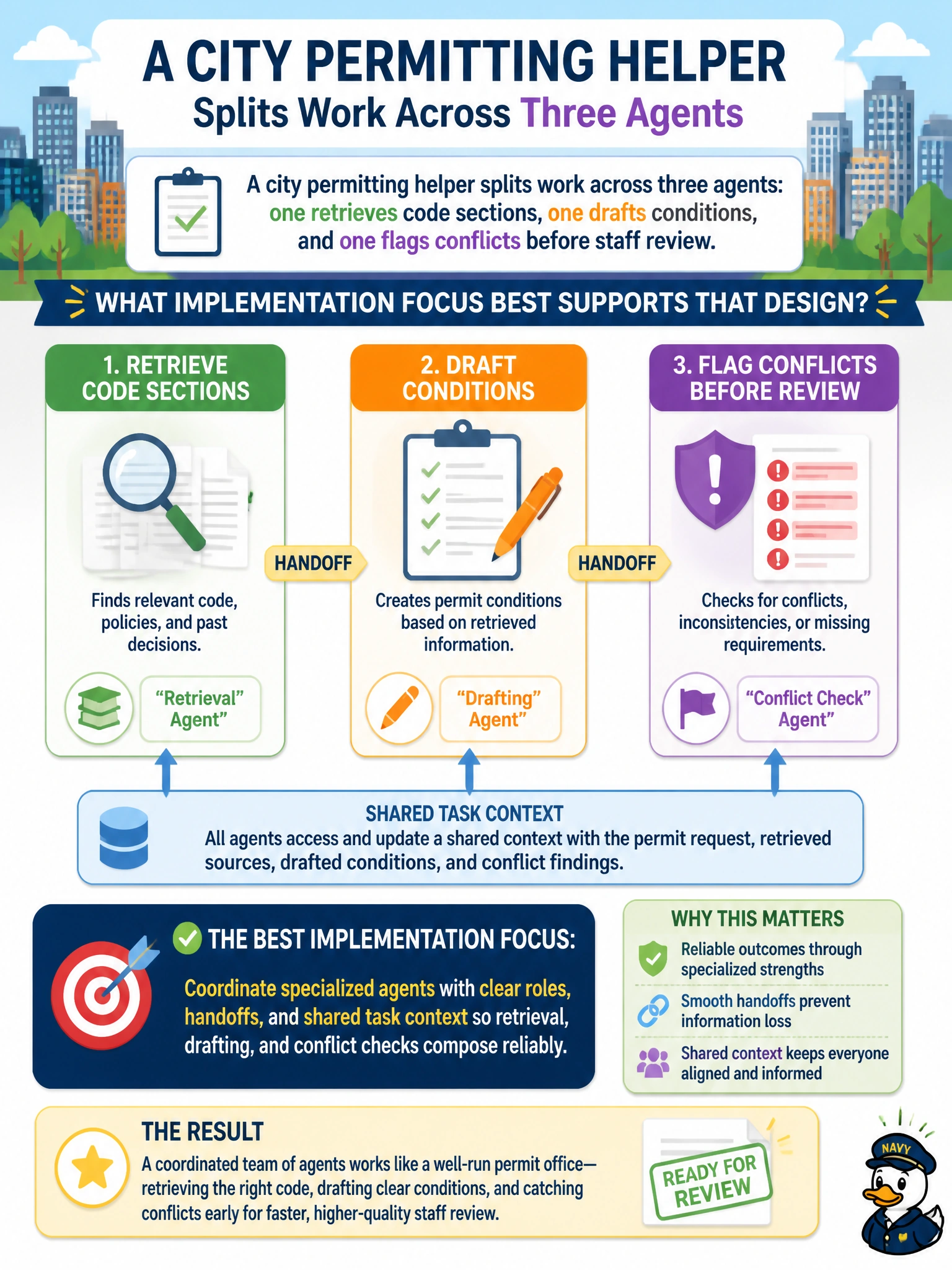
A city permitting helper splits work across three agents: one retrieves code sections, one drafts conditions, and one flags conflicts before staff review. What implementation focus best supports that design?
Select an answer to reveal the explanation.
Short Explanation
Building permits already bounce between plans examiner, conditions writer, and conflict checker—your agents should mirror that handoff, not one mega-clerk doing everything blind. Give each agent a role and a clean pass-off. Alphabetical JSON mashups are not coordination.
Full Explanation
A city permitting helper that splits work across retrieval, drafting, and conflict-flagging agents succeeds only when specialized agents are coordinated with clear roles, handoffs, and shared task context. Role contracts define what each agent receives and emits; shared context carries the permit application ID, retrieved code sections, and draft conditions so the conflict checker reviews the same artifacts staff will see. That composition is the implementation focus for multi-agent civic workflows. Forcing a single agent to call every tool in one opaque step with no handoff contracts loses intermediate inspection and makes failures hard to localize. Training three unrelated classical ML classifiers and abandoning foundation-model agents entirely ignores the stem’s agent design. Merging all outputs by alphabetical sort of raw JSON without task roles is not reconciliation—it destroys semantic structure operators need. Exam caveat: multi-agent stems emphasize role clarity and handoffs with shared context, not opaque monoliths or naive JSON concatenation. Operational check: define typed handoff payloads between agents, persist shared task state, surface each agent’s contribution in the staff UI, and fail the pipeline if a required handoff is missing before human review.