
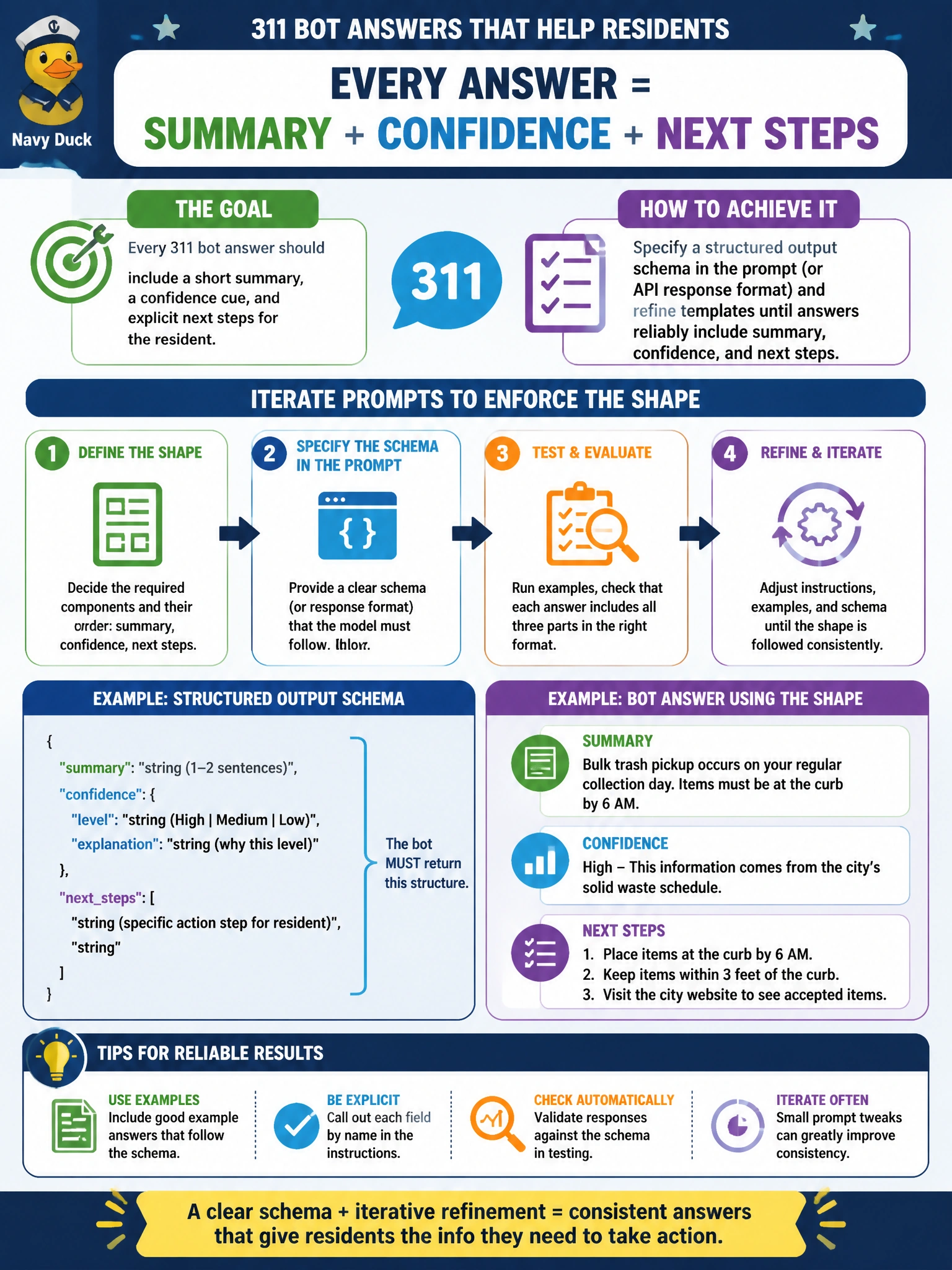
A 311 product owner wants every bot answer to include a short summary, a confidence cue, and explicit next steps for the resident. How should the team iterate prompts to enforce that shape?
Select an answer to reveal the explanation.
Short Explanation
311 scripts already say “what happened, how sure we are, what you do next”—the bot needs that same outline. Put the schema in the prompt and iterate until it sticks. Hoping for layout luck, or making residents reformat, is not product ownership.
Full Explanation
When a 311 product owner requires every bot answer to include a short summary, a confidence cue, and explicit next steps, the team should specify a structured output schema in the prompt or API response format and iterate templates until outputs reliably include those fields. Structured outputs turn a soft style preference into a testable contract for resident-facing consistency. Leaving format unspecified and hoping the model invents a consistent layout produces drift across turns and models. Asking residents to reformat answers in a spreadsheet after each chat shifts product work onto constituents and fails the bot’s job. Removing next-step language because “structured outputs conflict with foundation models” is false—schemas and constrained decoding exist precisely to shape FM responses. Exam caveat: stems that list required answer sections are asking for structured output specification and template refinement, not hope or resident post-processing. Operational check: define JSON or labeled sections for summary, confidence, and next steps; add automated validators in CI against golden 311 transcripts; reject or regenerate nonconforming outputs before display; and track field-completeness metrics in production.