
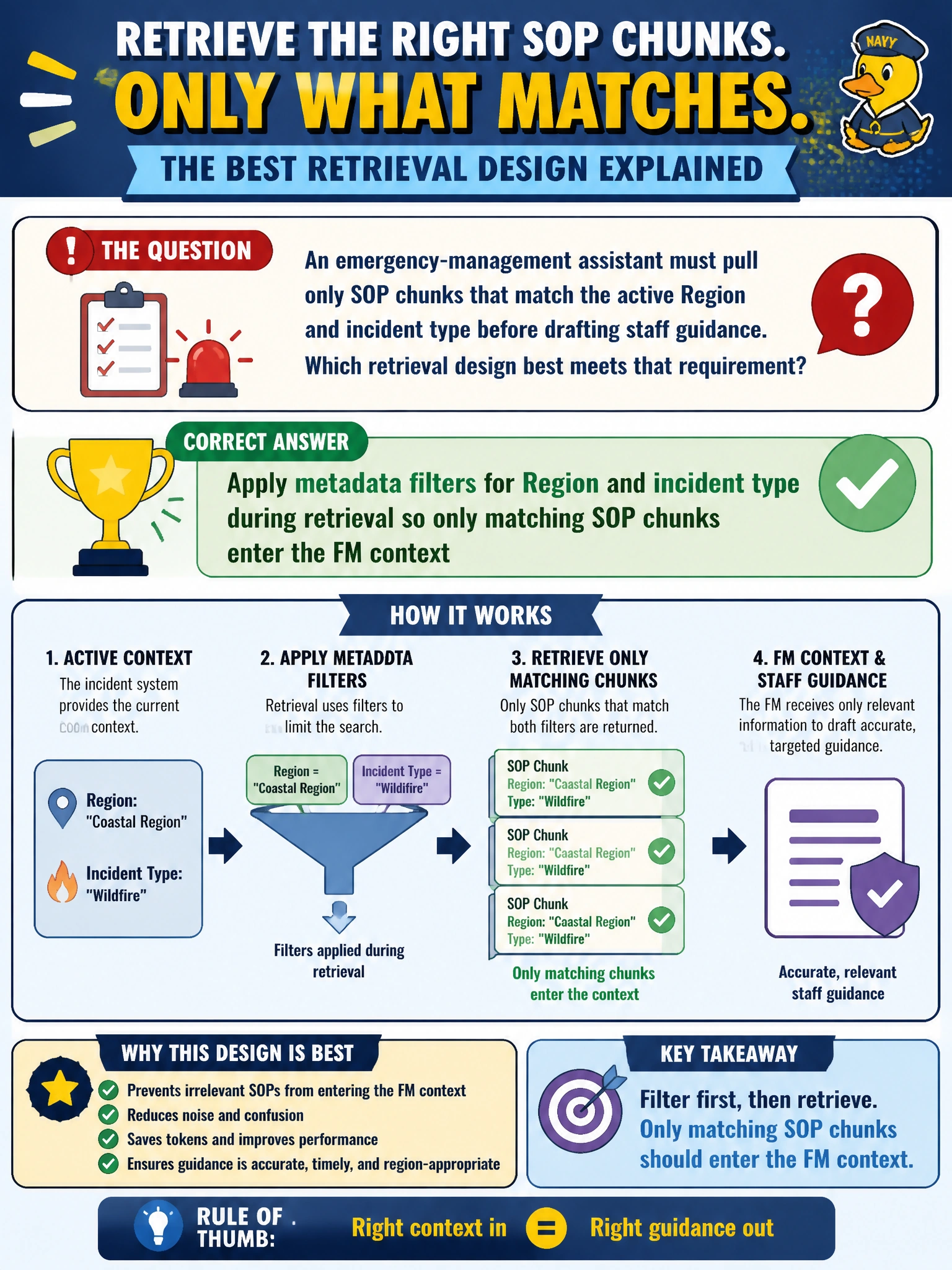
An emergency-management assistant must pull only SOP chunks that match the active Region and incident type before drafting staff guidance. Which retrieval design best meets that requirement?
Select an answer to reveal the explanation.
Short Explanation
Picture a go-bag labeled by storm type and county—you grab the right pouch, not every pouch in the warehouse. Metadata filters do the same for SOP vectors: Region plus incident type keep the wrong binders out of the model’s desk. That is how you keep emergency drafts situational instead of generic.
Full Explanation
Emergency-management assistants drafting staff guidance from SOP libraries must constrain retrieval to the active Region and incident type so only applicable procedures enter the foundation-model context. Metadata filters applied at retrieval time—Region, incident class, and related SOP attributes—are the design that meets that requirement: the vector search returns only matching chunks, precision rises, and cross-incident contamination (wrong county flood SOP during a wildfire) drops. That pattern preserves embeddings and incremental index updates while enforcing situational relevance for civic operations. Raising top-k indiscriminately widens recall without respect to metadata; more wrong SOPs can still reach the prompt and dilute guidance. Disabling embeddings and stuffing the entire SOP PDF library into every FM request blows past practical context limits, increases latency and cost, and still fails to guarantee Region and incident alignment. Fine-tuning a new foundation model from scratch whenever incident-type labels change confuses catalog metadata with model weights—labels belong on documents and filters, not as a reason to retrain. Exam caveat: exam stems that mention Region and incident type are signaling metadata-filtered retrieval, not bigger top-k, full-corpus stuffing, or fine-tuning. Operational check: require Region and incident-type fields on every SOP chunk, fail closed when filters are missing, log which filtered document IDs entered the prompt for after-action review, and periodically sample drafts against the active incident card to confirm no out-of-scope SOPs leaked.