
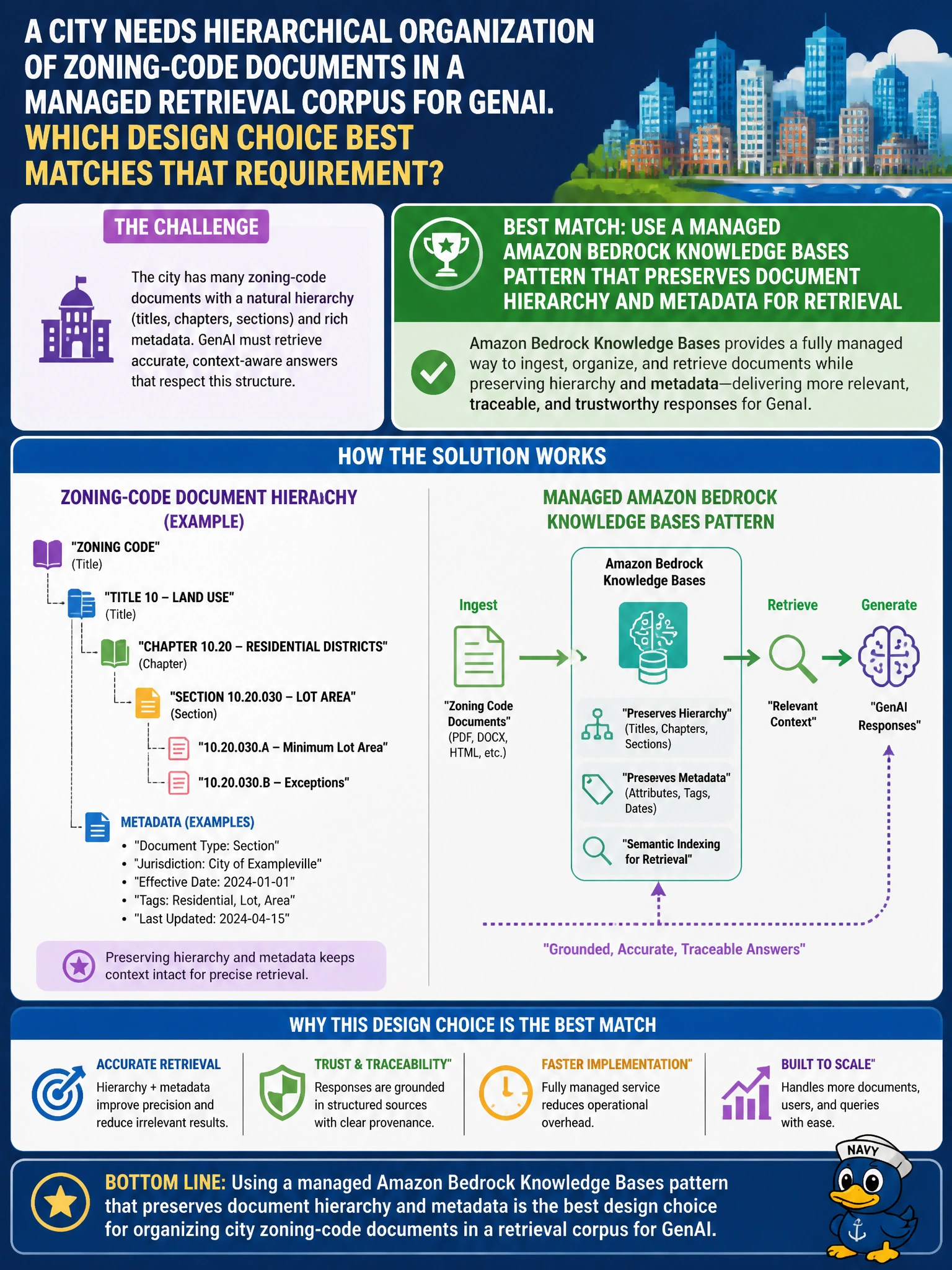
A city needs hierarchical organization of zoning-code documents in a managed retrieval corpus for GenAI. Which design choice best matches that requirement?
Select an answer to reveal the explanation.
Short Explanation
Zoning codes have chapters and sections — treat them like a well-labeled filing cabinet, not a junk pile. A managed Bedrock Knowledge Base keeps that hierarchy so retrieval can find the right shelf.
Full Explanation
Zoning codes are hierarchical—titles, chapters, sections, and cross-references matter for precise GenAI retrieval. A managed Amazon Bedrock Knowledge Bases pattern that preserves document hierarchy and metadata fits a city that needs organized retrieval without building a custom knowledge-platform stack. Hierarchy-aware ingestion lets filters and retrieval respect ordinance structure instead of treating zoning as an unordered blob.
Keeping zoning PDFs only on desktop shares and pasting excerpts manually fails because it is not a managed retrieval corpus and does not scale or audit. Flattening every ordinance into one unordered text file without section or metadata structure fails conceptually by destroying the hierarchy retrieval needs for precise cites. Hosting exclusively on a public CDN without a vector or knowledge-base layer fails because a CDN distributes files; it does not provide semantic retrieval or hierarchy-aware GenAI grounding.
Exam caveat: Managed Knowledge Bases are appropriate when the requirement is organized, metadata-rich retrieval for GenAI—not mere file hosting or ad-hoc paste workflows.
Operational check: verify section/chapter metadata survives ingestion, run retrieval tests that must return the correct zoning section for sample parcel questions, restrict public exposure of draft ordinances, and monitor sync errors when codes are amended.