
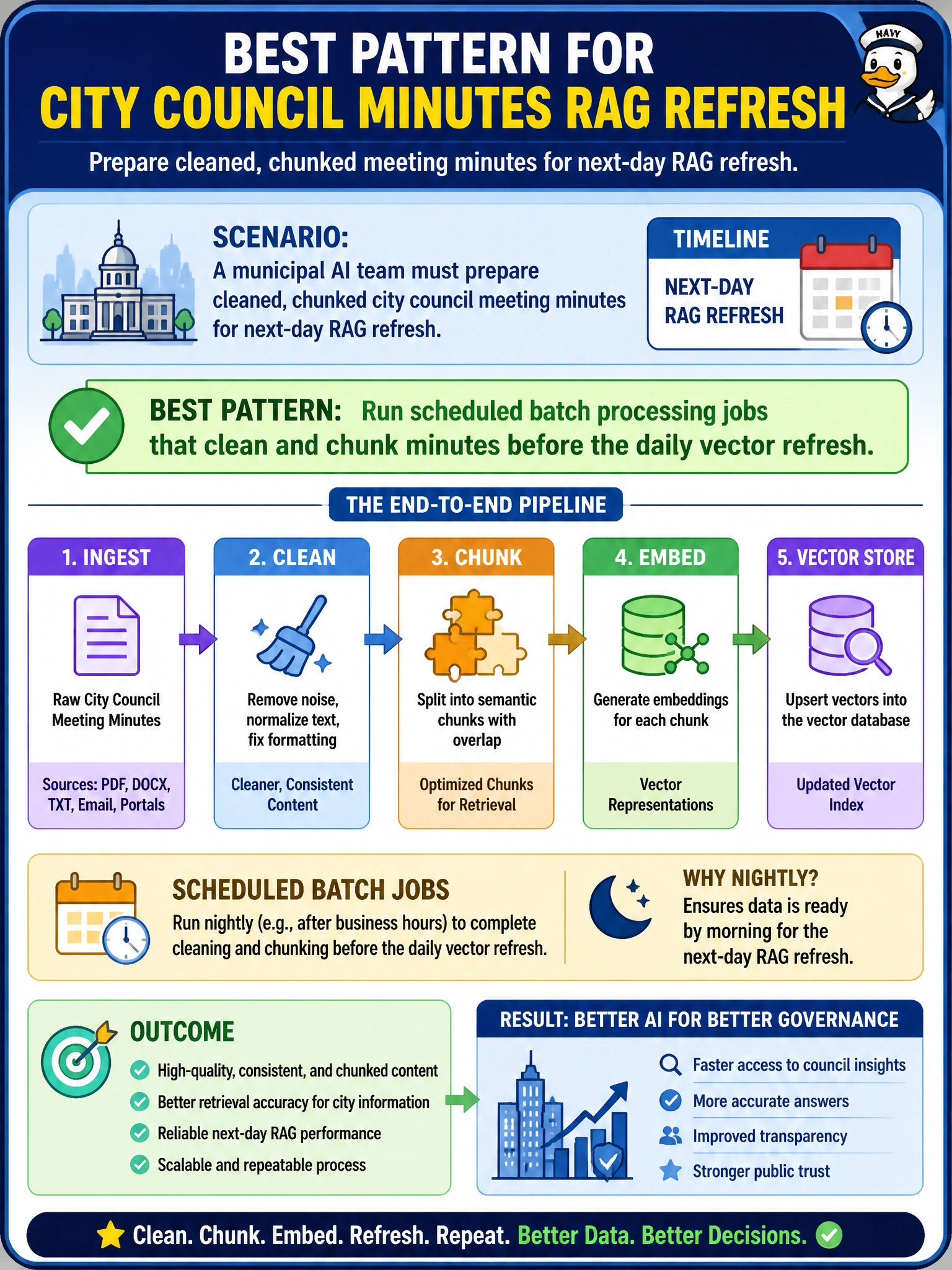
A municipal AI team must prepare cleaned, chunked city council meeting minutes for next-day RAG refresh. Which pattern best fits that workload?
Select an answer to reveal the explanation.
Short Explanation
Night-shift prep, day-shift service. Batch jobs clean and chunk the minutes while the city sleeps so the RAG store wakes up ready — no need to retrain a whole model overnight.
Full Explanation
City council meeting minutes prepared for next-day RAG belong in a scheduled batch pattern: clean text, chunk with structure awareness, then refresh vectors before the service day. Batch jobs fit municipal overnight windows, avoid coupling heavy preprocessing to live resident chats, and produce a stable corpus for retrieval without training a new foundation model. The correct pattern is scheduled batch clean-and-chunk ahead of the daily vector refresh.
Invoking the FM interactively on every raw minute page during daytime chats fails conceptually—it mixes preparation with online serving, adds latency and cost, and still leaves the knowledge base poorly prepared. Training a new foundation model overnight from scratch on the minutes archive fails because RAG refresh is a corpus update problem, not a from-scratch training problem, and is operationally unrealistic for a city team. Storing minutes only as scanned images and skipping text extraction fails because unextracted images cannot populate a text/vector knowledge base for reliable retrieval.
Exam caveat: Distinguish batch corpus preparation for RAG from online inference and from model training. Minutes refresh is ETL-plus-embed, not FM fine-tune-from-scratch.
Operational check: schedule job completion before the refresh cutover, track OCR/extract and chunk counts, fail the refresh if cleaning aborts, smoke-test retrieval on a known motion from yesterday’s meeting, and alert if the vector store age exceeds the next-day SLA.