
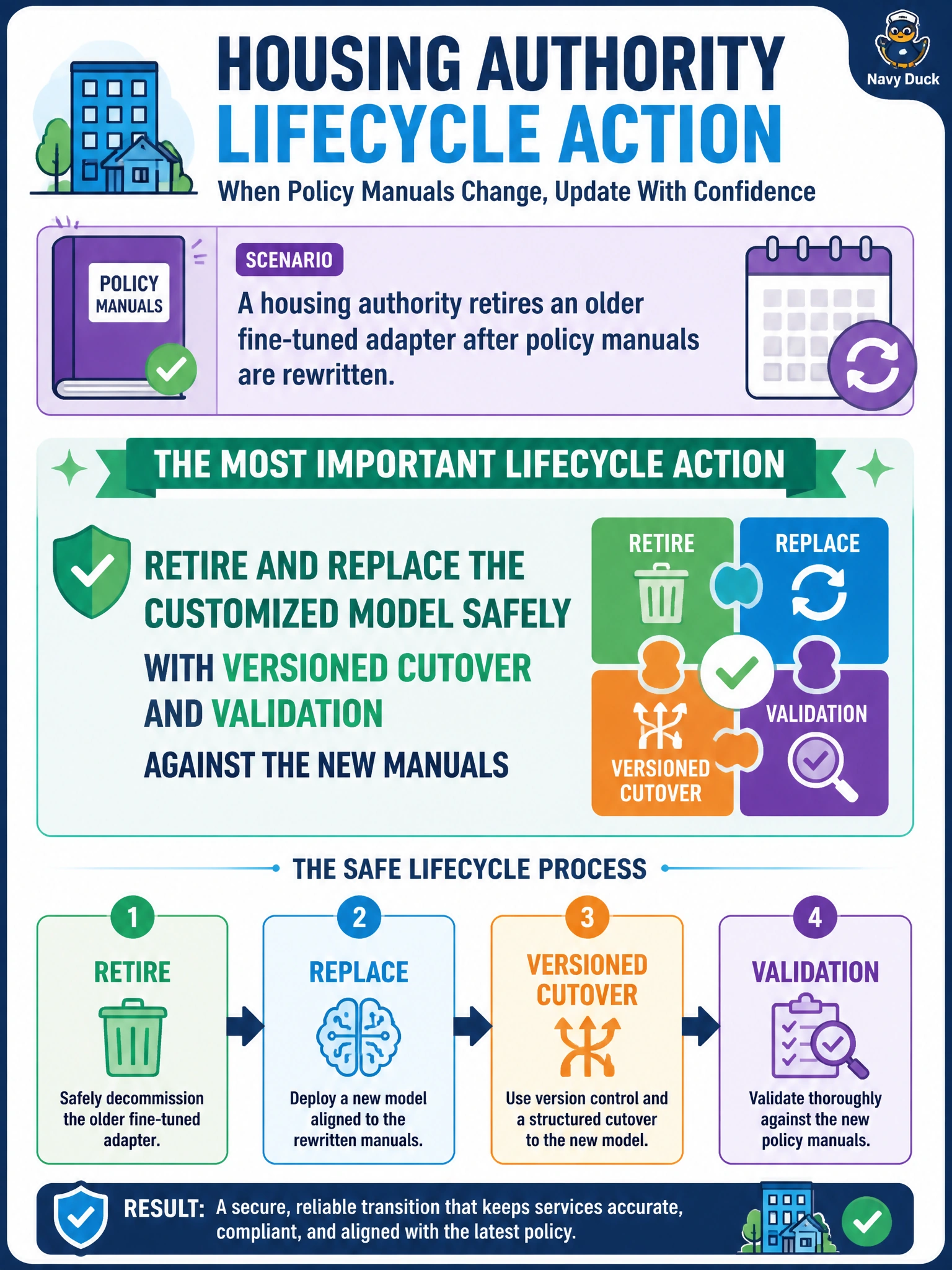
A housing authority retires an older fine-tuned adapter after policy manuals are rewritten. What lifecycle action is most important?
Select an answer to reveal the explanation.
Short Explanation
Old policy language in an old adapter is a trap. Retire it cleanly, cut over to a version that matches the rewritten manuals, and validate before you trust it with live cases.
Full Explanation
When a housing authority retires an older fine-tuned adapter after policy manuals are rewritten, the most important lifecycle action is to retire and replace the customized model safely with versioned cutover and validation against the new manuals. Obsolete adapters still encode old policy language; leaving them live silently misguides casework. Safe retirement means registering a new adapter trained or adapted to the rewritten manuals, validating on representative cases, cutting over traffic, and decommissioning the old version without destroying evidence of what was previously production.
Leaving the obsolete adapter as the silent default for all new cases continues wrong policy phrasing under a false sense of continuity. Keeping the old adapter forever to avoid change tickets prioritizes ticket avoidance over correct policy application. Deleting registry metadata so nobody can prove which adapter was live undermines auditability and incident review when a bad cutover is suspected.
Exam caveat: customized FM lifecycle includes deployment, monitoring, and retirement/replacement—not only initial fine-tuning.
Operational check: validate the new adapter on cases drawn from the rewritten manuals, cut over via registry version pointer, monitor quality/complaints, archive the retired adapter metadata, and confirm no traffic remains on the obsolete default.