
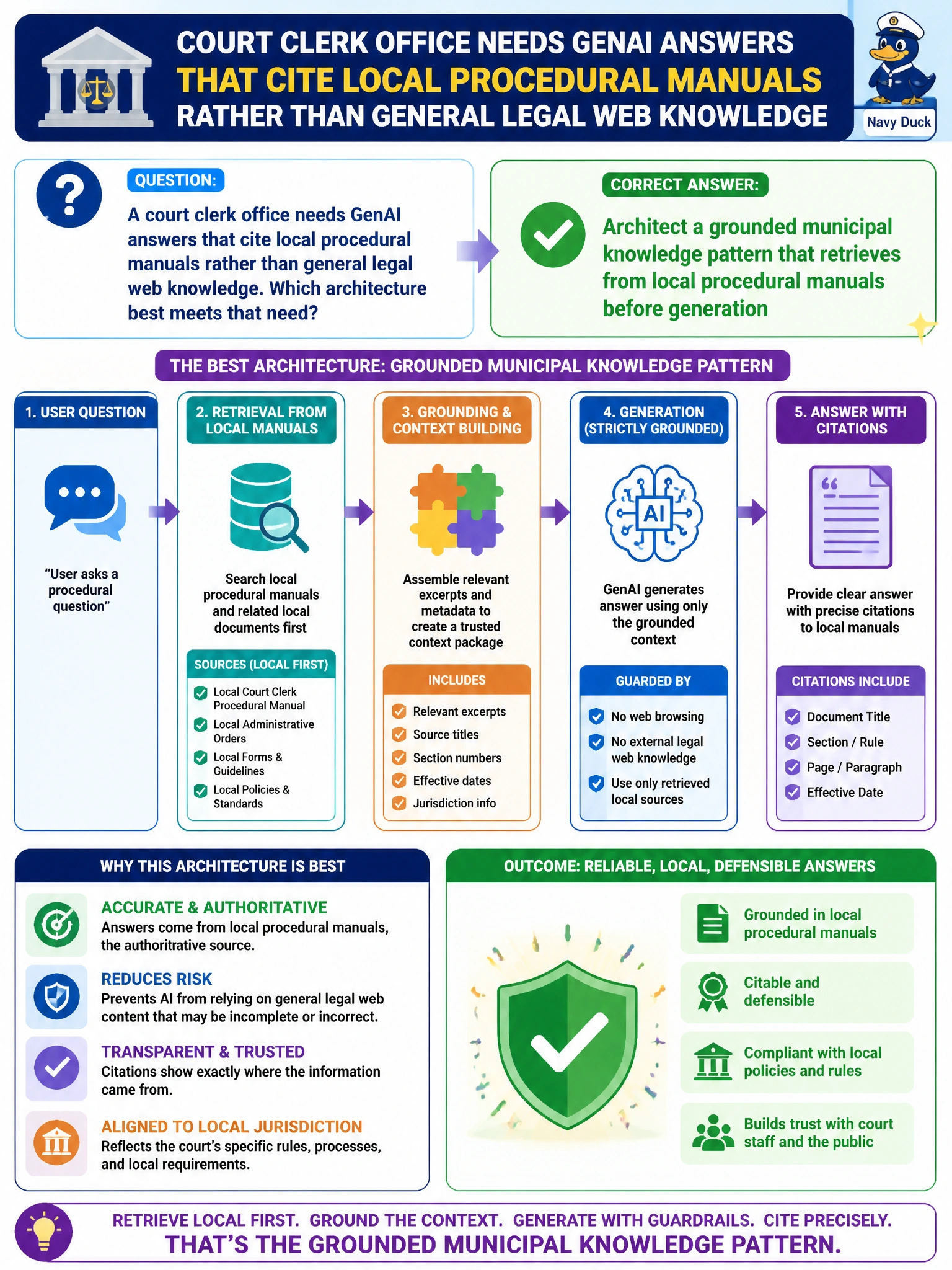
A court clerk office needs GenAI answers that cite local procedural manuals rather than general legal web knowledge. Which architecture best meets that need?
Select an answer to reveal the explanation.
Short Explanation
You need the local playbook, not a general law-blog remix. Ground your assistant in the office’s procedural manuals—retrieve first, then draft—so its citations point to the court’s own guidance.
Full Explanation
A court clerk office that needs answers citing local procedural manuals—not general legal web knowledge—should architect a grounded municipal knowledge pattern that retrieves from those manuals before generation. Retrieval brings the clerk’s authoritative procedures into the model’s context so it can draft with local citations instead of improvising from pretraining or the open web. In court operations, grounding is the difference between an answer that merely sounds legal and one that matches the clerk handbook. An unconstrained general-purpose chat model with web browsing and no local corpus favors broad internet knowledge and does not reliably use the office’s manuals. Disabling retrieval and asking the foundation model to recall nationwide case law from pretraining alone risks hallucinated citations and answers from the wrong jurisdiction. A static PDF search page can help staff find documents, but it cannot draft the clerk-facing summaries the office needs. Exam caveat: when a question emphasizes local or enterprise documents over general knowledge, retrieval-grounded generation is the intended architecture; fine-tuning alone does not guarantee citations to the current manual revision. Practical check: index current procedural manuals, require answers to include retrieved section references, spot-check clerk scenarios against the PDFs, and block web browsing for this workload unless explicitly approved for non-authoritative enrichment.