
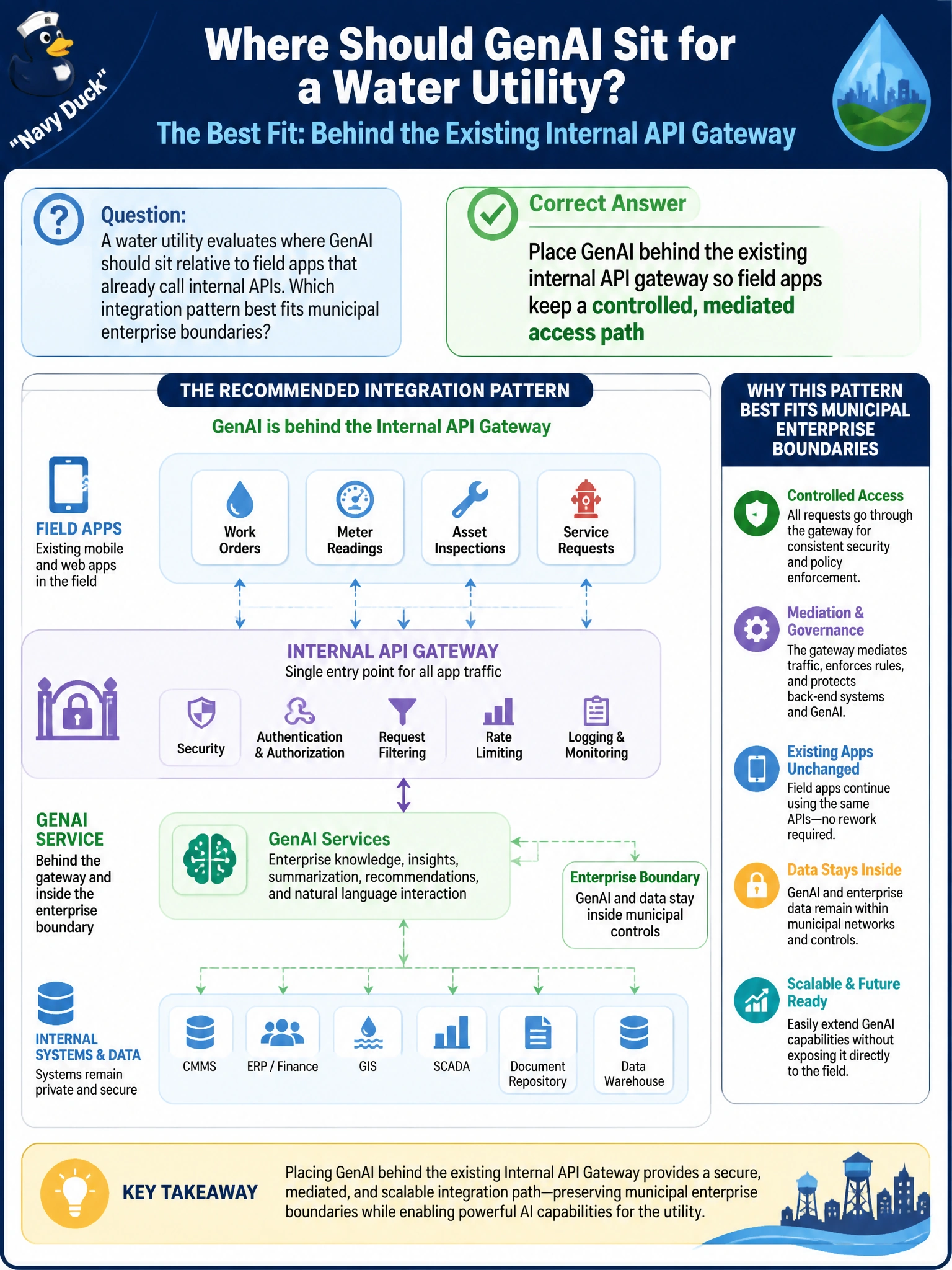
A water utility evaluates where GenAI should sit relative to field apps that already call internal APIs. Which integration pattern best fits municipal enterprise boundaries?
Select an answer to reveal the explanation.
Short Explanation
Field apps already know the utility's front door—the API gateway. Keep GenAI behind that same door so tablets don't smuggle raw model keys or wander onto the public Internet. Mediated access fits how municipal systems usually draw their boundaries.
Full Explanation
When a water utility’s field apps already call internal APIs, the GenAI integration pattern that best fits municipal enterprise boundaries is to place FM access behind the existing internal API gateway so tablets keep a controlled, mediated path. The gateway centralizes authentication, authorization, throttling, audit logging, and policy checks; field apps continue to call familiar internal endpoints while the platform service invokes Amazon Bedrock or other FMs server-side. That preserves the utility’s security perimeter and avoids scattering model credentials across ruggedized devices.
Embedding long-lived foundation-model API keys directly inside every field tablet app breaks key rotation, invites extraction from lost devices, and bypasses centralized authZ. Allowing field apps to call public foundation-model endpoints on the open Internet with no gateway circumvents municipal network controls and makes consistent logging nearly impossible. Requiring crews to paste prompts into a consumer chatbot from personal phones abandons enterprise integration, creates data-handling violations, and cannot be operated as a utility system of record.
Exam caveat: enterprise GenAI on AWS is typically application-mediated (API Gateway / private integration) rather than embedding provider keys in thick clients—especially for OT-adjacent field mobility.
Operational check: expose a utility-owned GenAI API through the existing gateway, keep Bedrock credentials in server-side secrets, enforce IAM/scopes per crew role, and verify field tablets never hold raw FM keys while still completing work-order assist flows.