
A hospital network is scaling an AI clinical-documentation tool across all facilities. Select the two factors most important for the transformation lead to evaluate throughout scaling to protect business continuity and performance. (Select 2.) (Select TWO.)
Select all correct answers, then click Submit.
Short Explanation
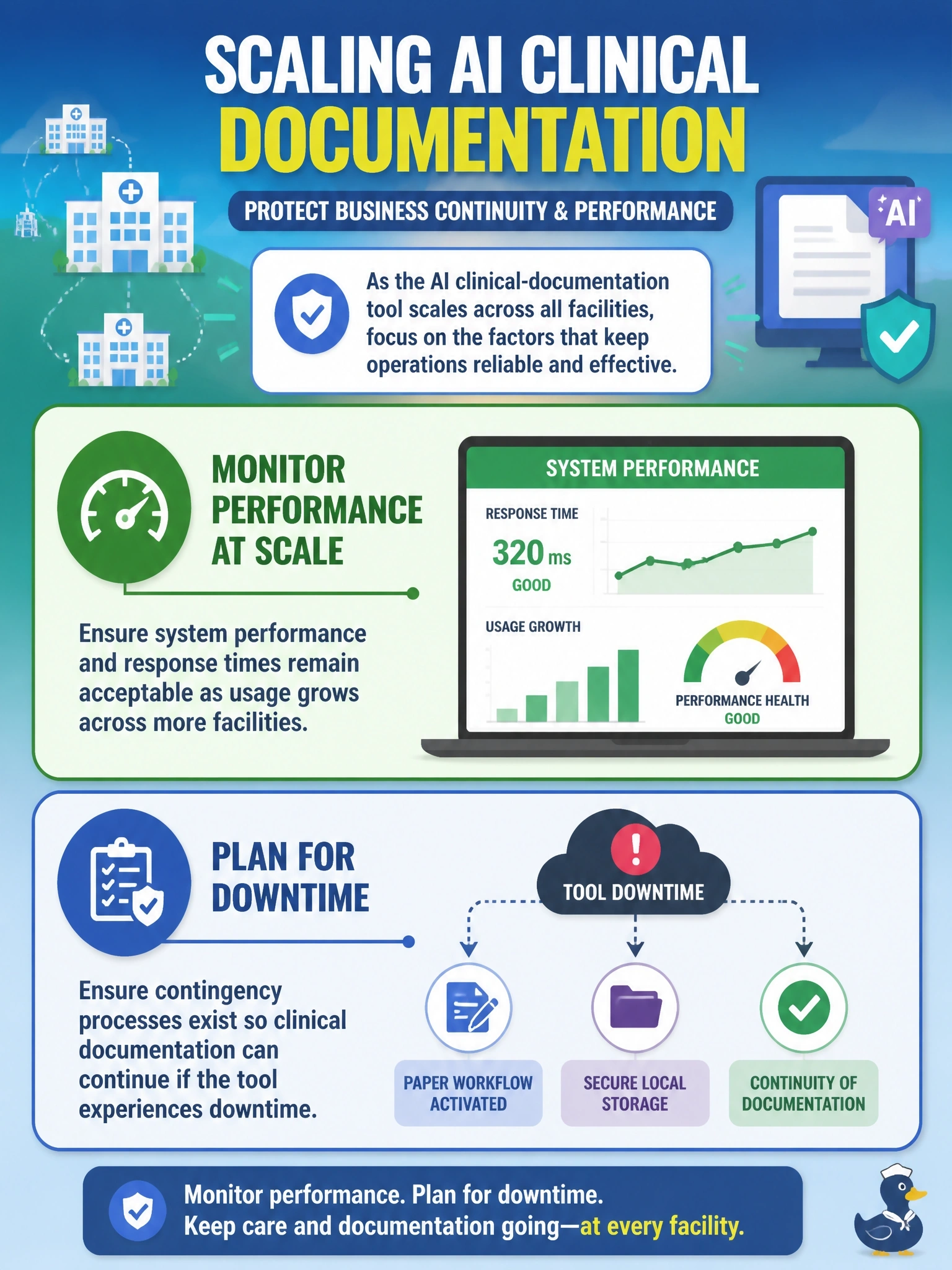
Scaling this tool safely comes down to two questions you need answered for every facility: does performance hold up as more people use it, and can your hospital keep documenting patients if the tool goes down. Vendor market share and identical license counts are noise next to those two.
Full Explanation
Whether system performance and response times remain acceptable as usage grows across more facilities, and whether contingency processes exist so clinical documentation can continue if the tool experiences downtime, are both direct continuity and performance factors that determine whether the network can actually rely on the tool at scale. Requiring the original pilot facility's leadership to personally approve each new facility's rollout creates a bottleneck unrelated to continuity or performance and would slow scaling without a clear benefit to reliability. Whether the tool's vendor has the largest market share among documentation AI vendors is irrelevant, since a vendor's standing among its competitors says nothing about how this specific deployment will perform or hold up operationally within this hospital network. Requiring every facility to use an identical number of AI licenses regardless of its size is an arbitrary uniformity requirement; license counts should reflect each facility's actual size and usage rather than being forced identical, and doing so doesn't protect continuity or performance in any meaningful way. The operational check: continuity and performance evaluation focuses on how the system and the organization's processes hold up under scale, not on vendor reputation or arbitrary standardization rules.