
A community college is reviewing its readiness to deploy an AI advising assistant. Select the TWO statements below that describe capability gaps in GOVERNANCE specifically, as opposed to people, process, or technology gaps. (Select TWO.)
Select all correct answers, then click Submit.
Short Explanation
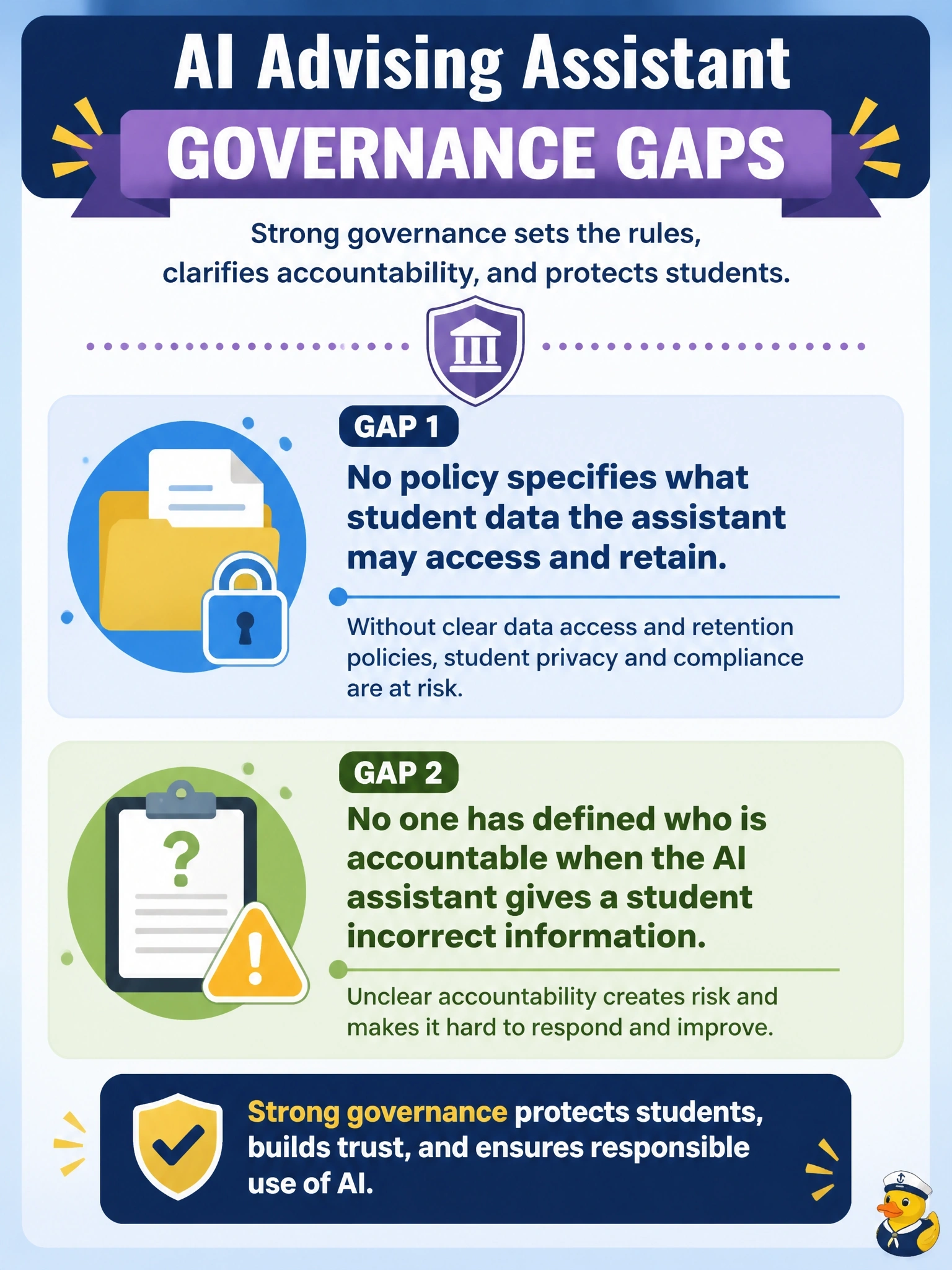
Governance gaps are specifically about missing rules and missing owners, so you're looking for things like no policy on what student data the assistant can touch, and nobody assigned to own the outcome when it gives a student wrong information. Distrust among your advisors is a people issue, and slow servers are a tech issue — neither one is a missing rule.
Full Explanation
No policy specifying what student data the assistant may access and retain, and no one having defined who is accountable when the assistant gives a student incorrect information, are both genuine governance gaps: they describe missing policy and missing accountability structure, which is exactly what governance is responsible for. Advising staff saying they don't trust the assistant's advice describes a people-and-culture signal, not a missing rule or decision right — trust can be low even where policy and accountability are perfectly well defined. Advisors not being trained on how the assistant's recommendations are generated is a skills gap, since it's about staff capability rather than about who owns the outcomes or what data-handling rules exist. The college's servers being unable to support real-time chatbot response times is a technology and capacity limitation, unrelated to policy or accountability. The operational check: when sorting a capability gap into people, process, technology, or governance, ask whether the missing piece is a rule or an owner — if it is, it's governance; if it's a skill, a workflow step, or infrastructure capacity, it belongs to one of the other three categories even in the same overall readiness review.