
A public school district's superintendent wants to deploy an AI tool to flag students at risk of falling behind. Teachers are enthusiastic and have already piloted similar tools informally. However, student records are split across three separate systems (attendance, grades, and counseling notes) that do not share a common student ID, and no policy governs who may access combined student data. Which combination of readiness gaps should the district address first?
Select an answer to reveal the explanation.
Short Explanation
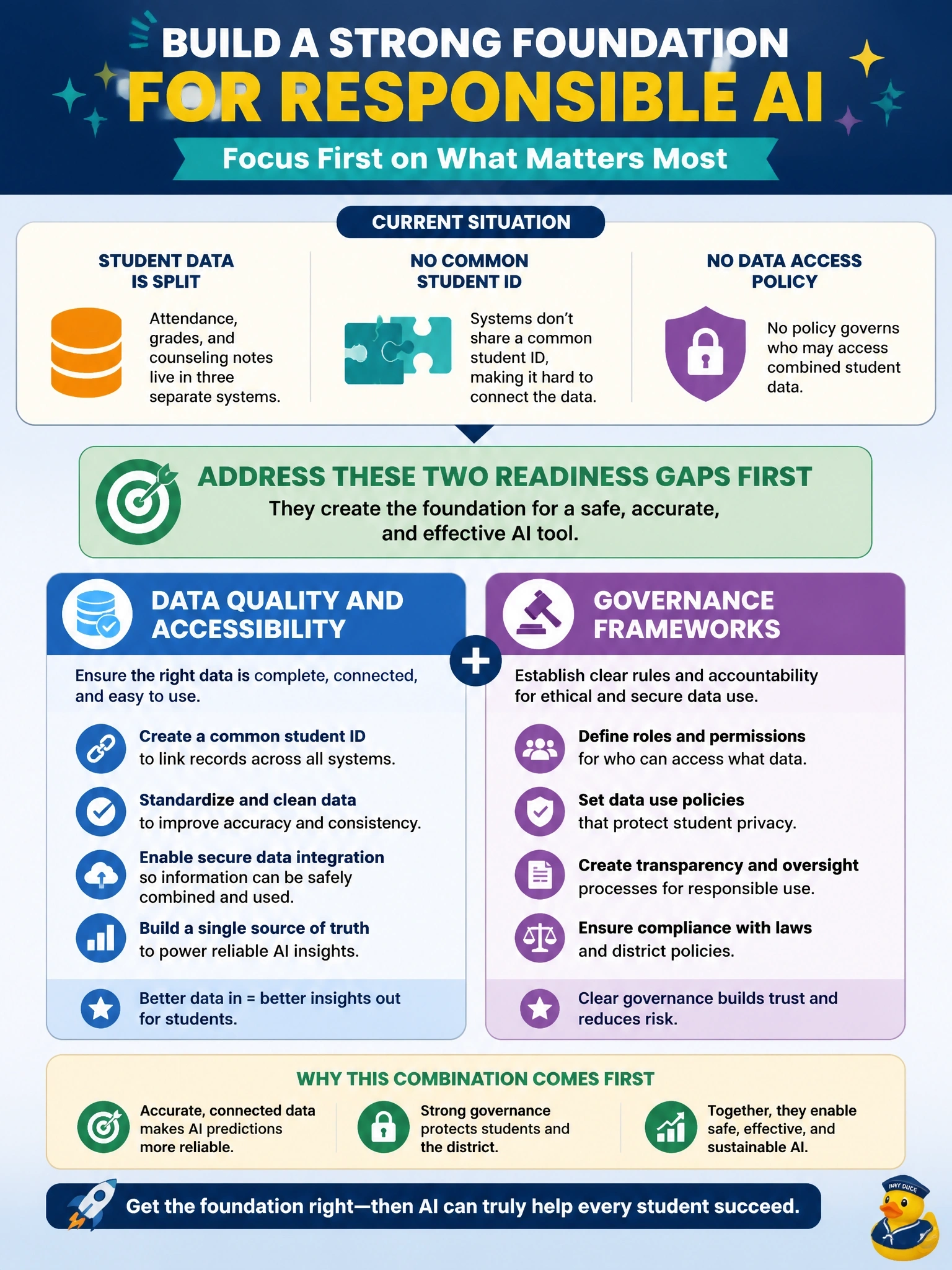
Picture three student databases that don't even agree on a student's ID number: you can't build one risk score out of that, no matter how enthusiastic the teachers are. The real blockers here are data accessibility (mismatched IDs across systems) and governance (no policy on who can see combined student data). Culture and leadership are already strong in this scenario, so they're not what's standing in the way.
Full Explanation
The mismatched student IDs across systems are a data accessibility problem, and the absence of any policy on who may view combined student data is a governance gap. Both must be resolved before a cross-system AI tool can be built responsibly, making data quality/accessibility paired with governance frameworks the right answer. Pairing cultural preparedness with leadership alignment is wrong because the stem describes enthusiastic teachers and a driving superintendent, meaning culture and leadership are not the weak links here. Pairing technical infrastructure with cultural preparedness repeats the same error on culture and adds infrastructure, which the scenario never flags as insufficient — the systems exist and run, they just don't talk to each other. Pairing leadership alignment with technical infrastructure again cites leadership, already shown to be strong, alongside infrastructure, which is unsupported by the facts given. The underlying principle: readiness gaps should be identified from the specific evidence in a scenario, and a strong dimension should never be listed as a priority fix just because it sounds plausible in the abstract.