
An auto manufacturer's steering committee has limited budget and must choose which reliability risk to address first among three flagged AI systems: a supplier-quality forecasting tool showing early signs of model drift as new suppliers onboard, a customer-facing chatbot that occasionally hallucinates minor details about vehicle trim options, and an internal HR tool used only for non-critical scheduling whose data quality has degraded since a recent system migration. Which should the committee prioritize first?
Select an answer to reveal the explanation.
Short Explanation
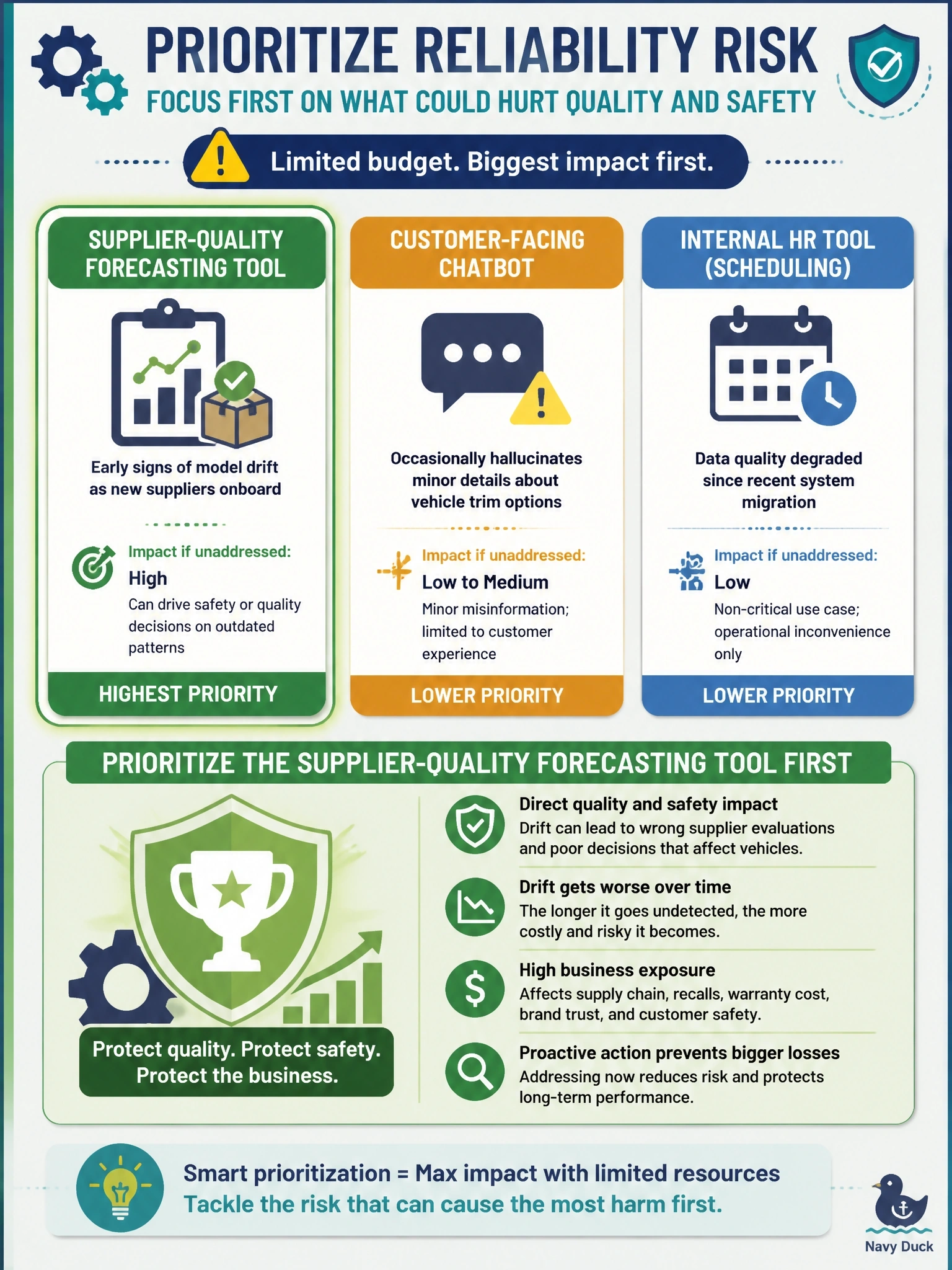
Think of these three risks like patients coming into an ER: you don't treat the paper cut before the internal bleeding, no matter how easy the paper cut is to explain. A forecasting model that's quietly drifting off-target can feed bad decisions straight into vehicle quality and safety, and that's the kind of risk that compounds silently until it's expensive. The chatbot's trim-detail slip-ups and the HR tool's scheduling mess are real, but neither one touches safety the way supplier-quality drift does.
Full Explanation
Prioritizing the supplier-quality forecasting tool is correct because prioritization should follow potential business and safety impact: drift in a tool that informs supplier-quality decisions could affect vehicle quality and safety, which carries materially higher consequences than the other two systems described. Prioritizing the chatbot treats all hallucinations as equally urgent regardless of stakes, but the chatbot's issue is explicitly minor, trim-option details, which is lower-impact than a system tied to supplier quality decisions. Prioritizing the HR tool because it's easy to explain values ease of explanation over actual risk, and choosing a fix because it is simple to justify to auditors is not the same as choosing the fix with the greatest business consequence. Treating all three equally by discovery order ignores differences in severity entirely and would treat a low-stakes scheduling issue the same as a risk with potential safety implications. The general principle: when resources are limited, reliability risks should be prioritized by their potential business and safety impact, not by which tool is public-facing, easiest to address, or discovered first.