
An auto dealership network's financing chatbot was piloted on a small dataset and showed no signs of bias. Nine months after a full rollout, it is found to favor applicants from certain zip codes. What ongoing control should the company have established to catch this kind of issue earlier?
Select an answer to reveal the explanation.
Short Explanation
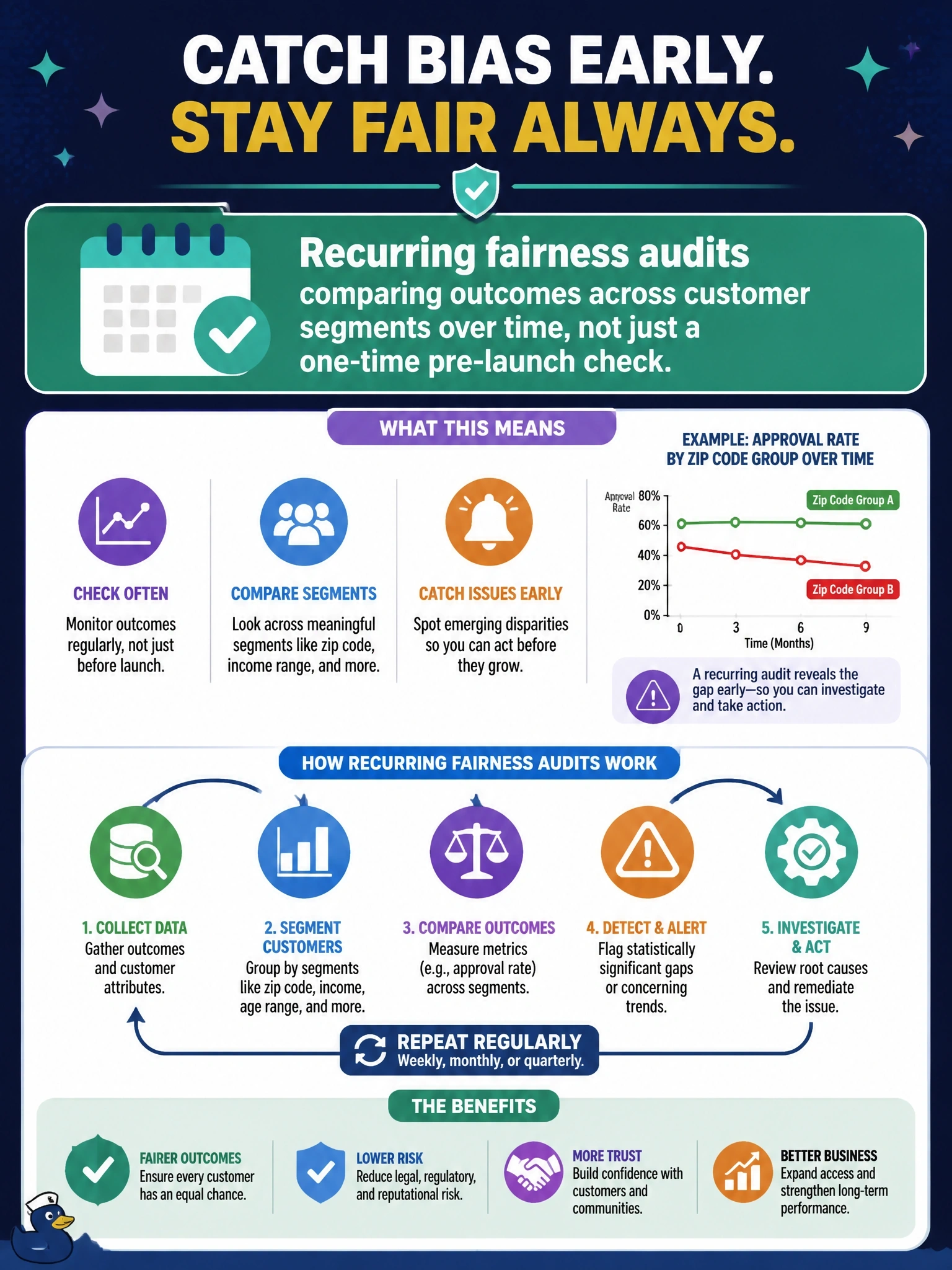
Think of a bias check like a car's alignment — get it right once at the factory, and it can still drift out of true after a few thousand miles of real driving. A tiny pilot dataset doesn't have enough variety to expose patterns that only show up once thousands of real applicants from different zip codes start applying. That's why you need recurring fairness audits comparing outcomes over time, not a single pre-launch stamp of approval.
Full Explanation
Recurring fairness audits are correct because a small pilot dataset may not reveal patterns that only emerge at scale, so ongoing checks across real production data are needed to catch disparities that a one-time check would miss. Relying on a single vendor certification obtained before launch is exactly the gap that allowed nine months of skewed outcomes to go undetected, since that certification could never have reflected conditions the system only encountered at scale. Banning the collection of zip code data going forward does nothing to detect or explain the existing disparity, and outcomes could still be skewed through other correlated factors even without that field. Repeating the pilot annually with the same small dataset just repeats the same already-insufficient sample rather than testing against the larger, more representative population the system now actually serves. The general principle: a pilot's fairness results reflect only the conditions of that pilot, so meaningful bias-drift monitoring requires recurring checks against real, current production outcomes.