
A broadcast network's AI-based ad-targeting tool passed a fairness review before launch. A year later, why does the company still need to monitor it for bias drift rather than treating the pre-launch review as sufficient?
Select an answer to reveal the explanation.
Short Explanation
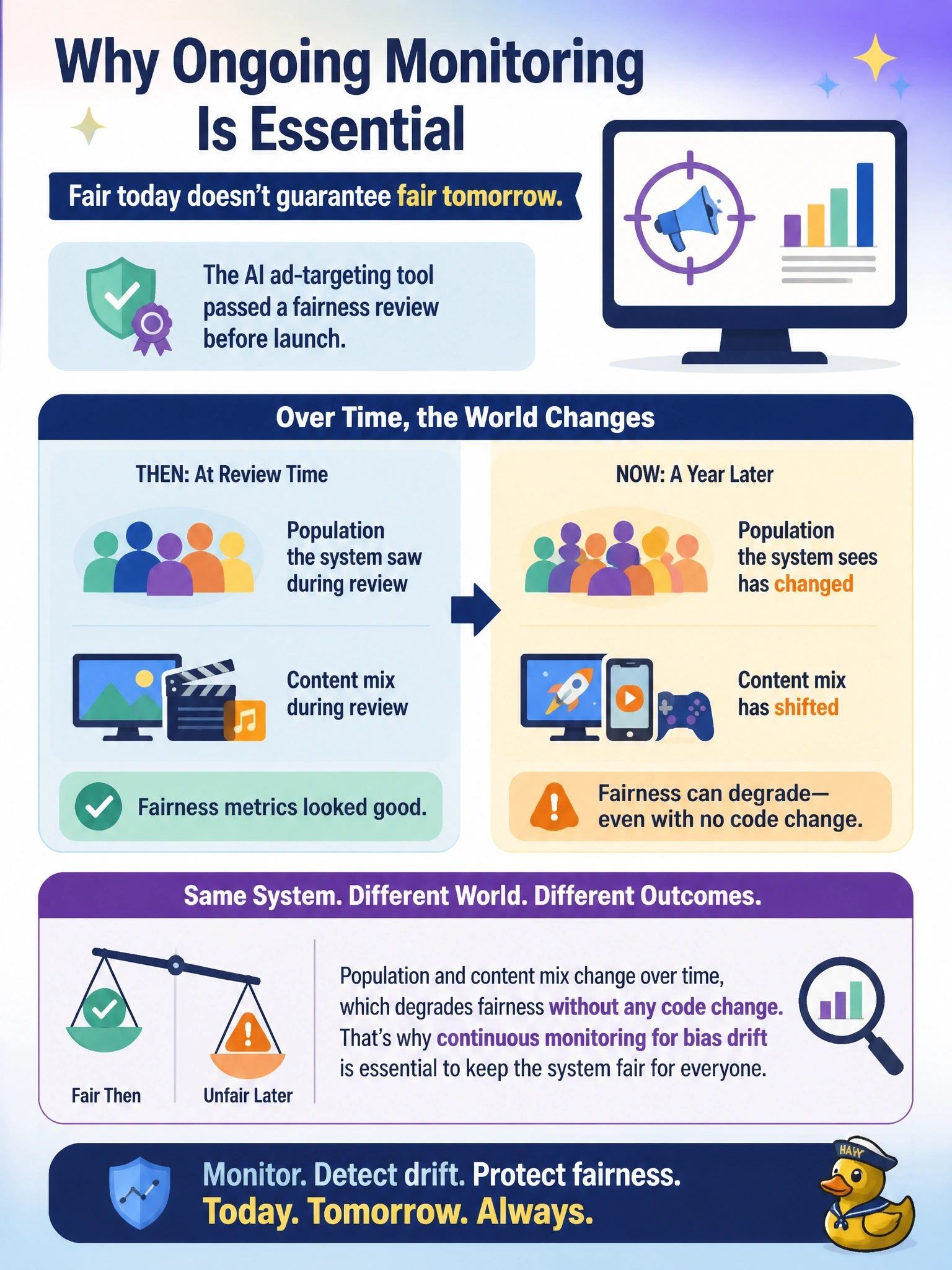
A fairness review is a snapshot, not a warranty—it tells you the system was fair for the audience and content it saw that day. As your viewer base and content mix shift over the following year, the same untouched model can start producing unequal outcomes, which is exactly why drift needs watching, not just a one-time stamp of approval.
Full Explanation
Pointing to the changing population and content mix is correct because fairness is measured against a specific population and context at a point in time; as viewers, advertisers, and content mix shift, the same model can begin producing unequal outcomes even though nothing about its code changed. Claiming bias only needs to be checked once is a common misconception: while the algorithm's code may be static, its inputs are not, so a system can drift into unfair behavior purely from changes in the world around it. Treating monitoring as regulator-triggered reduces it to a compliance checkbox rather than a genuine business and ethical safeguard; waiting for a regulator to ask means problems are found by outsiders instead of caught internally. Handing bias testing to the vendor misapplies the shared responsibility model, which governs infrastructure security and operations, not the fairness of business outcomes produced by a company's own application built on that infrastructure. The general principle: fairness is a property of a system operating in a specific, changing environment, so it must be monitored continuously rather than certified once.