
As a hurricane approaches, a state emergency management agency wants to use a GenAI tool to auto-generate and publish evacuation zone guidance to the public within minutes, rather than following the usual same-day human review and sign-off process. Speed could save lives, but an unreviewed error in evacuation zone boundaries could also endanger the public. What is the best approach?
Select an answer to reveal the explanation.
Short Explanation
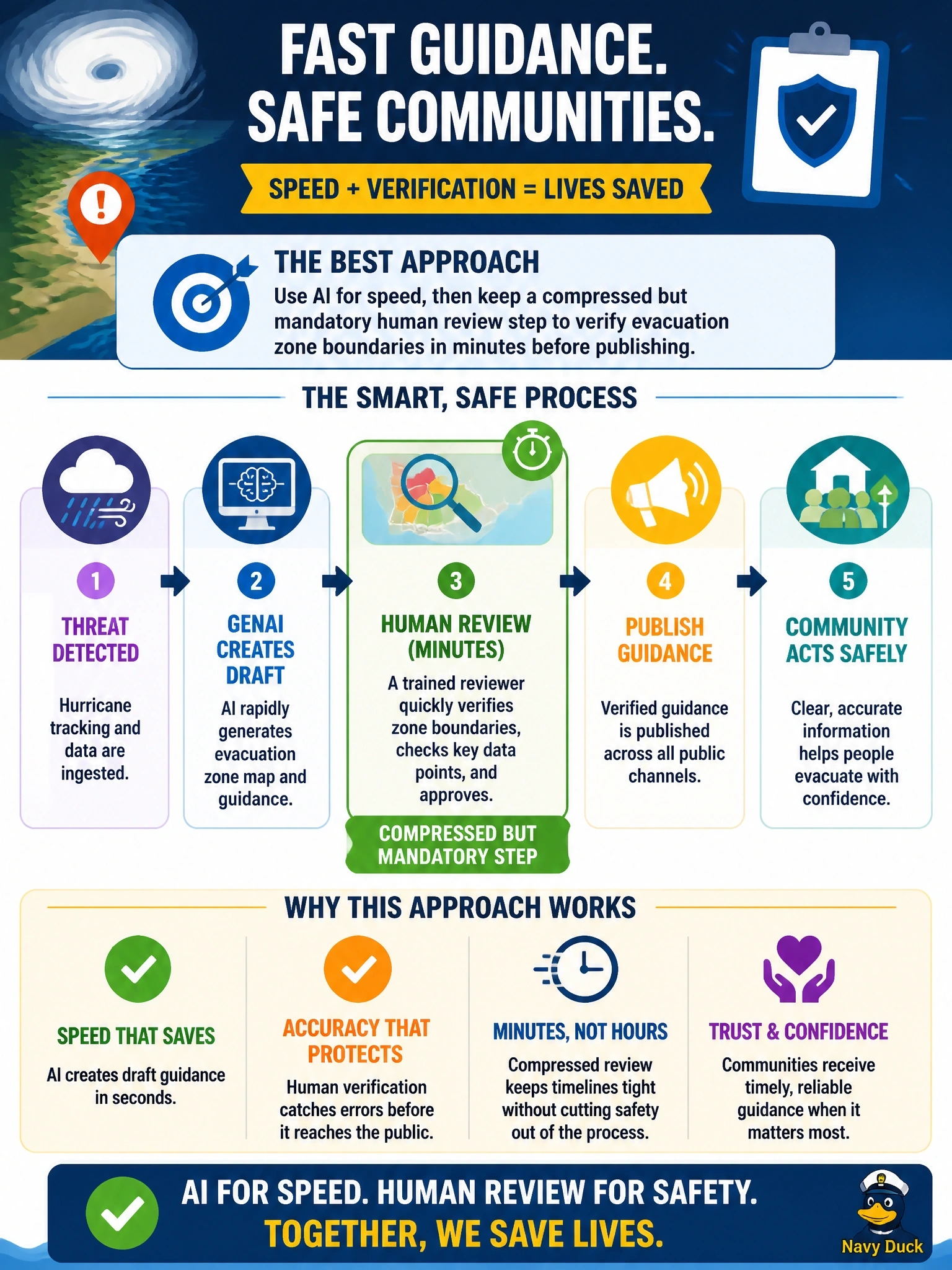
A pilot doesn't skip the pre-flight checklist during an emergency, they just run it faster. Keeping a quick, mandatory human review step on those AI-drafted evacuation zones does exactly that — it compresses the safeguard instead of removing it, so you keep both the speed and the check.
Full Explanation
A compressed human checkpoint keeps the speed the emergency demands while still catching boundary errors before they reach the public, which is the core risk this scenario presents. Publishing the AI-drafted guidance immediately without any review removes all verification for guidance with direct life-safety consequences, an unacceptable risk given how quickly a senior manager could confirm zone boundaries instead of skipping the check entirely. Continuing the full same-day review process unchanged treats the standard process as untouchable even though the emergency itself creates real time pressure with its own safety value, so an unyielding "never rush" answer fails to weigh the actual tradeoff the scenario presents. Publishing immediately and issuing a correction later treats a later fix as an adequate substitute for review, but residents may already have evacuated the wrong area, or failed to evacuate the right one, before any correction reaches them — the harm from an error isn't undone by fixing it afterward. Operational check: when both speed and accuracy carry real safety stakes, look for a way to compress the review step to the minimum time genuinely needed, rather than eliminating it or leaving it at its normal, non-emergency length.