
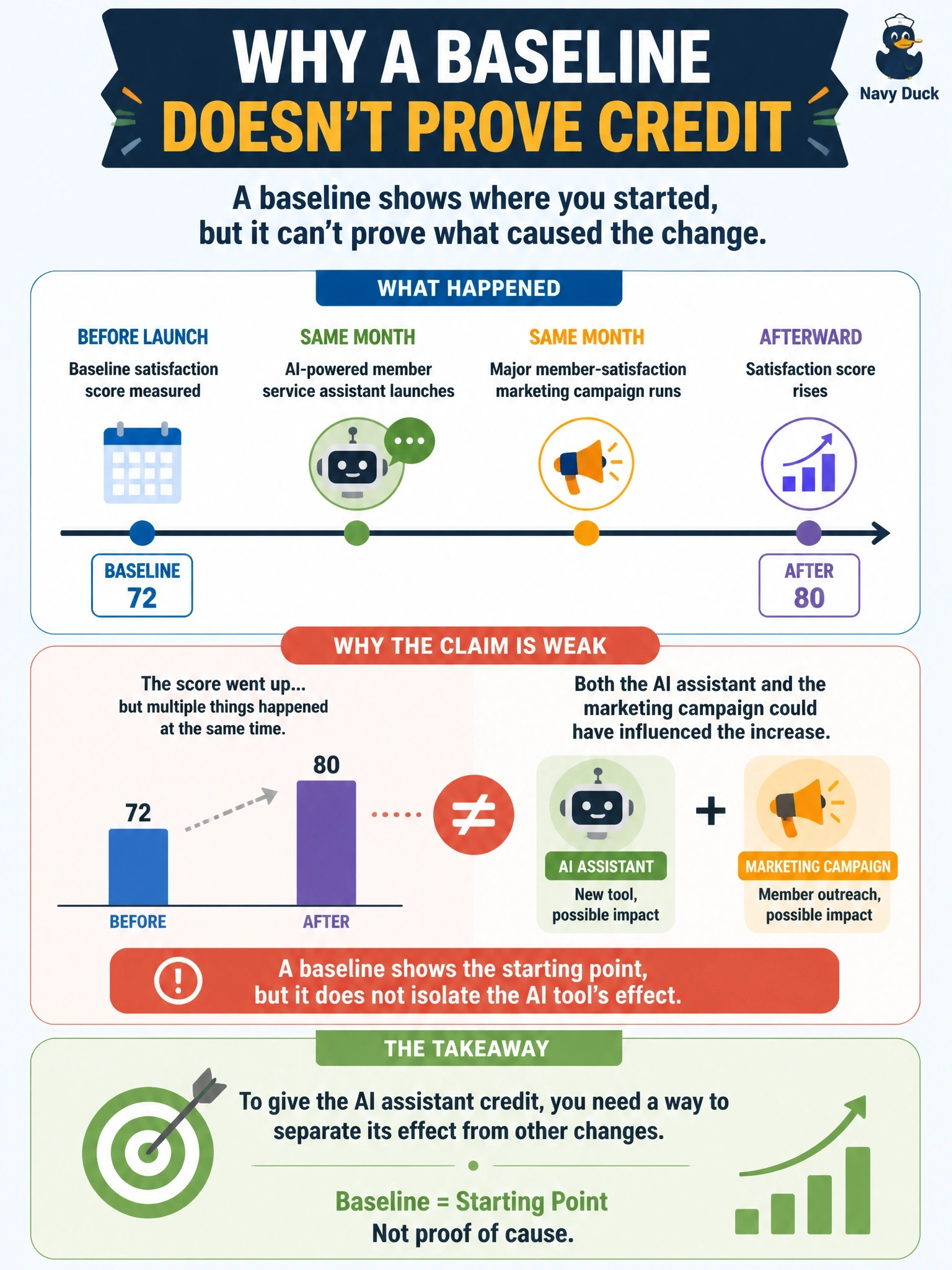
A credit union launches an AI-powered member service assistant. In the same month, marketing also runs a major member-satisfaction campaign unrelated to the AI rollout. Member satisfaction scores rise afterward, and the AI program owner wants to credit the assistant. Why is this claim weak even though a baseline satisfaction score exists from before launch?
Select an answer to reveal the explanation.
Short Explanation
Think of it like this: knowing where you started doesn't tell you what pushed you forward. The credit union has a real baseline, but the marketing campaign landed in the exact same window, so the satisfaction bump could belong to either program, or both. A starting line proves you moved — it doesn't prove who moved you.
Full Explanation
Having a baseline is necessary but not sufficient; it establishes the starting point but doesn't by itself separate the AI assistant's contribution from other concurrent changes like the marketing campaign. To credibly attribute the improvement, the team would need to control for or account for other factors, such as comparing trends before and after each event separately or examining segments untouched by the campaign. The distractor claiming intangible measures can't be baselined is wrong because subjective, perception-based measures can and should be baselined; being subjective doesn't make a metric unmeasurable. The distractor calling the baseline invalid because it predates the tool is wrong because a baseline is supposed to be collected before the tool existed; that's exactly what makes it a baseline in the first place. The distractor attacking survey reliability in general is wrong because it targets the measurement method rather than the actual issue, which is confounding factors, not unreliable data collection. The general principle: a baseline shows where you started, but it doesn't automatically prove causation when other changes occur at the same time as the AI rollout.