
A freight company rolled out an AI dispatch tool six months ago. Leadership now wants proof of ROI, but the team never recorded dispatcher planning time or load assignment accuracy before the rollout. What is the program owner's best next step?
Select an answer to reveal the explanation.
Short Explanation
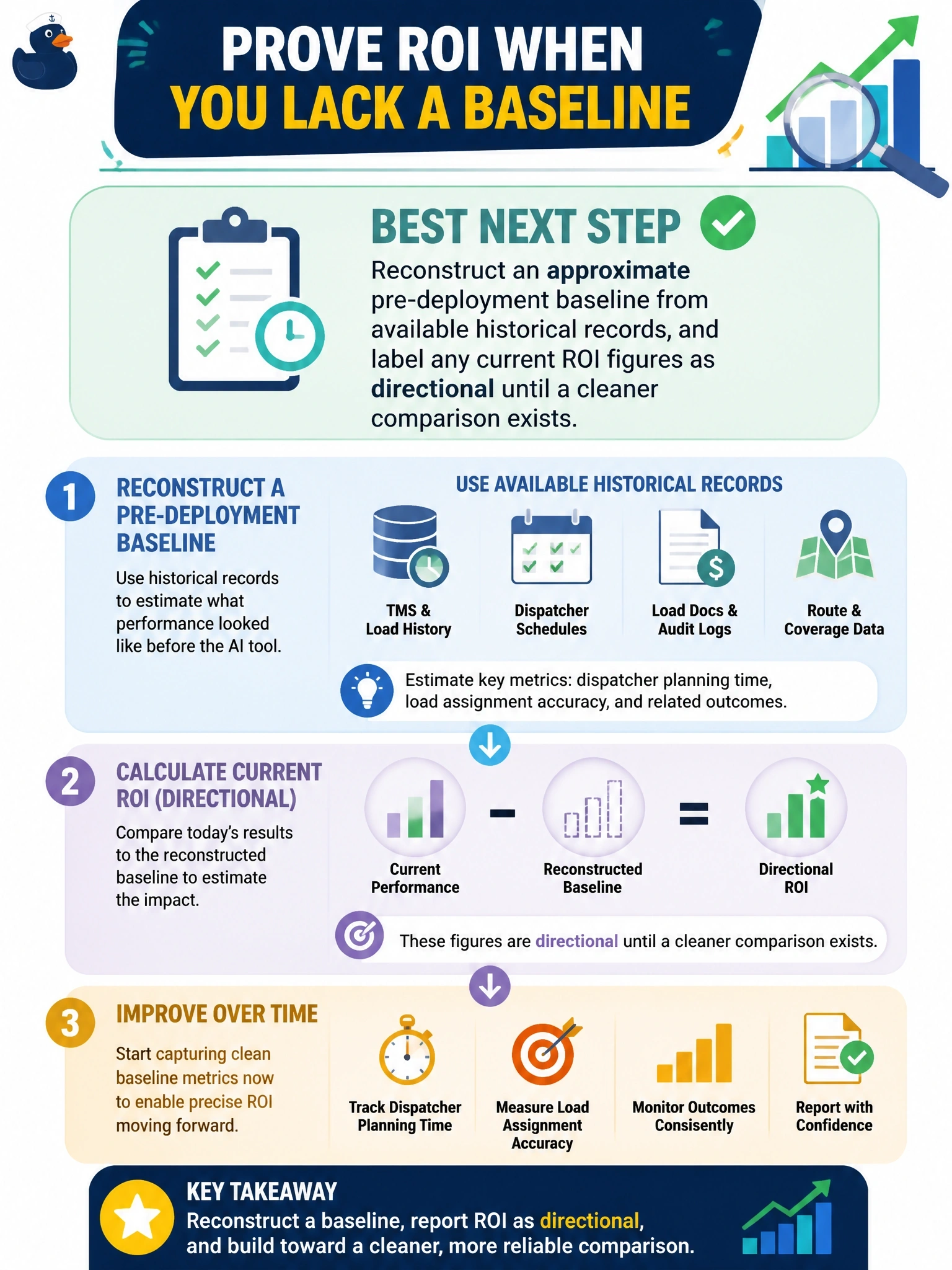
Think of it like this: you missed the starting gun, but the race still happened, so go dig up whatever records exist — old dispatch logs, timesheets, prior reports — and rebuild an approximate starting line. Label the resulting ROI as directional, not final, until you can measure it cleanly. That's more honest, and more useful, than pretending six months of data with no reference point is a finished answer.
Full Explanation
Reconstructing an approximate baseline from historical dispatch logs, timesheets, or prior reporting periods is the most practical way to recover a usable reference point, as long as the resulting ROI figures are labeled as estimates rather than presented with false precision. The distractor reporting six months of current data as the full ROI ignores that there is still no verified comparison point behind it, and presenting it as final would overstate confidence in the number. The distractor of disabling the tool sounds rigorous but is impractical and disruptive: turning off a production tool to create a retroactive baseline risks operational harm and still wouldn't reflect the conditions from six months ago, since dispatch volume and conditions have likely changed. The distractor of postponing all reporting for a year is overly cautious and unnecessarily delays any useful reporting when a reasonable estimate is achievable now. The general principle: when a true baseline was never captured, reconstruct the best available approximation and be transparent about its limitations, rather than overstating certainty or delaying indefinitely.