
A streaming media company's customer support assistant gives outdated answers about which shows are currently available, because availability changes weekly as licensing deals shift. Retraining the underlying model every week would be costly and slow. Which approach best addresses this problem?
Select an answer to reveal the explanation.
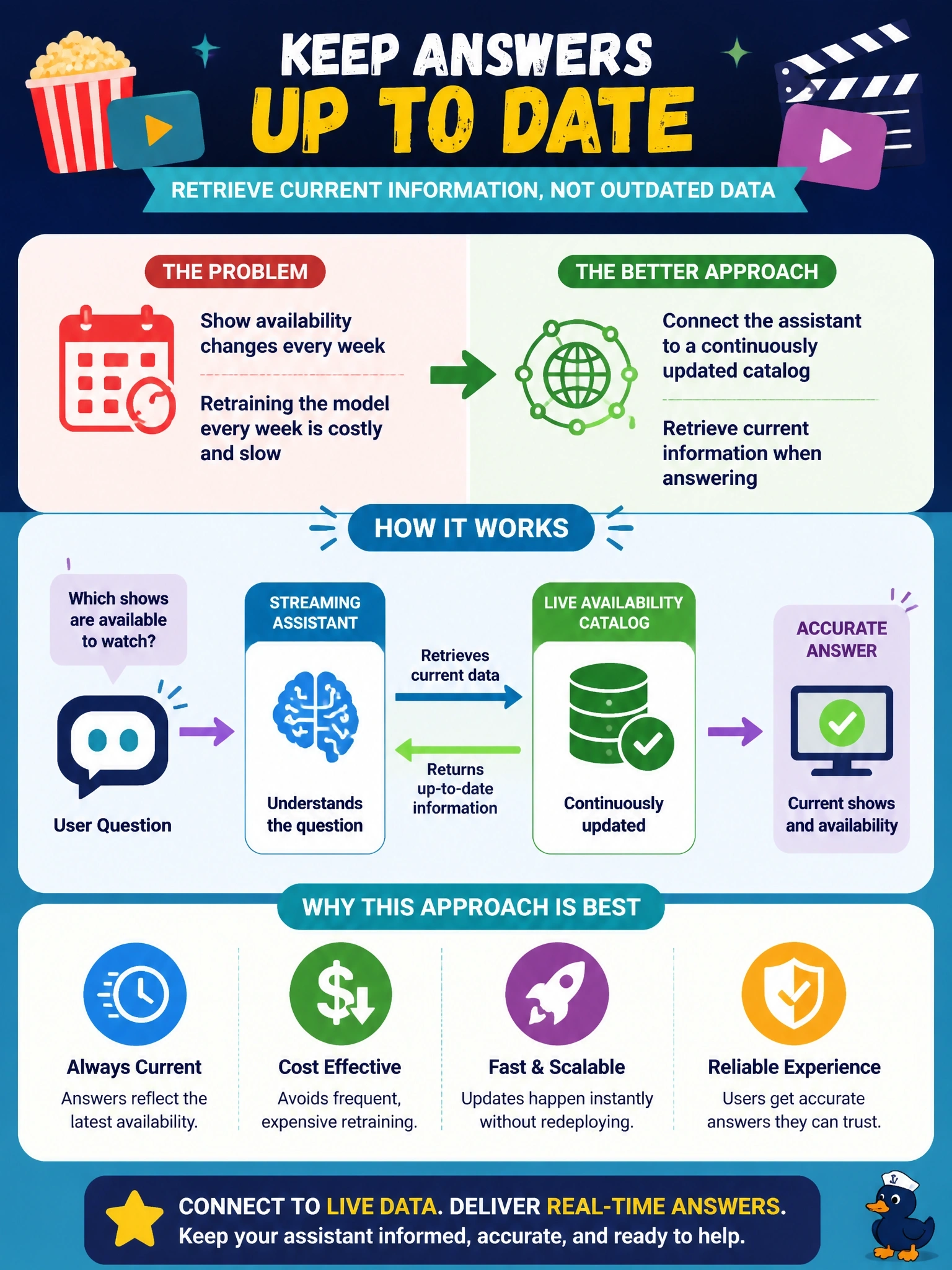
Short Explanation
Think about it like this: your assistant doesn't need to memorize the entire catalog if it can just look it up. Connecting it to a live, continuously updated feed means every answer reflects what's actually available right now, without anyone retraining a thing. That's retrieval in action — current facts pulled fresh, not baked into the model.
Full Explanation
This is a textbook case for retrieval-augmented generation: connecting the assistant to a current, authoritative source of catalog data lets it retrieve up-to-date facts at answer time without retraining, which fits a fast-changing, factual problem well. Fine-tuning the model on the full catalog every week bakes patterns into the model itself and is a poor fit for information that changes weekly — it's exactly the costly, slow cycle the company wants to avoid. Having support staff manually correct every response treats a solvable systems problem as a permanent manual workaround, which doesn't scale and defeats the purpose of automating support in the first place. Throttling the assistant's usage until the catalog changes less often avoids the problem rather than solving it, sacrificing a useful capability instead of fixing the staleness. The generalizable principle: retrieval suits fast-changing, fact-based business needs, while fine-tuning suits stable, style- or pattern-based needs. A quick operational check: if the fix requires editing model weights every time a fact changes, you've picked the wrong tool.