
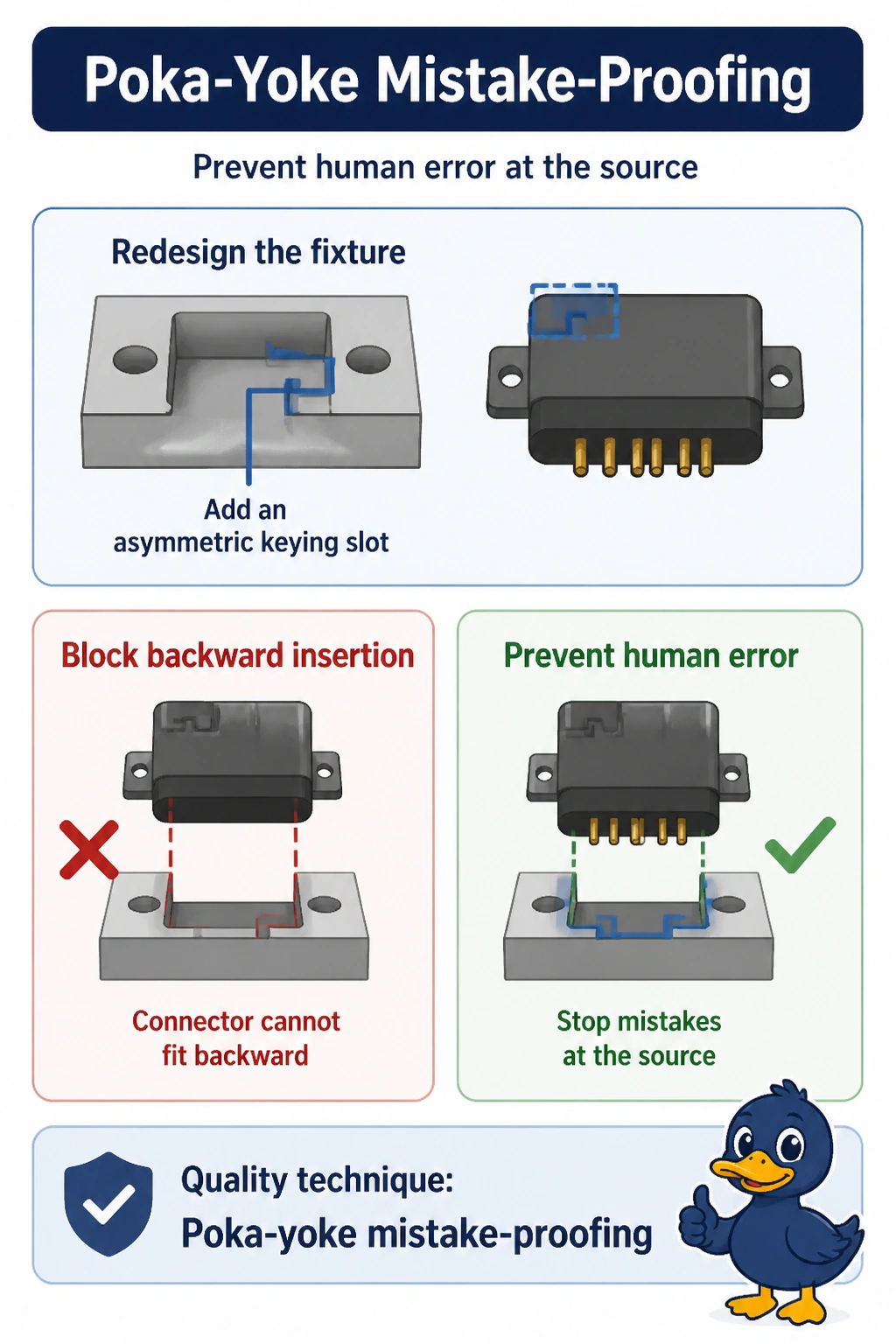
An automotive wire-harness plant repeatedly shipped connectors with reversed pin orientations despite retraining operators twice. Engineering proposes redesigning the assembly fixture with an asymmetric keying slot so a connector physically cannot be inserted backward. Which quality technique does this solution apply?
Select an answer to reveal the explanation.
Short Explanation
When retraining fails, your smartest fix is making the wrong way physically impossible rather than hoping people remember better next time. If the part simply will not fit backward, you have solved the error at its source. Watch out for the trap of confusing workstation mistake-proofing with downstream inspection or data analysis.
Full Explanation
Redesigning the fixture with an asymmetric keying slot applies "Poka-yoke mistake-proofing to prevent human error at the source". Poka-yoke devices use physical shapes, sensors, or interlocks so an operator either cannot make a mistake or receives an immediate signal before a defect passes downstream. By contrast, "Statistical process control to monitor variation after assembly" tracks process stability over time using control charts but does not physically block an operator from inserting a part backward. Using "Acceptance sampling to inspect finished lots before shipment" relies on post-production inspection to catch defects after they have already occurred, which still allows rework and scrap. Applying "Stratification analysis to separate defects across production shifts" helps diagnose where problems cluster in historical data rather than engineering a physical safeguard into the tool. Keep in mind the caveat that even a physical mistake-proofing fixture can wear out or be bypassed if maintenance is neglected. As an operational check during follow-up verification, test the fixture with an intentionally reversed connector to confirm it blocks insertion as designed.
Prefer to study offline? Printable PDF study book + test engine ($7.50, unofficial). These questions stay free here.