
An audit program manager must allocate limited auditor hours across four regional distribution centers for the upcoming year. Center A had zero customer complaints and stable metrics; Center B recently integrated a new warehouse management system and had two shipping errors; Centers C and D operate legacy processes with minor administrative findings. How should the manager prioritize audit frequency?
Select an answer to reveal the explanation.
Short Explanation
Think of audit hours like an emergency-room triage board: you direct attention to the symptoms and recent disruption, rather than dividing it evenly among every waiting chair. You’ll get more risk reduction by focusing on Center B, where the new system and shipping errors signal elevated risk, than by choosing easy fieldwork or postponing audits.
Full Explanation
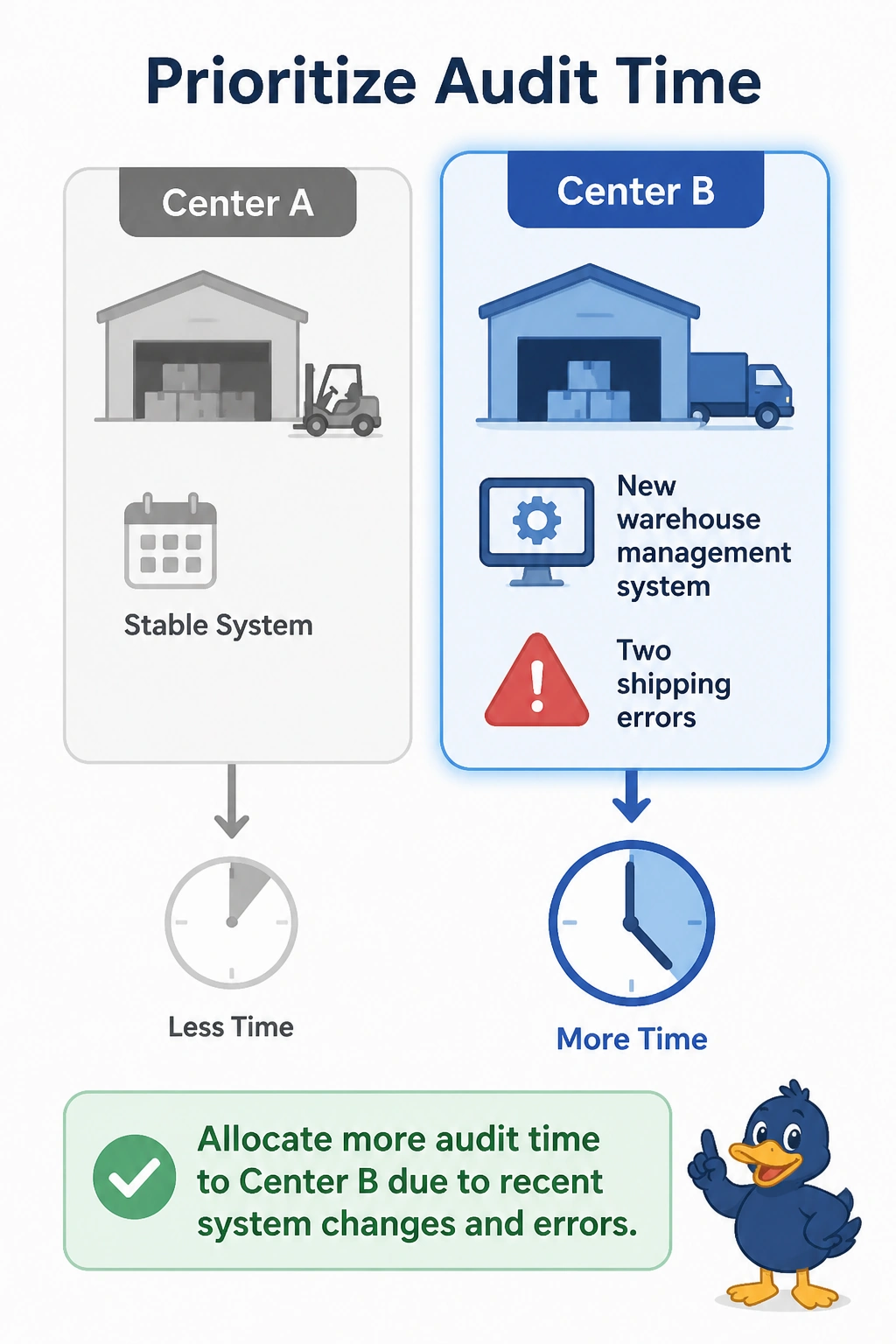
A risk-based audit program directs finite resources toward locations with the highest likelihood and impact of failure. Allocate more audit time to Center B due to recent system changes and errors: the warehouse management system integration and shipping defects indicate process instability that warrants deeper sampling and earlier verification. Scheduling equal audit days at all four centers to ensure complete fairness would spend scarce auditor capacity on lower-risk sites while under-sampling Center B’s known vulnerabilities. Auditing Center A first because its clean record makes fieldwork faster to finish confuses administrative convenience with risk reduction; zero complaints and stable metrics do not outweigh active indicators of change-related risk elsewhere. Deferring all site audits until every center completes its software transitions would create blind spots during the period when controls are most likely to break down. As a caveat, lower-risk centers such as Center A should remain in the multi-year audit cycle, since complacency can erode performance over time. As a practical check, review quarterly defect trends, system change logs, and prior corrective and preventive action (CAPA) closure rates before finalizing the annual schedule.
Prefer to study offline? Printable PDF study book + test engine ($7.50, unofficial). These questions stay free here.