
During a quality system audit at a medical-imaging manufacturer, the receiving and assembly areas are spotless, and the quality director delivers a polished presentation of key metrics. When moving to the complaint-handling department, how should the auditor guard against the halo effect?
Select an answer to reveal the explanation.
Short Explanation
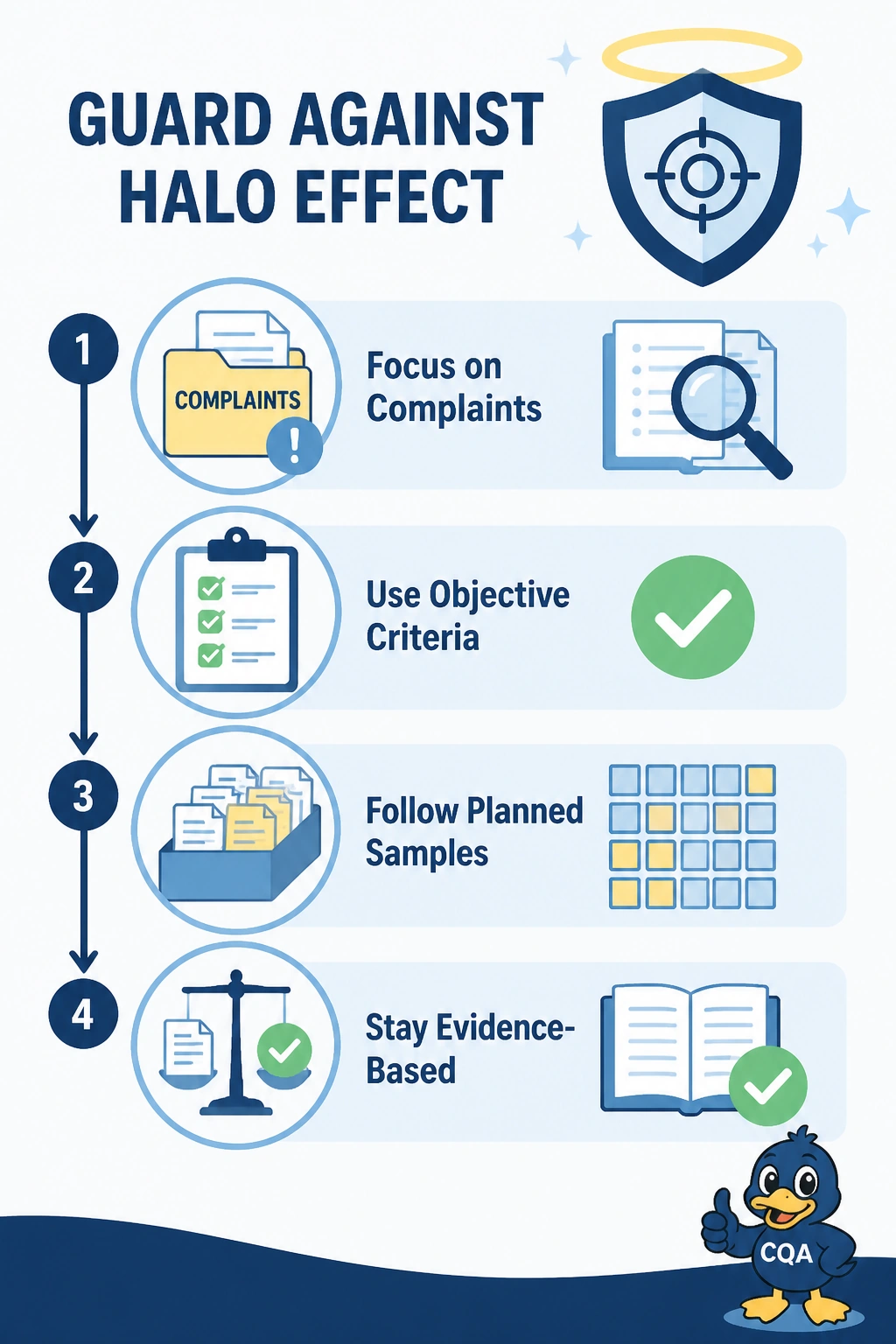
A sparkling lobby and slick slide deck can charm you into lowering your guard! The halo effect tricks auditors into assuming every department runs as smoothly as the first one they saw. You avoid this trap by sticking to your planned sample sizes and judging complaint handling strictly on its own objective evidence.
Full Explanation
The halo effect is a cognitive bias in which an auditor's favorable impression of one area or leader unfairly colors their judgment of unrelated processes. Choosing to Evaluate complaint-handling records strictly against objective audit criteria and planned samples preserves impartiality by forcing every department to stand on its own documented evidence. Conversely, deciding to Reduce sample sizes in complaint handling since the facility's overall quality discipline appears strong allows early positive impressions to weaken audit rigor, potentially hiding serious regulatory gaps in post-market surveillance. Similarly, choosing to Focus primarily on positive compliance examples to stay consistent with the site's strong reputation turns an objective assessment into a confirmation exercise that overlooks nonconformities. Finally, deciding to Skip document verification in complaint handling and rely on the director's summary metrics substitutes high-level management assertions for primary audit trails. As an audit caveat, strong visual housekeeping in manufacturing often has little correlation with administrative compliance in complaint or CAPA workflows. As an operational check, compare your actual sample count and evidence depth in late-day administrative departments against your pre-audit plan to confirm uniform rigor.
Prefer to study offline? Printable PDF study book + test engine ($7.50, unofficial). These questions stay free here.