
During a quality system audit of a wearable glucose-monitor developer, an auditor reviews benchtop electrical tests showing the sensor meets engineering voltage tolerances, alongside clinical usability studies showing patients can read alerts accurately in daily life. How should the auditor classify the clinical usability studies?
Select an answer to reveal the explanation.
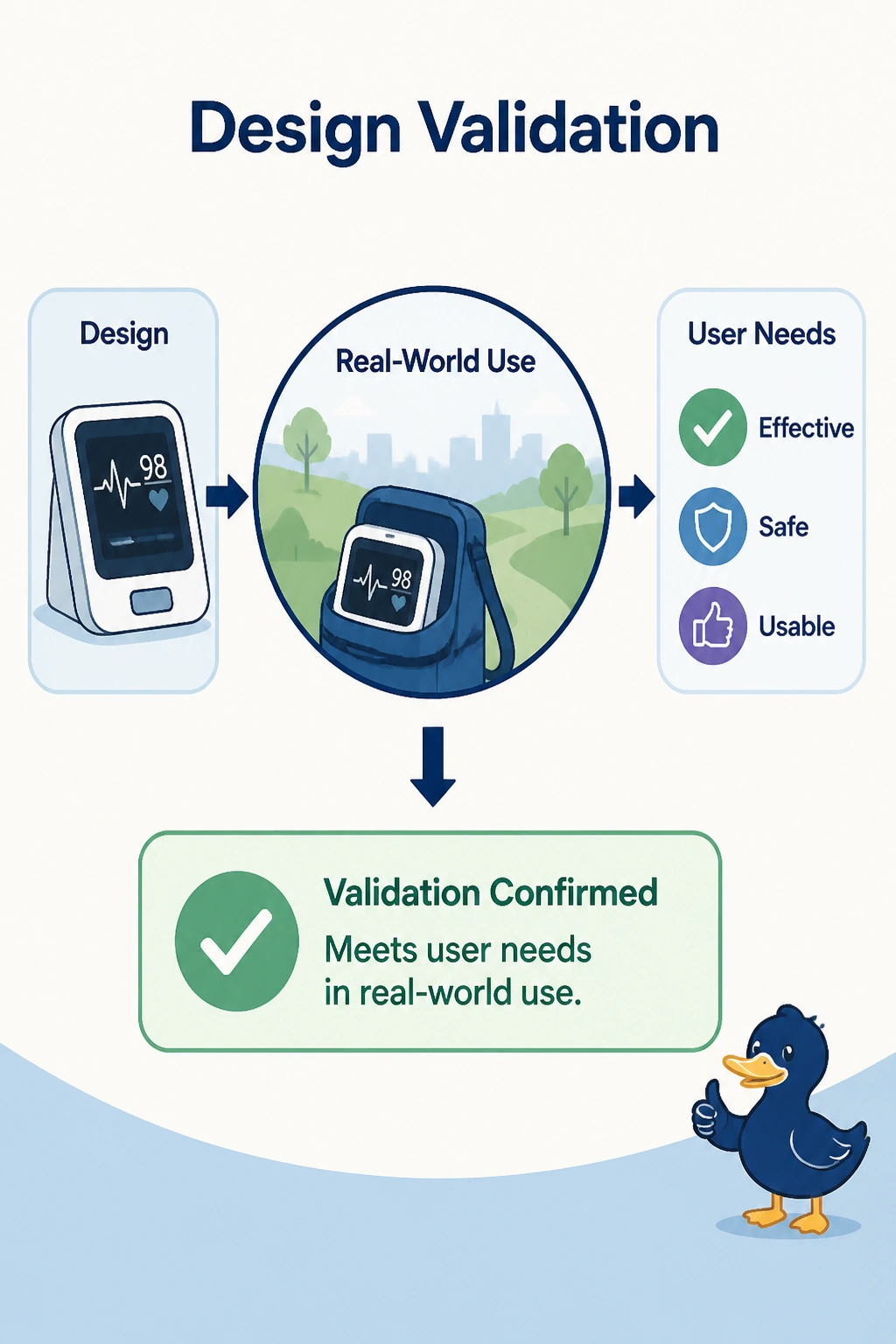
Short Explanation
Verification asks whether you built the product right against specs, while validation asks whether you built the right product for real users. The trap is mixing up benchtop specification checks with real-world usability evidence.
Full Explanation
Choosing Design validation confirming the device meets user needs in real-world use accurately reflects the distinction between validation and verification in quality management. Design validation uses representative devices under actual or simulated use conditions to prove the finished product fulfills intended user needs—such as patients accurately reading alerts in daily life. Choosing Design verification confirming the sensor meets engineering specifications describes the benchtop electrical tests that check outputs against design inputs, not clinical usability. Choosing Incoming receiving inspection confirming component supplier conformance applies to purchased parts entering the warehouse rather than finished-device usability studies. Choosing Process qualification confirming manufacturing line repeatability over time evaluates production equipment stability rather than whether patients can use the device effectively. As a caveat, both verification and validation records are required before design transfer, and an auditor should check that usability studies tested final production-equivalent units. As an operational check, trace the design history file to confirm that usability-study findings fed back into final labeling and interface controls.
Prefer to study offline? Printable PDF study book + test engine ($7.50, unofficial). These questions stay free here.