
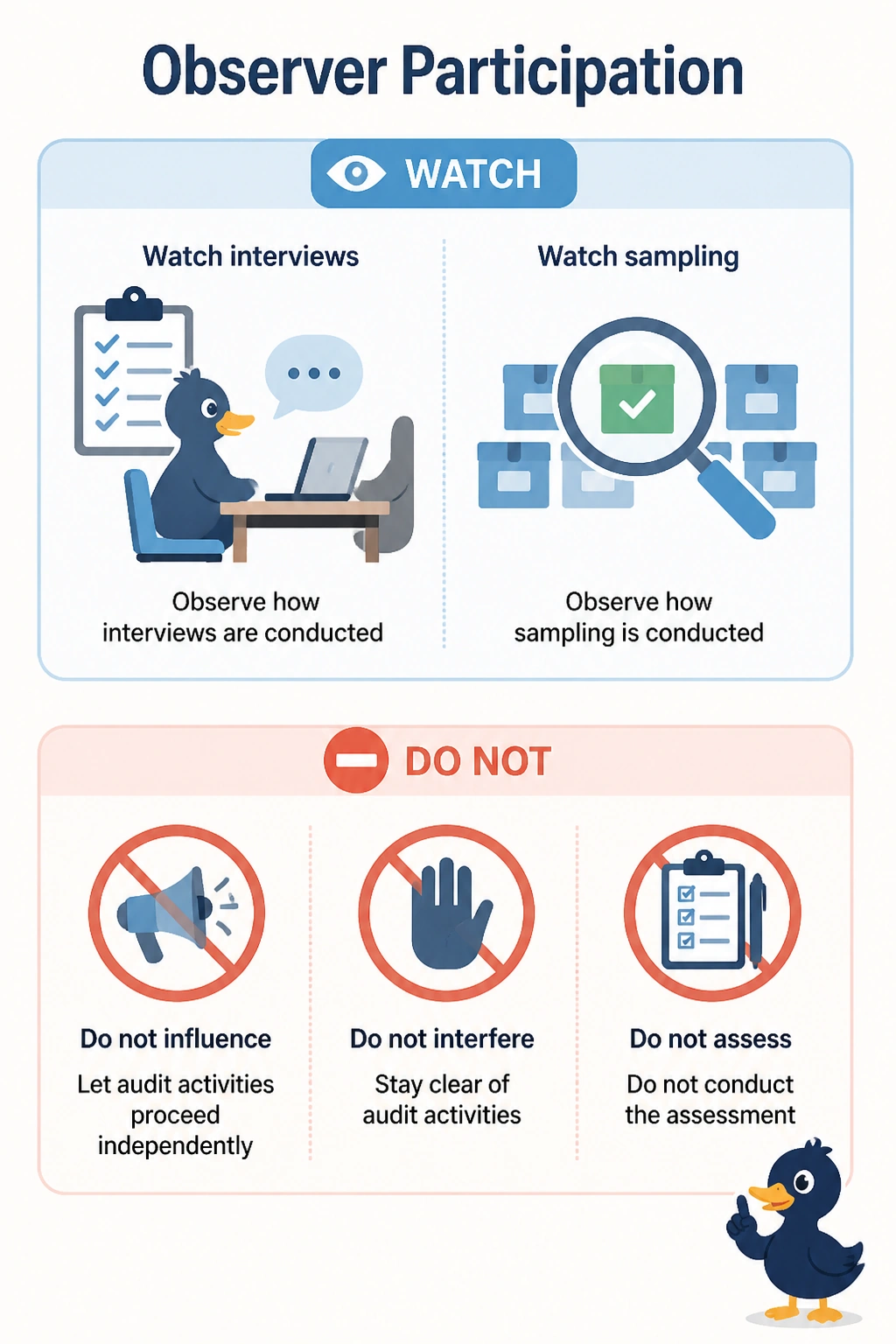
During a third-party quality system audit at a medical-device assembly plant, a newly hired trainee auditor and a customer representative attend the fieldwork to watch how interviews and sampling are conducted. What rule governs their participation?
Select an answer to reveal the explanation.
Short Explanation
Think of an audit observer like a ride-along passenger in a patrol car—present to learn, never to grab the steering wheel. If you let observers steer interviews or sign off on findings, you compromise both objectivity and audit control.
Full Explanation
An observer accompanies an audit team for training, witnessing, or client visibility, so the correct rule is that They may watch the audit activities without influencing, interfering with, or conducting the assessment. Keeping observers strictly non-participatory preserves the independence and controlled flow of the examination. Allowing an observer to act on the claim that They may question operators directly whenever they spot a potential procedural gap introduces uncalibrated interviewing and disrupts the lead auditor's planned sampling. Requiring that They must co-sign the nonconformity log to validate the lead auditor's conclusions blurs accountability, because only qualified audit team members evaluate evidence against criteria and own the resulting findings. Assuming that They should replace the auditee's assigned guide when touring restricted production bays confuses roles, since the auditee's guide manages facility access, safety escorts, and witness confirmation. As a practical caveat, any observer's presence and confidentiality obligations must be agreed upon with the auditee before fieldwork begins. During the opening meeting, confirm the observer's non-interfering status on the attendance record and brief them privately on staying silent during interviews.
Prefer to study offline? Printable PDF study book + test engine ($7.50, unofficial). These questions stay free here.