
On a digital radiography unit morning QC shows faint uniform banding across chest images, no positioning change explains it, the physicist suspects gain-map drift, and repeat calibration has not been done in months despite vendor schedule. Which quality control action should the radiographer perform to evaluate detector calibration and uniformity?
Select an answer to reveal the explanation.
Short Explanation
You're hunting a ghost stripe that follows every patient. A blank even exposure makes uniformity errors pop when calibration drifts.
Full Explanation
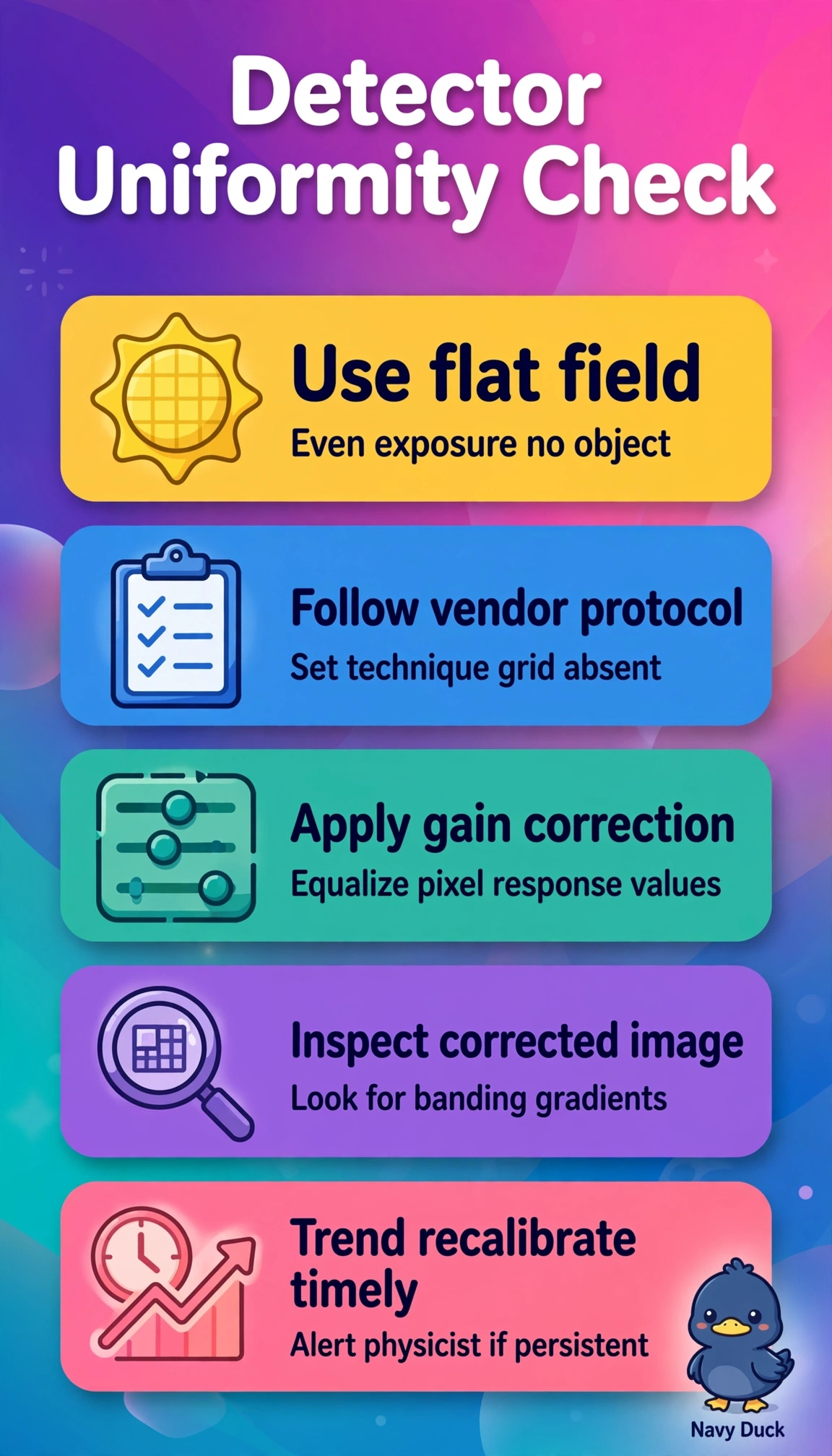
The correct action isolates detector response by removing object, scatter, grid cutoff and positioning variables through a uniform exposure made exactly as the vendor specifies for gain correction testing, so residual banding on the corrected image directly reflects flat-field calibration error rather than anatomy or technique, which fits the morning QC finding of faint uniform banding unexplained by positioning and the history of missed gain calibration. Completing the overdue recalibration and checking improvement on a repeat chest study is otherwise appropriate maintenance, but it is corrective rather than evaluative and it uses a structured clinical image where ribs, scatter and grid effects can mask or mimic detector nonuniformity, so it cannot confirm calibration status before intervening. Using an anthropomorphic phantom at clinical techniques is a sound method for assessing clinical image quality impact, yet the phantom introduces attenuation structure, scatter and positioning dependence that violate the requirement for a uniform field, preventing separation of gain-map drift from other banding causes. Reviewing longitudinal charts and prior gain factors is valuable for documenting chronic drift and overdue maintenance, but retrospective trending characterizes past performance and does not provide a current measurement of detector uniformity as requested. On exams, distinguish evaluate uniformity from perform recalibration, and distinguish uniform field from phantom testing when gain correction is suspected; in practice, confirm vendor-specified beam quality, dose, grid status, field coverage and absence of debris, then save and compare the uncorrected and corrected uniformity images per protocol before escalating to recalibration.