
A teenage patient with a hearing impairment and high anxiety arrives with a non-English-speaking parent for a wrist examination, nodding silently while avoiding eye contact and clutching the injured arm. Which verbal and nonverbal communication and barrier strategy best supports understanding and cooperation during this encounter?
Select an answer to reveal the explanation.
Short Explanation
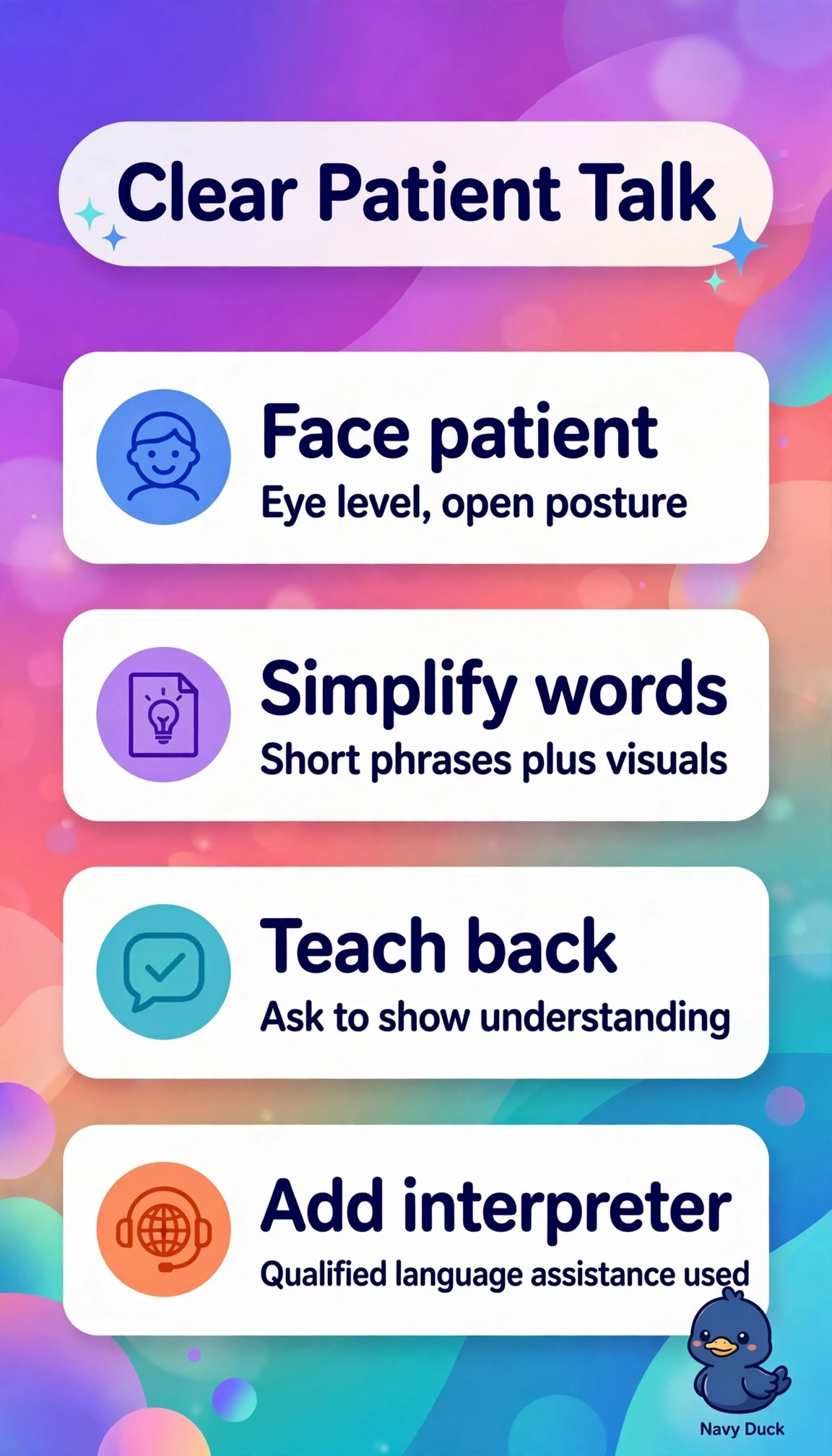
You build trust when your words, body, and checks all line up. Facing the patient and using teach-back keeps understanding honest across barriers.
Full Explanation
The correct strategy is right because it addresses auditory, language, literacy, and anxiety needs together: eye-level facing supports speechreading and trust, plain words with visual aids make wrist examination steps concrete for a hearing-impaired teenager, teach-back distinguishes true understanding from anxious nodding and avoidance, and qualified interpreter assistance includes the non-English-speaking parent without burdening them. Accepting polite nodding as confirmation fails on verification, since nodding in anxious adolescents often signals deference or desire to finish rather than comprehension and cannot replace demonstrated teach-back. Relying on the bilingual parent to interpret fails on accuracy and boundaries, because even fluent family members may paraphrase, omit risks, add pressure, and compromise confidentiality, while standards require neutral professional language access with family as support partners. Omitting pictures or diagrams to save time fails on accessible encoding, because dual verbal-visual input is essential when hearing is limited and anxiety narrows processing, so speech alone remains insufficient. An exam caveat is that writers offer choices satisfying three of four barriers, so select the response resolving hearing, language, comprehension check, and anxiety together and treat nodding and family interpreting as classic traps. A practical check is to pause before touching the injured arm, keep the interpreter in sight, show one step with an image, then ask the teenager to explain or demonstrate back what happens next.