
A newly declared pregnant technologist is assigned to portable and fluoroscopy rotations wearing a lead apron, with monthly badge exchange and a wall-mounted control badge in the department. She asks about fetal monitoring under NCRP guidance and federal regulations. Which personnel monitoring practice should the RSO confirm to address dosimeters and embryo-fetus limits?
Select an answer to reveal the explanation.
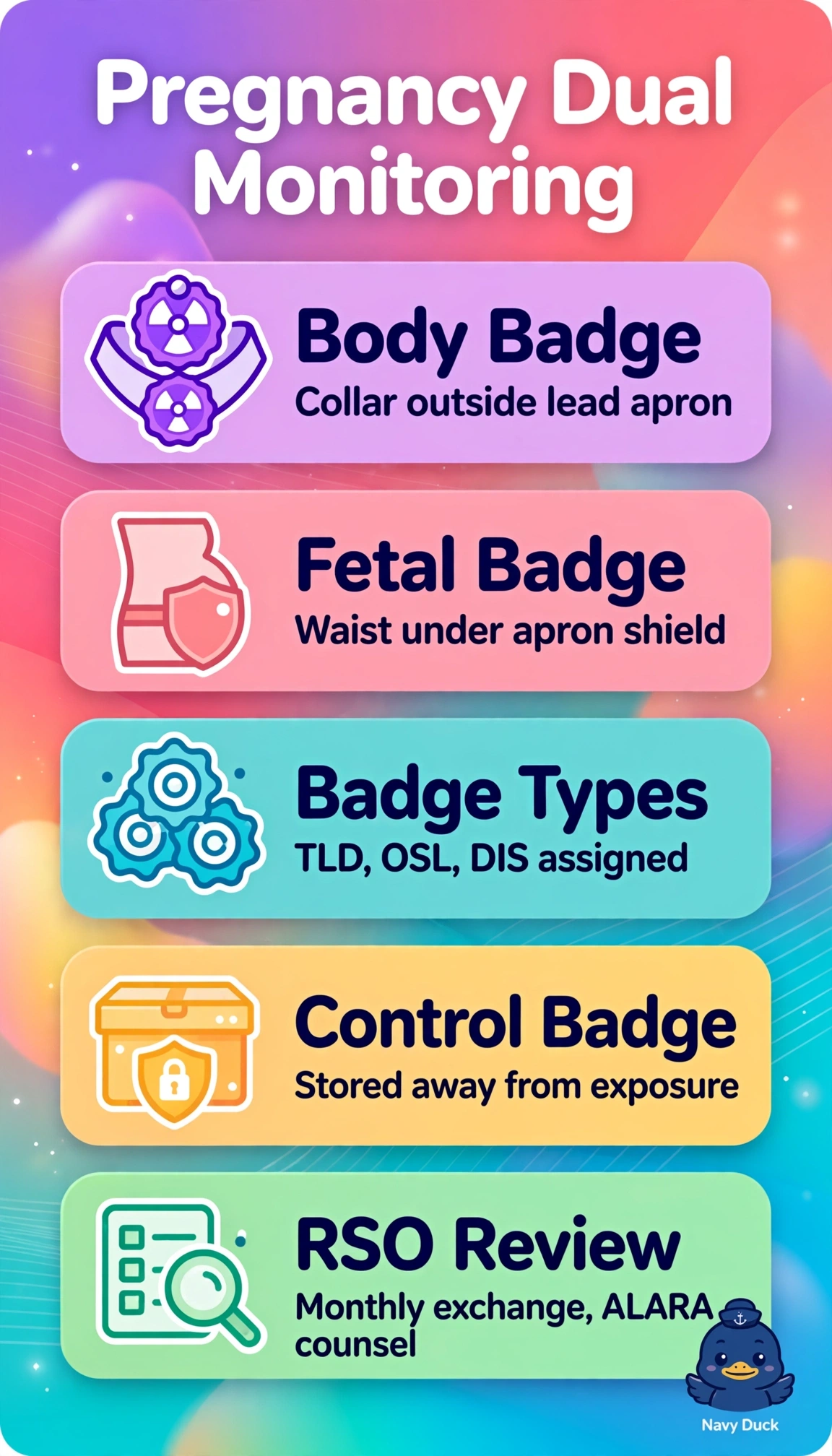
Short Explanation
You're tracking two doses with two badges here. Dual dosimetry with one outside and one sheltered at the waist tells the real fetal story, like indoor and outdoor thermometers.
Full Explanation
Correct practice implements 10 CFR 20.1208 and NCRP guidance limiting embryo-fetus dose to 5 mSv per gestation and 0.5 mSv per month after declaration, requiring monthly exchange for timely intervention, plus dual dosimetry when an apron is worn because one badge cannot represent both shielded and unshielded regions, so the collar badge outside the apron estimates unshielded head-neck and lens dose for effective dose calculation while the fetal badge at the abdomen under the apron measures attenuated uterine dose behind lead. Quarterly exchange of correctly placed badges fails temporal surveillance because integration over three months cannot verify the monthly 0.5-mSv criterion or prompt reassignment. An abdominal fetal badge worn outside the apron fails shielding assessment because it records incident scatter rather than protected fetal dose, causing overestimation and unwarranted restriction. Correctly placed monthly badges worn only during fluoroscopy fail scope of assessment because portable examinations also create scatter and declared-pregnant monitoring must cover all occupational exposures. An exam caveat is to separate the wall-mounted control measuring background in a low-dose area from worn personnel dosimeters never stored together. A practical check is confirming two badges, monthly dates, under-apron placement, and separate control storage.