
An outpatient fluoroscopy suite is performing an upper GI examination on an adult patient requiring extended observation of swallowing dynamics. The radiologist wants magnified detail but the team must limit skin dose and total beam-on time. Which fluoroscopic technique combination best minimizes patient exposure while preserving diagnostic review?
Select an answer to reveal the explanation.
Short Explanation
You're stacking every dose saver at once with this combo, so the skin gets a real break. pulsed fluoroscopy blinks the beam like a strobe instead of leaving the faucet running.
Full Explanation
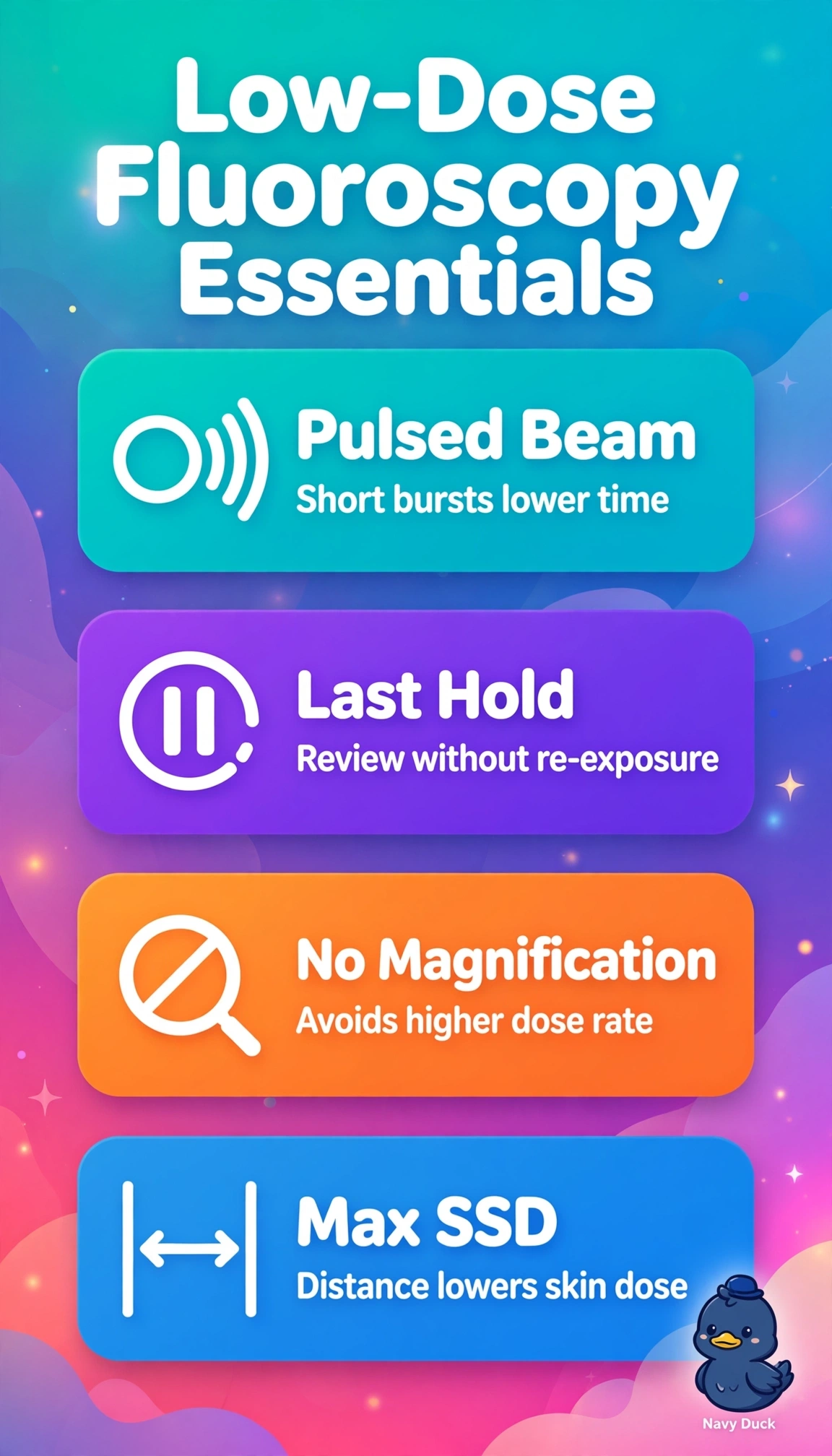
Patient dose during fluoroscopy is driven by beam-on time, dose rate, and source-to-skin distance, and the correct combination addresses all three without losing diagnostic information. Pulsed mode delivers radiation in brief bursts rather than continuously, substantially reducing total exposure time, while last image hold allows review and discussion of the frozen last frame without additional exposure. Avoiding electronic magnification prevents the automatic increase in dose rate needed to maintain brightness over a smaller input field, and maintaining maximum source-to-skin distance lowers entrance skin exposure by the inverse square law. Continuous fluoroscopy fails by concept of time reduction because it leaves the beam on constantly despite last image hold and distance savings. Added electronic magnification fails by concept of dose-rate control because magnification mode demands higher tube output for the same display brightness. Live review with close tube positioning fails by concepts of image retention and distance because it discards the dose-free benefit of last image hold and increases skin dose by reducing source-to-skin distance. For the exam, remember that magnification and decreased SSD both increase patient skin dose even if image detail improves, and in practice verify pulsed rate, confirm last image hold is displayed, and keep the tube as far from the patient as positioning allows.